

Initial Summary
There is a quiet but significant gap opening up between professors who control their online presence and those who don't. The professors on one side of this gap are findable, they attract the PhD students they want, they get contacted for media commentary, and their research reaches audiences beyond their subfield. On the other side are academics who are technically accomplished but digitally invisible relying entirely on an institutional profile page they can't edit, a Google Scholar profile they haven't updated in two years, and a LinkedIn that still lists their old university. This article makes the case for why a personal academic website is no longer optional and shows what the difference looks like in practice.
The Institutional Profile Problem
Every university gives its faculty a profile page in the department directory. It typically includes your name, photo, title, research interests, and a publications list. It is clean, functional, and completely inadequate.
Here's what an institutional profile cannot do: it cannot be found independently in search results for your research area. It cannot be updated the same day you receive a grant. It cannot host a blog post explaining your recent paper to a general audience. It cannot include a recruitment section when you're looking for PhD students. And crucially—it disappears the day you change institutions, taking with it any search ranking it had accumulated.
Your personal website does all of these things, and it belongs to you.
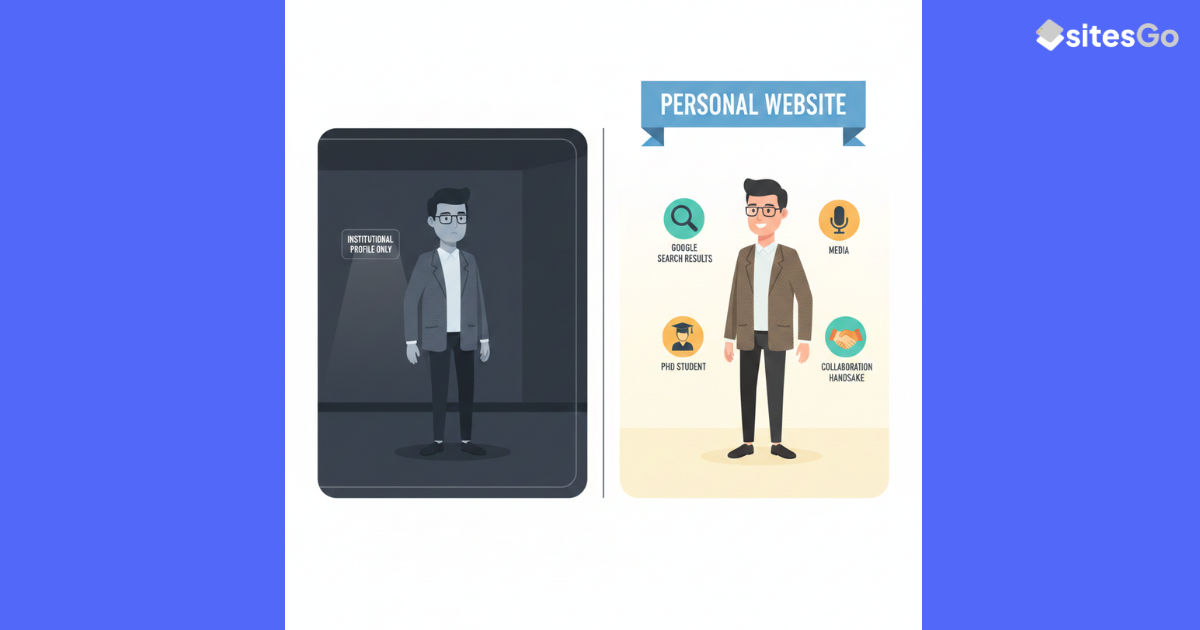
Five Things a Personal Website Does That Nothing Else Can
1. It ranks for your name independently. When a prospective student searches your name, a well-built personal site typically appears alongside or above your institutional profile—giving you two results on page one and doubling your visibility.
2. It lets you recruit selectively. A dedicated "Join the Lab" or "Prospective Students" page lets you describe exactly who you're looking for, what funding is available, and what your lab culture is like. This is the difference between receiving 200 unfocused applications and 20 well-matched ones.
3. It communicates to non-academic audiences. Journalists, NGOs, government agencies, and industry partners don't know how to read a publications list. A well-written research page with plain-language project summaries is the bridge between your scholarship and the world that needs it.
4. It travels with you. Your institutional profile is your university's property. Your personal domain is yours. Every academic who has changed institutions and watched their online presence reset to zero understands the value of this.
5. It signals investment in your professional identity. A well-maintained personal website communicates that you take your research seriously enough to present it professionally. In fields where reputation is currency, this matters more than academics often acknowledge.
Key Insight: The professors who are most cited, most invited to keynote, and most sought after for collaboration are not necessarily the most brilliant researchers in their field. They are often the most findable ones. A personal website is, fundamentally, infrastructure for serendipity. It creates the conditions for good things to find you.
Real Examples
1. Lisa Tang, NUS
Prof. Lisa Tang of NUS is a strong example of what a thoughtfully built personal academic website achieves. Her site at lisaxtang.com is clear, professionally designed, and structured around the visitor rather than the CV. Research is explained in accessible language, contact information is immediately visible, and the overall impression is of someone who is active, approachable, and serious. The result: when collaborators, students, or journalists search for her area of expertise, her site surfaces clearly and creates an immediate, positive first impression.

Key Insight: The most common objection to building a personal academic website is time. But the alternative, an institutional profile that misrepresents your current work, a Google Scholar profile that hasn't been touched since your PhD, and no presence in searches where your target audiences are actively looking, costs far more time in missed opportunities than building a clean website would ever take.
2. OSON Lab, NUS
The OSON Lab website is a different kind of demonstration here, the personal brand is a lab brand. The site was designed to attract international talent to an NUS research group. The "Join Us" section is specific and welcoming, the research descriptions are accessible, and the visual design signals that this is a lab that takes its work and its presentation seriously.

Curious what a professional academic website would look like for your research?
SitesGo has built sites for professors at MIT, NUS, NTU, Stanford, Harvard, and institutions across Asia and the US. See the work, then decide.
→ View SitesGo's academic portfolio
What a Good Professor Website Looks Like
Based on the sites that perform best across student recruitment, media attention, and academic collaboration, the pattern is consistent. Effective professor websites share five characteristics:
They load fast and work on mobile. They have a professional photo that looks like the person actually works there. They explain research in two registers, technical for peers, plain language for everyone else. They show activity—a dated news item from the last three months tells visitors this person is engaged. And they make contact easy—an email address on the homepage, not buried in a form on a hidden page.
That's it. The difference between an invisible academic profile and a high-performing personal website is not budget or technical skill. It's structure and intentionality.
Stop leaving your online presence to chance. A personal website built for your career stage, your audience, and your goals
-> Build my professional website with SitesGo
Frequently Asked Questions
Do I need a personal website if I already have a Google Scholar profile? They serve very different purposes. Google Scholar is a citation index—it tells peers how much your work has been cited. A personal website tells every audience who you are, what you do, and why it matters. You need both, and they should link to each other.
What's the minimum viable academic website I can launch quickly? A homepage with your name, position, and research summary; a publications page; and a contact page. Three pages, well done, is infinitely better than ten pages half-finished.
Can I maintain a personal website without technical skills? Yes. Platforms like Webflow, Squarespace, and WordPress make it possible to maintain a professional academic website without touching code. SitesGo builds on Webflow specifically because it gives academics full control over their content without requiring developer knowledge.
.gif)


