

Initial Summary
You have a coaching website. People visit it. And then they leave without booking a call, filling in a form, or sending a message. This is the most common and most frustrating problem coaches face with their online presence and it is almost always fixable. The reasons coaching websites fail to convert are well-documented and fall into a predictable set of patterns: unclear value propositions, the wrong calls to action, trust deficits that professional design choices could fix, and structural problems that prevent visitors from understanding what to do next. This article diagnoses the most common coaching website conversion failures and explains exactly how to fix them.
The Coaching Website Conversion Problem Is Different From Other Industries
Coaching is a high-trust, high-investment purchase. A client considering executive coaching, leadership coaching, or business coaching is typically evaluating a relationship that will cost thousands of dollars, require significant vulnerability, and have real consequences for their career or organisation. They are not making an impulse purchase.
This means the standard e-commerce conversion psychology — urgency, scarcity, social proof via volume — applies poorly. What converts coaching website visitors is a different set of signals: a clear articulation of who the coach works with and what changes for clients, credible evidence that the coach has produced real results, and a low-friction path to a no-commitment first conversation.
Most coaching websites get at least one of these three things wrong. Many get all three wrong.
Conversion Problem #1: Your Value Proposition Is Too Vague
This is the most common problem on coaching websites. Statements like "I help people unlock their potential," "I empower leaders to become their best selves," or "I guide transformation and growth" communicate almost nothing.
These statements are not wrong — they may accurately describe aspects of what you do. But they are so generic that they apply to every coach in your market, which means they give a potential client no reason to choose you over anyone else.
The test: Can you replace your own name with any other coach's name on your homepage and have the content still make sense? If the answer is yes, your value proposition is not differentiated enough to convert.
The fix: Articulate your coaching value proposition with three specifics: who you work with (specific role, industry, or situation), what problem or challenge you address, and what the outcome looks like for clients. For example:
"I work with newly promoted Vice Presidents at financial services firms who are struggling to lead former peers, and I help them build the authority and communication style to lead effectively within six months."
This is specific enough to immediately resonate with exactly the right client — and specific enough that the wrong client will self-select out.

Key Insight: Research by the International Coaching Federation (ICF) found that when coaching clients were asked what most influenced their decision to hire a specific coach, "clarity about who the coach works with and what outcomes they help achieve" ranked first — ahead of credentials, years of experience, and price. A coaching website that does not clearly articulate a specific client profile and specific outcomes is failing to address the primary decision factor.
Conversion Problem #2: Your Homepage Speaks to You, Not to Your Client
Coaching websites frequently make the mistake of being about the coach rather than about the client. The majority of content describes the coach's background, philosophy, methodology, and credentials — and relatively little describes the client's situation, challenges, and aspirations.
Clients don't visit your website because they want to learn about you. They visit because they have a problem they want to solve. The most effective coaching websites lead with the client's situation and only introduce the coach's background and credentials as evidence of their ability to address that situation.
The structural fix:
Replace an opening paragraph about yourself with an opening paragraph that describes your ideal client's current situation with enough specificity that they immediately recognise themselves:
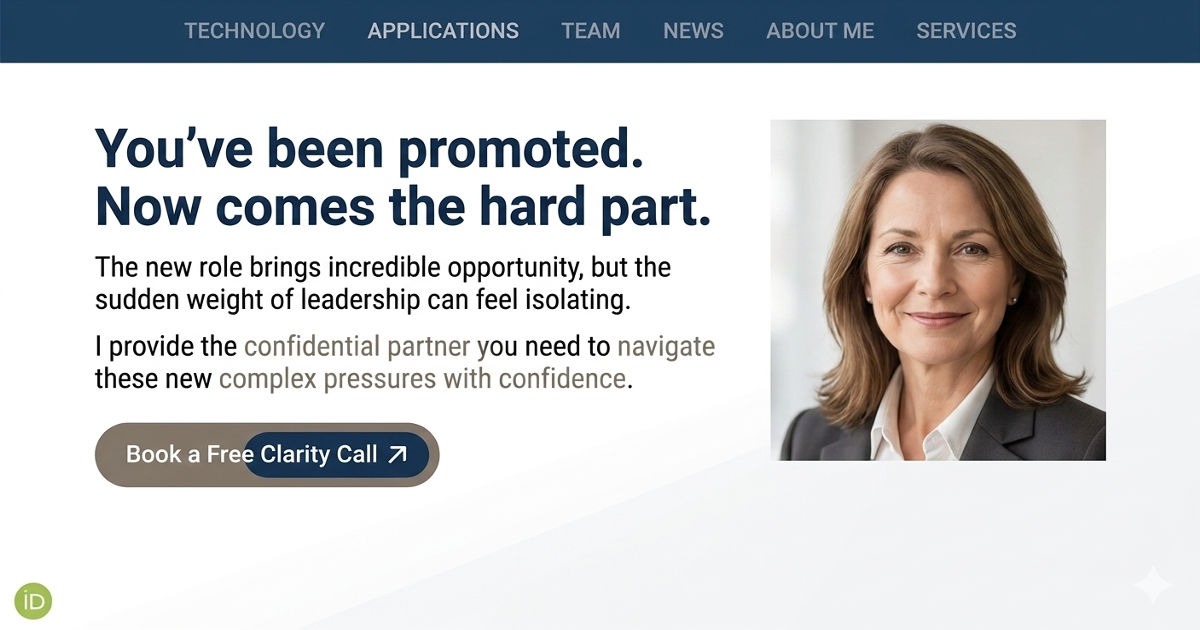
"You've been promoted into a senior leadership role. The pressure is different from anything you've faced before. Your old ways of working are starting to show their limits. And you're not sure who you can be honest with about how hard this actually is."
This kind of mirror-to-the-client opening creates immediate emotional resonance that a bio-first opening cannot.
Conversion Problem #3: Your Call to Action Is Wrong for the Buying Journey
Most coaching websites have a Contact page or a "Book a Call" button. These CTAs fail to convert for two related reasons.
First, "Book a Call" is too high a commitment for a first interaction. A visitor who is in early research mode evaluating whether coaching might help them, comparing several coaches, not yet ready to commit to a conversation is not ready to book a call with a stranger. The friction of this task causes them to leave.
Second, "Contact" implies form-filling and waiting, which is perceived as low-responsiveness. Potential coaching clients, especially senior executives, do not want to fill in a form and wait for a reply.
The fix is a staged CTA strategy:
- Low-commitment CTA for early-stage visitors: A free resource — a self-assessment, a short guide, a brief video — that provides immediate value and captures an email address. This allows you to continue a relationship with visitors who are not yet ready to book.
- Medium-commitment CTA for warmer visitors: A "Book a Free 30-Minute Clarity Call" with a scheduling tool (Calendly, Acuity) that shows real-time availability and allows immediate booking. This removes the "contact and wait" friction entirely.
- Social proof near every CTA: A brief testimonial from a past client positioned immediately adjacent to the booking button significantly increases conversion rates.
Replace your “Contact Me” CTA with a Calendly link for a free 30-minute clarity call
Instead of asking visitors to fill out a contact form and wait for a reply, give them the option to instantly book a call with you. Reducing friction in this step makes it easier for interested prospects to take action, and many coaches see a noticeable increase in inquiries once scheduling becomes immediate.
-> We’ll help you set up a high-converting Calendly booking flow!
Conversion Problem #4: Your Social Proof Is Weak or Misplaced
Coaching is a relationship business, and the most powerful social proof is not star ratings or abstract testimonials — it is specific, named, detailed accounts of client transformations.
The hierarchy of coaching website social proof, from most to least effective:
- Named video testimonials from identifiable clients: A 60–90 second video of a real client describing their situation before coaching, what changed during the engagement, and what their outcomes looked like. This is the gold standard.
- Written testimonials with full name, title, company, and specific outcomes: "After six months working with [Coach Name], I successfully navigated my first board presentation and secured approval for a $15M capital allocation." This is specific and verifiable.
- Case study format testimonials with context, challenge, and result: A one-page case study is significantly more persuasive than a brief pull quote.
- Anonymous testimonials or vague praise: "Working with [Coach Name] changed my life." These are nearly worthless from a conversion perspective — they cannot be verified, and sophisticated buyers discount them heavily.
The placement fix: Testimonials should not be confined to a dedicated Testimonials page that requires active navigation. They should appear on the homepage, adjacent to CTAs, and on the individual service pages. Bury your social proof and it stops working.
Key Insight: A 2021 study of service business website conversion rates by CXL Institute found that specific, named testimonials with quantifiable outcomes placed near CTAs increased conversion rates by an average of 34% compared to generic testimonials placed on a dedicated page. For coaching websites, where trust is the primary conversion barrier, the placement and specificity of social proof is a direct revenue lever.
Conversion Problem #5: Your Website Is Slow, Broken, or Poor on Mobile
This sounds basic, but a significant proportion of coaching websites — especially those built on outdated WordPress themes or by DIY builders without technical expertise — have performance problems that directly suppress conversion.
The most common technical conversion killers:
- Page load times above three seconds: Studies by Google and Akamai consistently show that pages loading in more than three seconds lose a substantial proportion of visitors before any content is seen.
- Mobile layout problems: Over 60% of website traffic arrives on mobile devices. A coaching website that is hard to read or has buttons too small to tap on a phone is losing the majority of its potential clients before they read a word.
- Broken contact forms or booking tools: A booking button that leads to a broken Calendly integration is a silent conversion killer. Test every conversion path monthly.
- Outdated SSL certificate: A browser security warning on a coaching website — which asks for personal information and may process payments — is a catastrophic trust signal failure.
Conversion Problem #6: No Clear Client Journey Structure
Many coaching websites have all the right elements — a bio, testimonials, service descriptions, a booking option — but they are not structured in a way that guides a first-time visitor through a logical progression from "curious" to "converted."
A high-converting coaching website structure:
- Hero section: Client-focused headline + clear value proposition + primary CTA
- Mirror section: Describe the client's current situation with enough specificity to create recognition
- Transformation section: Describe what life or work looks like after coaching
- Credibility section: Brief bio positioned as evidence of your ability to deliver the transformation, not as an autobiography
- Social proof section: Two to three specific testimonials with names and outcomes
- Services section: Clear, named offerings with what's included and how to get started
- Secondary CTA: Another booking opportunity for visitors who scrolled past the first one
- FAQ section: Addressing the most common objections and questions before they become barriers
This structure mirrors the psychological journey a potential coaching client takes — and it works because it is client-centred rather than coach-centred.
Is Your Coaching Website Working As Hard As You Are?
Most coaching websites were built once and never systematically optimised. A website that doesn't convert is not just leaving revenue on the table — it is undermining the investment you've made in your coaching practice, your marketing, and your reputation.
→ Book a free coaching website conversion audit
Frequently Asked Questions
How long should a coaching website homepage be?
Long enough to address every significant objection a first-time visitor might have, and no longer. For most coaching websites, this means a homepage that takes 2–4 minutes to read at a comfortable pace — enough space for a compelling client-centred narrative, substantive social proof, service descriptions, and multiple CTAs. Shorter homepages tend to under-qualify leads; longer ones tend to overwhelm or lose visitors. Test your homepage with people who match your ideal client profile: if they can't clearly articulate what you do and who you serve after reading it, it needs revision.
Should a coaching website display prices?
This is a genuine strategic question with legitimate arguments on both sides. Displaying prices filters out non-qualified prospects and saves time for both parties. Not displaying prices allows for a discovery conversation where value can be established before price is discussed. For executive and leadership coaching at premium price points (SGD 5,000+ per engagement), most experienced coaches use a "get in touch to discuss" approach for pricing, with a short explanation of typical investment ranges to prevent significant misalignment.
How many testimonials should a coaching website include?
Quality matters far more than quantity. Three to five specific, named testimonials with detailed outcomes are more persuasive than fifteen generic pull quotes. You want a potential client to read these testimonials and see themselves in the clients who are describing their experience. Two or three testimonials that cover different client profiles, challenges, and outcomes are ideal for a coaching homepage.
Should a coaching website have a blog?
Yes, if you can commit to publishing consistently — and no if you can't. A blog last updated eighteen months ago actively damages credibility. If you have the time and inclination to write, a coaching blog can significantly improve search engine visibility for your target client's search terms and establish intellectual authority. If consistent writing is not realistic, a resources page with a small number of high-quality downloads achieves similar credibility benefits with lower maintenance demands.
How important is the coach's headshot on conversion?
More important than most coaches realise. Professional headshots consistently outperform casual photos. Research on service business websites specifically shows that headshots where the subject makes direct eye contact with the camera perform better in conversion tests than headshots with averted gaze. For coaching, where the relationship is the product, the visual impression a potential client forms of the coach from their photo is a significant conversion variable.
.gif)


