

Initial Summary
Most academic websites are invisible to the people who matter most. A prospective PhD student searching "computational biology professor Singapore" won't find you if your site has no title tags, no keyword structure, and no links pointing to it from anywhere. Academic SEO is not about gaming algorithms, it's about ensuring that your research, your expertise, and your lab are findable by the people actively looking for exactly what you offer. This guide walks through how to build an academic SEO strategy from scratch, with no technical background required.
The Unique Challenge of the Business Professor's Online Identity
Business academics occupy a peculiar professional position. Unlike a physicist or historian whose primary audience is almost entirely academic, a business professor's work has immediate and obvious commercial relevance. Students choose whose courses to take based on the professor's industry credibility. Companies seeking expert witnesses or consulting advisors search for specific domain expertise. MBA applicants evaluate whether a faculty member's research and network will help open the doors they're trying to walk through.
This means the business professor website must accomplish something most academic sites never attempt: communicate credibility simultaneously to audiences with radically different frameworks for evaluating expertise—without appearing to pander to any of them.
A research-only site that ignores teaching and industry engagement suggests the professor is inaccessible. A site that leads with media appearances and speaking fees suggests the professor is primarily a consultant, not a scholar. The best business professor websites thread this needle deliberately: they present an integrated professional identity where rigorous research and real-world relevance coexist and reinforce each other.

Part One: What Business Professors Get Wrong About Their Websites
Before examining what makes a great business professor website, it is worth naming the failure modes that are most common—because recognising your site in one of them is often the fastest path to improving it.
Failure mode 1: The CV website. This is the most common failure in every academic discipline, but it is especially damaging for business faculty. A CV website presents your credentials as a list: degrees, positions, publications, awards. It tells visitors what you have done but gives them no sense of who you are, what you stand for intellectually, or what working with or learning from you would be like. For business students and industry partners evaluating whether you are the right person for them, a CV website provides almost no useful signal.
Failure mode 2: The out-of-date website. A business professor's last update was in 2021. The most recent publication is from 2020. The listed courses include one that was discontinued two years ago. Every piece of out-of-date content damages credibility—because it signals either that the professor is no longer active or that they don't care about how they present themselves. Neither impression is helpful.
Failure mode 3: The research-only website. A business professor whose website only discusses their publications and research interests is leaving enormous value on the table. Their teaching philosophy, executive education experience, media commentary, and industry engagement are all signals that matter enormously to the audiences who will visit their site. A research-only site is essentially a Google Scholar profile with a custom domain.
Failure mode 4: The inaccessible website. Jargon-heavy research descriptions, no plain-language summaries, and a contact page with no email address just a form, with a response time of "5–7 business days." A business professor site with these characteristics is functionally invisible to the journalists, executives, and students who are exactly the people that business academics most need to reach.
Part Two: The Six Core Pages of a Strong Business Professor Website
Page 1: Home — The Integrated Identity Statement
The business professor homepage needs to answer a more complex question than most academic homepages. It isn't just "who are you and what do you research?" It's "who are you, what do you research, what do you teach, why does your work matter outside academia, and why should I pay attention to you?"
This doesn't require a long homepage. It requires a well-organised one.
The most effective business professor homepages open with a single statement that bridges research and relevance: "I study how organisations respond to regulatory change, with particular focus on financial firms in Southeast Asia. My research has been cited in policy documents by MAS and the Hong Kong Monetary Authority." Two sentences. Academic credibility and real-world impact in equal measure.
Follow this with a professional photograph, your current position and institution, your three or four most recent publications or media mentions (with dates), and a clear navigation path to your Teaching, Research, Bio, and Contact sections.
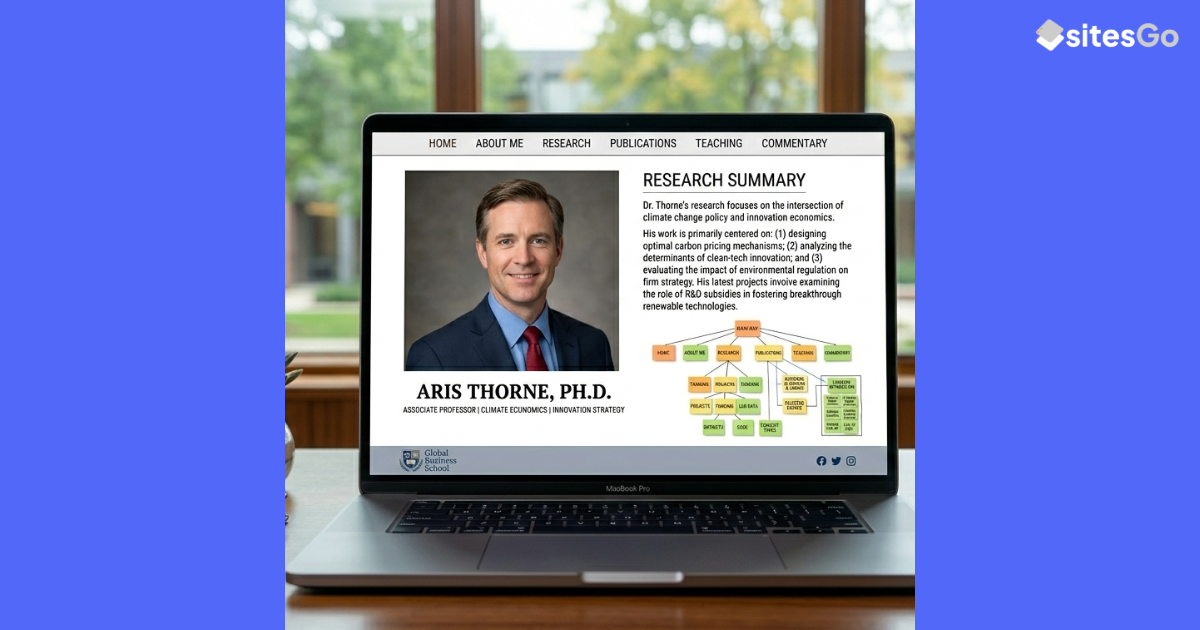
Page 2: Research — Explaining Your Work to Everyone
The research page is where business professors most often write only for academic peers—and lose everyone else. Every research project or active theme on your site should be presented in the same tiered format described for medical research websites: a plain-language summary first, technical detail second.
For business research, the plain-language summary has a specific additional requirement: it should name the practical implication of the research. What should a CFO do differently because of this finding? What does this mean for regulators? What should an MBA student understand about this market dynamic? These questions are not separate from the academic content—they are the bridge that makes academic content legible to the audiences who most need it.
Your research page should also signal the stage and status of your current work: what is published, what is under review, what is a working paper, and what is in early development. This tells both peers and industry partners where your current intellectual energy is focused.
Page 3: Teaching — More Than a List of Course Codes
Business schools compete intensely on teaching quality. MBA applicants, executive education participants, and undergraduate students all research faculty teaching before committing to a programme or course. Your teaching page is marketing material for your classroom—treat it accordingly.
A strong teaching section includes a brief description of each course you teach (not just its code and title), the level at which you teach it (undergraduate, MBA, executive), any teaching awards or student evaluations worth noting, and a brief, genuine statement of your teaching philosophy. The last element is the most commonly omitted and the most humanising—it gives prospective students a sense of what learning from you is actually like, which no list of course codes can convey.
If you run or have designed executive education programmes, list them here with the organisations they were delivered for (with permission). These are powerful credibility signals for industry partners.
Page 4: Bio — The Narrative Version of Your Career
Your bio page is where you write your professional story for human beings rather than promotion committees. It should cover your academic training and career trajectory, your industry experience (if any), the intellectual problems that drive your research, your non-academic affiliations and advisory roles, and where you see your research heading.
Write in the first person. Use complete paragraphs rather than bullet points. The bio page should feel like meeting someone, not reading a Wikipedia entry.
For business professors, the bio page has a specific additional function: it is often the first thing a journalist reads when they find you via a search. It needs to establish your expertise quickly, communicate your availability for comment, and give the journalist enough context to decide whether you're the right person to quote. A bio page that accomplishes this—typically around 300–400 words—is one of the highest-value pieces of content on your site.
Page 5: Media, Speaking, and External Engagement
This section is standard practice on the websites of business professors with significant public profiles—and entirely absent from the sites of many who would benefit most from having it.
The purpose of a media and speaking section is social proof: it communicates to future journalists and conference organisers that you are already in demand, which is the single strongest predictor that you will continue to be in demand. It tells a journalist that you have been quoted clearly and usefully before. It tells a conference organiser that you have held an audience.
This section should list media appearances (outlet name, article title or topic, date), keynote and panel speaking engagements (event name, topic, date and approximate audience size if relevant), podcast appearances, and any regular media column or commentary role you hold. Keep it updated quarterly at minimum.
Key Insight: Business professors who include a "media and speaking" section on their website listing past media appearances, keynotes, and panel discussions consistently attract more consulting inquiries and media opportunities than those who don't. The section functions as social proof: it tells a journalist that you've given clear, quotable commentary before. It tells a conference organiser that you've held an audience. The appearance of being in demand creates actual demand.
Page 6: Contact — Built for Multiple Types of Engagement
Most academic contact pages are designed for one type of contact: students or colleagues sending an email. A business professor's contact page needs to handle several very different contact types gracefully:
Student contact: Course enquiries, office hours, PhD application questions. These should have a clear path—typically an email and a note about office hours or response time.
Media enquiries: Journalists working on deadlines need a direct, fast path. A separate media contact email (or a clear note that your main email is appropriate for media) and a statement about your typical response time signals media-readiness.
Speaking and executive education: A brief note that you are available for keynote speaking and executive education, with an email or booking path.
Research collaboration: A note welcoming collaboration enquiries, with a brief statement of the kinds of collaboration you are currently interested in.
Combining all of these into a single contact page with appropriate labels is entirely manageable—and it is vastly more effective than a generic form that gives no guidance about what kinds of contact you welcome.
Key Insight: The business professors with the highest external engagement consulting clients, board advisory roles, media presence tend to have the simplest, clearest contact paths. A direct email address, a brief note about response time, and a clear indication of the kinds of engagements you welcome can double the quality of your inbound enquiries. Friction kills opportunity. Every additional step between a journalist finding you and reaching you is a chance for them to move on to someone more accessible.
Part Three: Content Strategy for Business Professor Websites
Writing Research Descriptions That Work for Every Audience
The practical approach to writing business research descriptions for multiple audiences is the "three-sentence rule": write three sentences about each research project. The first sentence names the problem and why it matters to non-specialists. The second sentence describes what you are doing about it and roughly how. The third sentence states the most important implication or finding, in plain language.
For example: "Boards of directors in family-owned firms face different governance pressures than those in widely-held public companies. This research examines how family ownership concentration affects earnings manipulation and the effectiveness of audit committees in Southeast Asian listed companies. The findings have direct implications for how regulators and investors evaluate governance quality in family-controlled firms in the region."
Three sentences. Accessible to a student, a journalist, and a policy advisor. Specific enough that a peer can identify the methodology and context.
The Role of a Blog or Commentary Section
Business professors are better placed than almost any other academic discipline to benefit from a blog or commentary section. Business school research is frequently directly relevant to current events—market movements, regulatory changes, corporate governance failures, economic policy shifts. Timely commentary that connects your research to the news cycle is one of the most powerful ways to build media visibility, demonstrate thought leadership, and give prospective students and collaborators evidence of how your mind works.
A commentary section does not require the production quality of an op-ed. A 300-word note connecting your research to a recent development in your field posted within a week of the event is more valuable than a polished 1,500-word essay posted three months later.
If you write a regular column for a business publication, embed or link to those articles here. External bylines in recognised publications are among the highest-value social proof elements on a business professor website.

Keeping the Site Current Without Spending Hours on It
The most common reason business professor websites go stale is that the perceived effort of maintaining them is higher than the actual effort required. A practical maintenance schedule: once a month, spend fifteen minutes. Add any new publications, awards, or media appearances. Update the news section with one item. Check that your current position and institutional affiliation are accurate. That is enough. Fifteen minutes per month, consistently, keeps a business professor website performing at a high level.
The bigger investments rewriting your bio, restructuring your research section, adding new photography—are annual tasks, not monthly ones.
Is your business professor website working as hard as you are?
If your site isn't bringing in student enquiries, speaking invitations, media requests, or industry connections, the structure might be the problem, not the content.
→ Book a free 20 minute consultation with SitesGo
Part Four: Design Principles for Business Professor Websites
Balancing Academic Credibility with Business Accessibility
The visual conventions that work best for business professor websites occupy a middle ground between corporate and academic aesthetics. The best reference points are high-quality business school websites (Harvard Business School faculty pages, LBS, INSEAD) and premium professional services sites—not either extreme.
Clean, restrained typography. A professional colour palette with one accent colour maximum. Generous white space. High-quality photography. A navigation structure that is immediately legible. These elements signal that the person behind the site takes their professional presentation seriously—which is itself a signal of how they take everything else.
Avoid design choices that feel either too corporate (stock photography of generic business settings, aggressive calls to action, conversion-optimised landing page structures) or too academic (dense text from margin to margin, no visual hierarchy, no photographs).
Photography: The Investment That Pays Back Most
For business professors in particular, professional photography is the single highest-ROI investment in their website. Business faculty are expected to present and communicate—to students, executives, media, boards. A professional headshot taken in appropriate attire communicates immediately that you inhabit the professional space your research addresses. A poor-quality photo—taken on a phone, in poor light, in a casual setting—undermines every other credibility signal on the site.
If you can afford one professional photography investment for your website, make it a proper headshot. And ensure it is consistent across your website, LinkedIn, Google Scholar profile, and any media appearances.
Part Five: SEO for Business Professor Websites
The Keywords That Matter for Business Faculty
Business professor websites face a distinctive keyword challenge: your research areas often overlap with terms that are dominated in search results by consulting firms, business news sites, and major business school programmes. "Corporate governance" is not a keyword you can realistically rank for in competition with McKinsey and the Financial Times. But "corporate governance researcher Singapore," "family firm governance Southeast Asia researcher," or "ESG disclosure research NUS" are far more achievable targets—and far more relevant to the actual searches your target audiences are making.
Your SEO strategy should focus on long-tail, specific combinations of your research area, your location, and your institutional affiliation. These compound keywords have lower competition and higher intent: the person searching "corporate governance expert Singapore for media" or "accounting professor SMU research" is looking for exactly you.
LinkedIn Integration: The Business Professor's Most Important Secondary Platform
For business academics, LinkedIn is not optional—it is the platform where the majority of their non-academic audience (executives, journalists, policy advisors, potential consulting clients) looks for credibility signals. Your website and your LinkedIn profile should work as a coherent system: consistent photography, consistent research positioning, links between them, and content that appears on both.
LinkedIn articles that summarise your research findings, comment on business developments in your area, or explain your teaching approach are indexed by Google and can drive traffic to your website. A LinkedIn profile that links prominently to your personal site gives visitors a clear path to more depth than LinkedIn allows.
Real Example: AESB Lab, NUS
The AESB Lab website, built by SitesGo for NUS, demonstrates how a business and economics research group can communicate long-term career achievement while remaining genuinely current and accessible. The site captures decades of research, collaborations, and contributions in a way that reads as a living legacy rather than a static CV. The site achieves something rare in academic web design: depth without heaviness, authority without inaccessibility.
SitesGo builds business professor websites designed to impress peers, attract students, and open industry doors.
Trusted by faculty at SMU, NUS, NTU, and business schools across Asia.
Build my business professor website
Frequently Asked Questions
Should a business professor include consulting rates or services on their website? Generally no—and for good reason. Listing rates or advertising consulting services too explicitly can create tension with your institutional role. Instead, note that you are available for consulting and speaking engagements and invite interested parties to reach out directly. This keeps the conversation professional and gives you flexibility in how you respond to different kinds of approaches.
How do I balance academic tone with business accessibility on the same page? Write in layers. The headline and first paragraph should be accessible to any intelligent reader. Subsequent paragraphs can become more technical. Use subheadings to signal when content becomes more specialist. A non-specialist can get what they need from the top of each section; a specialist reads further and finds the depth. The key discipline is never opening a section with jargon—always lead with the plain-language version.
What's the most important page for a business professor to get right? The homepage and the bio page together. These are where every visitor—student, journalist, executive, peer—forms their first and most lasting impression. Getting these two pages right has more impact than any other investment. If you have limited time, invest it here.
How often should a business professor update their website? Minimally: once a month for fifteen minutes (add new publications, media appearances, and a news item). Substantially: once a year for a full review of all content. The fifteen-minute monthly habit is what separates sites that feel alive from sites that feel abandoned.
Is a personal website worth the investment for a junior business faculty member? Especially for junior faculty, yes. A strong personal website signals professional seriousness, makes you discoverable to search committees and collaborators, and gives you control over your narrative during the most important career-building years. It is also one of the few things that genuinely differentiates strong candidates in a crowded academic job market.
.gif)


