

Initial Summary
The phrase "personal branding" makes many academics uncomfortable. It sounds like marketing which feels antithetical to the values of scholarship: objectivity, rigour, intellectual honesty, and peer recognition earned through published work alone. But academic personal branding is not about spin or self-promotion. It is about ensuring that your actual work, expertise, and intellectual identity are accurately and visibly represented to the people who need to find them. In 2026, a professor who has not thought deliberately about their online presence is not neutral; they are invisible. This guide explains what academic personal branding actually is, why it matters more than ever, what the common mistakes look like, and what the first practical steps are for an academic starting from scratch or rebuilding after years of neglect.
What Academic Personal Branding Is (and Is Not)
Academic personal branding is the intentional management of how your expertise and scholarly identity appear across the platforms and channels where your target audiences search for you. It is not about fabricating a persona or overstating your credentials. It is not about becoming a social media influencer or a professional speaker who happens to have a PhD. It is about ensuring that your genuine expertise—the work you have already done, the ideas you have already developed, the credibility you have already earned—is visible, coherent, and accessible to the right people.
Consider two professors with identical research outputs: same publication count, same institutions, same subfield. One has a well-structured personal website, a complete and frequently updated Google Scholar profile, a LinkedIn that accurately represents their current research, and a habit of posting brief plain-language summaries of their papers when they publish. The other has an institutional faculty profile they last updated in 2021 and a Google Scholar profile with no photo and incomplete research interests.
These two professors are not equally visible. The first will receive more collaboration enquiries, more media requests, more student applications, and more speaking invitations not because their research is better, but because it is findable.

Why Academic Personal Branding Matters More in 2026 Than It Did a Decade Ago
The Academic Job Market Has Changed
Search committees Google candidates. This is not a rumour—it is standard practice. A strong publication record presented on an institutional profile page competes poorly with the same record presented on a well-designed personal website that also shows the candidate's research vision, teaching philosophy, and professional personality. In a tight market, the candidate who controls their own narrative has a genuine structural advantage.
This is especially true for the growing number of international academic job applications, where a search committee has no opportunity to meet candidates informally before the shortlist. Your online presence is the first version of you they encounter.
Funding Evaluation Has Changed
Grant panels increasingly evaluate "impact beyond academia" as a formal assessment criterion. A coherent digital presence that demonstrates genuine public engagement with your research—blog posts, media appearances, social media commentary, accessible research summaries—is direct, visible evidence of this impact. The professor who can point their grant application toward a website demonstrating sustained public communication is making a materially stronger case than one who cannot.
Research Discovery Has Changed
Researchers increasingly discover collaborators and relevant work through digital channels rather than exclusively through conferences and journal browsing. Google Scholar, ResearchGate, personal websites, and LinkedIn now function as a significant part of the academic discovery infrastructure. A well-positioned online presence makes you discoverable to the right collaborators before you are ever in the same room—and those serendipitous connections are increasingly where the most interesting interdisciplinary work begins.
Media and Policy Engagement Has Changed
Journalists and policy advisors now rely heavily on search engines to identify expert commentators. A beat journalist covering climate policy who searches "carbon accounting researcher Singapore" will contact the first credible, accessible-looking result. If that is not you, it is someone else. The visibility question is not just about your career—it is about whether your research and your perspective enter the public conversation at all.
Key Insight: Academic personal branding is not about talking about yourself, it's about making your work accessible to the people it's most relevant to. The professor who writes a 500-word plain-language summary of their latest paper is not engaging in self-promotion. They're performing a genuine act of intellectual generosity: translating scholarship into knowledge that non-specialists can actually use. The researcher who builds a coherent online presence is not pursuing vanity; they are fulfilling the broader purpose that public funding of research is intended to serve.
Part One: The Five Components of a Coherent Academic Brand
Component 1: A Consistent Name and Identity Across Platforms
Decide how you want to be known professionally typically "Dr. [First Name] [Last Name]" or "Prof. [First Name] [Last Name]"—and use it consistently across every platform where you appear: your personal website, Google Scholar, ORCID, LinkedIn, ResearchGate, Twitter/X, institutional profiles, and any conference or journal profiles. This consistency matters for two reasons: it makes your name recognisable across contexts, and it ensures that all your online activity aggregates correctly in search results rather than being fragmented across name variants.
If your name has a common alternative spelling, choose one and use it consistently. If you publish under a different name than you use professionally, be deliberate about which name is primary and ensure your various profiles are linked or cross-referenced.
Component 2: A Clear Research Identity Statement
Your research identity is a one-to-three sentence summary of what you study, for whom it matters, and why. It should be written for an intelligent non-specialist not for a grant application, not for a peer reviewer. It should answer the question "what is this professor's expertise?" in under thirty seconds.
Developing this statement is harder than it sounds, especially for researchers whose work is genuinely interdisciplinary or whose interests span multiple areas. The discipline required is choosing: pick the one or two research themes that are most central, most active, and most distinctive, and build your public-facing identity around those. Breadth is accurately represented in your CV; focus is what makes a public-facing identity useful.
Once developed, this research identity statement should appear verbatim or near-verbatim on your personal website homepage, your Google Scholar profile, your LinkedIn headline and summary, your ORCID profile, your email signature, and your conference bios. Repetition across platforms builds the association between your name and your expertise.
Component 3: A Professional Photo Used Consistently
A single professional headshot, used consistently across all platforms, is a surprisingly powerful branding element. It makes your name and face associate quickly for people who encounter you across different contexts, and it signals the kind of professional seriousness that is itself a credibility signal.
The photo should be taken by a professional photographer in appropriate attire for your field and institutional context. It should be updated when your appearance changes significantly. And it should be the same photo—or photos from the same session—across your website, Google Scholar, LinkedIn, ResearchGate, and any other public-facing platform. A collection of mismatched photos from different events and different years undermines the coherence you are trying to build.
Component 4: A Platform Architecture That Serves Your Goals
Not every professor needs to be on every platform. Platform proliferation without platform depth is a brand-building trap: a collection of empty or neglected profiles across multiple platforms is worse than a small number of well-maintained ones.
Every professor, regardless of field or career stage, benefits from these four core platforms:
Personal website: Your owned, permanent home base. The only platform over which you have complete control and which belongs to you regardless of institutional affiliation changes.
Google Scholar: Your academic credibility anchor. A complete Scholar profile—professional photo, verified institutional email, research interest keywords, regularly updated publications—is the single highest-ROI investment in academic online presence. It takes under thirty minutes to complete properly.
LinkedIn: Your professional discovery platform. For most academics, LinkedIn is how industry partners, media, and alumni find them. A current, complete LinkedIn profile with a clear research summary and regular (monthly is sufficient) activity is the minimum standard.
ORCID: Your research identity persistence layer. ORCID provides a unique persistent identifier that travels with you across institutions and ensures your publication record is correctly attributed regardless of name variants or institutional changes.
Beyond these four, platform choices should be driven by where your specific target audiences actually spend their time. A computational biologist whose peers are active on Twitter/X benefits from a presence there. A business professor whose industry audience is on LinkedIn benefits from deeper LinkedIn investment. A humanities scholar whose public engagement targets a general reading audience might benefit from a Substack. Choose based on audience, not on platform popularity.
Component 5: Regular Content That Signals Active Scholarship
An academic brand is not static. The professors whose online presence is most effective maintain it through regular, small additions rather than infrequent large efforts.
The most accessible content format for most academics is a brief news or updates section on their personal website. A single sentence with a date "March 2026 New paper published in [Journal]. Read the abstract here →"—takes three minutes to write and post. Twelve of these per year creates a news section that is always current, always signals activity, and is indexed by search engines as evidence that the site is alive and being maintained.
For academics who are comfortable writing for general audiences, blog posts or short commentary pieces add another dimension—demonstrating the ability to explain research clearly and engage with current events in their field. For those who are not, the news section alone is enough. The key principle is consistency over amplitude: a small regular habit of updating beats an occasional major effort every time.
Key Insight: The most common academic personal branding mistake is treating it as a project with an end date rather than a practice with a maintenance schedule. Building a website and then ignoring it for two years is worse than having no website at all; it signals inactivity. The most effective academic brands are maintained in small, regular increments: ten minutes a month updating your news section beats two full days every three years. And a Google Scholar profile reviewed and updated quarterly is more valuable than one perfected once and forgotten.
Part Two: Academic Personal Branding by Career Stage
PhD Students and Postdoctoral Fellows
Early career academics have the most to gain from deliberate personal branding—and the most time to benefit from it. A personal website built during a PhD or postdoc compounds in value with every passing year: search engines reward sites that have been around longer, and a coherent online presence established early becomes increasingly valuable as your career progresses.
At this career stage, your personal website should focus on four things: your research focus and question, your methodological expertise, your publications and conference papers (including preprints and working papers), and a clear signal about your status and availability. If you are on the academic job market, say so clearly—it is one of the most important signals a personal website can send.
Assistant Professors and Early Career Faculty
For assistant professors, the personal website's most important function is establishing credibility and distinctiveness. You are building a research identity that is independent from your PhD institution and supervisor, demonstrating to search committees and collaborators that you have a clear and developing independent research programme, and beginning to establish the public-facing presence that will matter increasingly as your career progresses.
At this stage, begin developing a media and speaking record. Even a single clearly-documented media interview, a departmental blog post, or a podcast appearance adds to the social proof section that you will want to grow over time.
Associate and Full Professors
At more senior career stages, the personal website's primary functions shift toward maintaining visibility in a crowded field, attracting the right PhD students and postdocs, establishing a legacy, and supporting non-academic engagement. The research identity statement may have evolved—update it to reflect your current work, not your earlier career positioning.
Senior academics often have the richest material for a compelling personal website decades of publications, extensive media and speaking records, significant collaborators and alumni networks—but frequently have the most neglected sites. If this describes you, a systematic website refresh is one of the highest-leverage investments in your professional presence.
Want an honest assessment of your current academic brand?
Google your name plus your research area. Then Google your closest peer in your field. The difference between what you find is your branding gap. If you're not happy with what comes up, SitesGo can help you close it.
→ Talk to SitesGo about your academic brand
Part Three: The Academic Personal Branding Audit
If you want to understand where your current academic brand stands, run this audit before making any changes.
Step 1: Search your own name. Open an incognito browser window and search "[Your Name] [Your Research Area] [Your Institution]." What appears on page one? Is your personal website there? Is your Google Scholar profile complete? Do the results tell a coherent story about who you are and what you research?
Step 2: Check your Google Scholar profile. Is your photo there? Is your institutional email verified? Are your research interests listed as keywords? Are your publications up to date? Have you identified any missing or incorrectly attributed papers?
Step 3: Check your LinkedIn. Does your headline reflect your current position and research focus? Is your summary up to date? Does it link to your personal website? Have you had any activity in the last three months?
Step 4: Check your personal website. When was the last time it was updated? Is your most recent publication listed? Does your bio reflect your current position and research? Is your contact information current?
Step 5: Check your ORCID profile. Is it claimed? Is it linked to your personal website? Are your publications correctly attributed?
The results of this audit tell you exactly where to focus. Most academics find that Step 1 reveals the problem clearly: their institutional profile appears on page one and their personal site either doesn't exist or doesn't rank. Everything else follows from fixing that.
Real Example: Maanasa.io
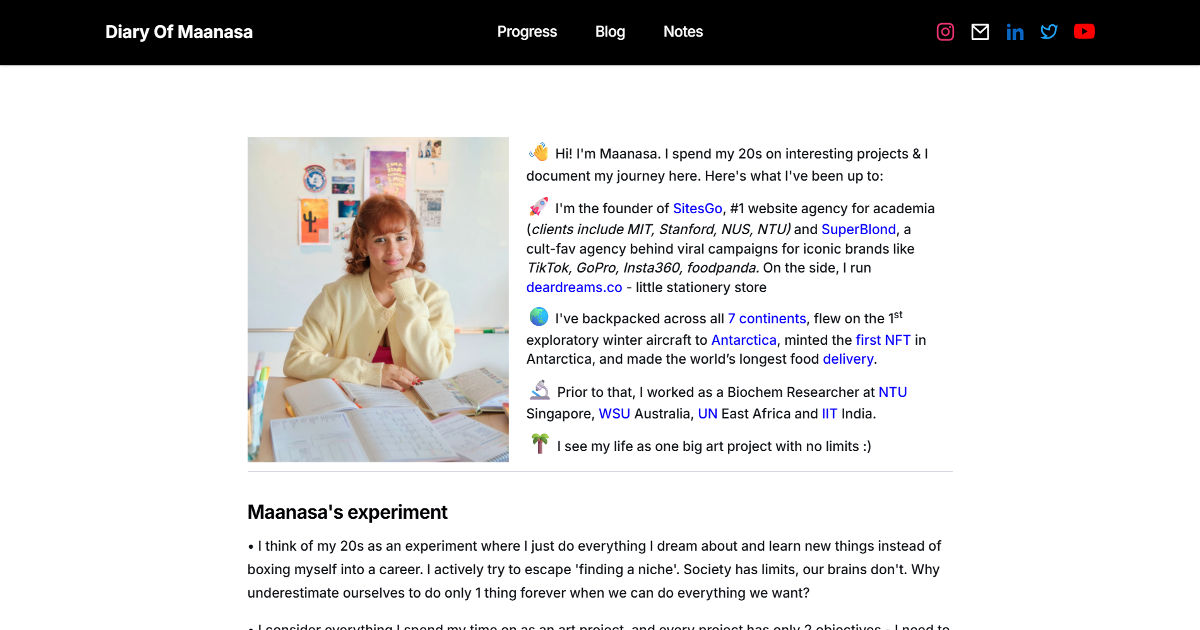
Maanasa's personal academic website, built by SitesGo, is a strong example of a coherent individual academic brand executed at a high level. The site has a consistent visual identity, a research positioning statement that is immediately clear and accessible, and a design that communicates expertise and personality simultaneously without veering into self-promotion. Every section of the site answers a specific visitor question, and the overall impression is of someone who has thought carefully about how they present themselves—which is itself a positive signal about the care and precision they bring to everything else.
Your research is worth being found. SitesGo builds academic personal brand platforms
websites, architecture, and design that put your work in front of the people who need it.
Build my academic brand with SitesGo
Frequently Asked Questions
Is academic personal branding appropriate for junior academics and PhD students? Absolutely and in many ways it matters more at the early career stage. A well-built personal website during a PhD or postdoc gives you a genuine advantage in the academic job market: it signals professional seriousness, gives search committees something to find beyond your publications list, and begins building search authority that compounds over time.
How is academic personal branding different from self-promotion? Self-promotion is about creating an impression that exceeds your actual credentials. Academic personal branding is about accurately and accessibly representing the credentials you have already earned. The difference is honesty and precision. The goal is visibility and accuracy, not inflation. A professor who makes their research findable by the people who need it is not promoting themselves they are doing their job as a publicly-funded researcher.
Do I need to be on social media to build an academic brand? No. Your personal website and Google Scholar profile are the foundation. Social media extends your reach but is optional and should be chosen based on where your target audiences actually are. A well-maintained website and Scholar profile, with consistent LinkedIn presence, is the minimum effective academic brand for most disciplines. Add other platforms only when you have the capacity to use them consistently an inactive Twitter account is marginally worse than no Twitter account.
How long does it take to build a coherent academic brand? The foundation personal website, complete Google Scholar profile, updated LinkedIn can be built in a focused weekend. Building authority and visibility from that foundation takes longer: three to six months of consistent small updates before meaningful SEO improvements are visible, and twelve to eighteen months before the compounding effects of a well-maintained online presence become clearly measurable. Start now; the benefits accumulate over time.
What's the most common mistake academics make when building their brand? Starting with the platform rather than the strategy. Choosing a website builder before deciding what the site needs to do, or creating a LinkedIn before clarifying their research identity statement. The strategic work defining your audience, writing your research identity, choosing your platforms takes a few hours and makes every subsequent execution decision faster, easier, and more coherent.
.gif)


