

Initial Summary
A university spin-off occupies a uniquely challenging position when it comes to building a website. It has one foot in the university — drawing legitimacy from its academic origins, institutional affiliations, and research credentials — and one foot in the commercial world, where investors, enterprise clients, and commercial partners are evaluating it using entirely different criteria. Most spin-off websites try to serve both audiences simultaneously and end up serving neither particularly well. The academic identity subsumes the commercial proposition, or the commercial framing distances the venture from the scientific credibility that justifies its existence. This article explains how to build a spin-off website that resolves this tension effectively, and the structural and content decisions that separate spin-off websites that generate investor and client interest from those that disappear into obscurity.
Understanding Your Three Audiences
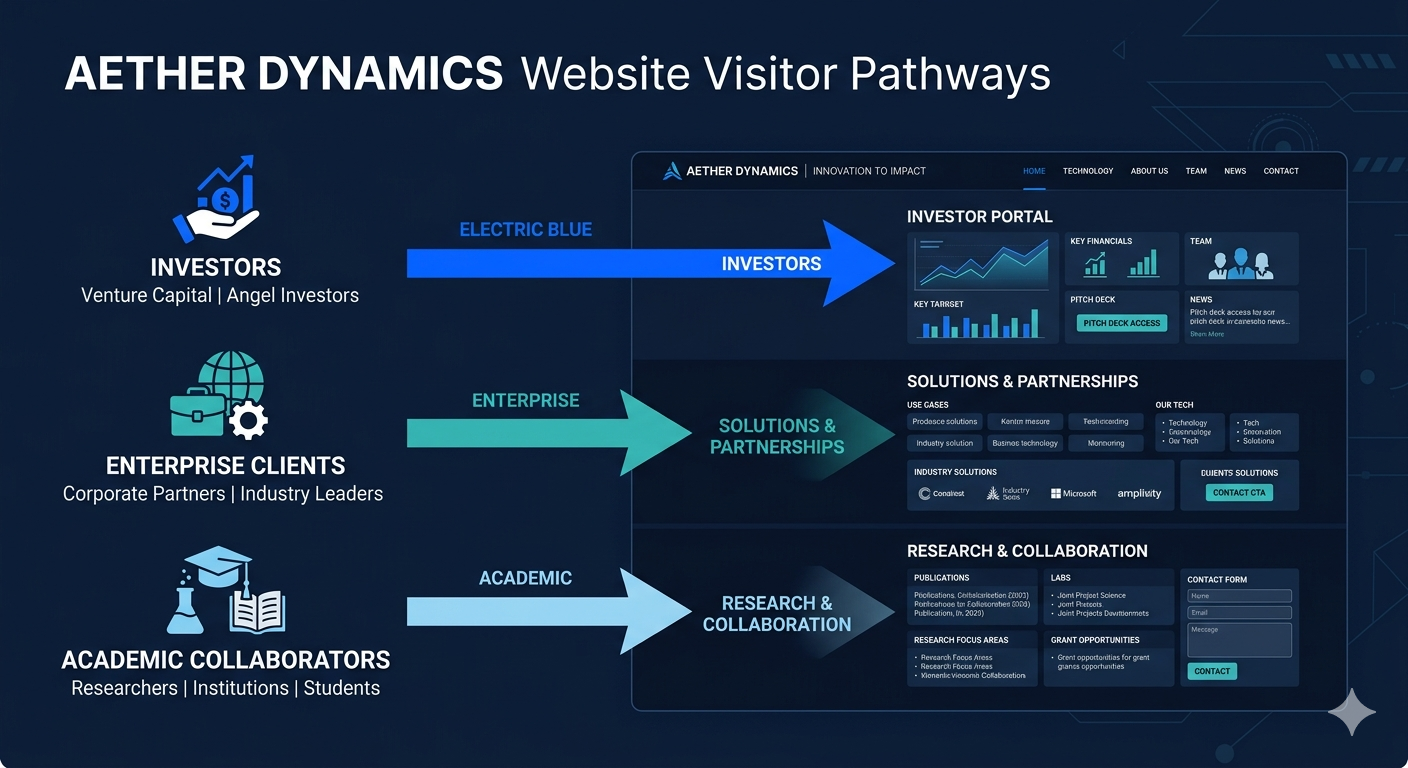
Before any design or content decisions are made, a university spin-off website needs to be architected around a clear-eyed understanding of its three primary audiences and what each needs to find, quickly.
Investors arrive at a spin-off website having typically already seen a pitch deck. They are looking for corroboration and depth: is the technology real and defensible, is the team credible, and is there evidence of commercial traction or institutional validation? They will look hard at the founding team section, any evidence of IP protection, and any indicators of commercial progress.
Enterprise clients and commercial partners are often early-stage prospects evaluating feasibility. They need to understand what problem the technology solves, what evidence exists that it works, and how they would engage with the company. They are often not technically sophisticated enough to evaluate the underlying science directly, so the website's job is to translate technical capability into commercial value.
Peer researchers and academic collaborators need to verify the scientific foundations. They will look at the founding team's publication records, the institutional affiliations, and the evidence of peer-reviewed validation.
A spin-off website that architects distinct content pathways for each of these audiences rather than producing a single undifferentiated narrative significantly outperforms one that tries to speak to all three with the same voice.
Principle 1: Lead With the Problem, Not the Technology
The most common mistake in spin-off website design is leading with the technology. "We have developed a novel CRISPR-based platform for gene editing in non-dividing cells" is a technology statement. It is accurate, but it is not a value proposition.
A value proposition begins with the problem: "Late-stage cancer patients frequently cannot access gene therapies because current tools require cells to be dividing during treatment. We have built a platform that changes this." The technology comes immediately after the problem but the problem comes first.
This principle applies regardless of how technically sophisticated your primary audience is. Investors are not primarily interested in your technology; they are interested in the market problem your technology solves and the size of the opportunity that problem represents. Lead with the problem every time.
Key Insight: Analysis of spin-off company pitch success rates at major university technology transfer offices consistently finds that ventures that can articulate a clear, specific problem and a defensible technology solution outperform technically equivalent ventures that lead with technology description over commercial framing. The website is often the first place this framing test is applied and failing it there means fewer investor meetings, not just fewer website conversions.
Principle 2: Academic Credibility as a Commercial Asset
For a spin-off, academic credibility is a commercial asset — but only if it is translated into commercial language. A publications list cited in the "About" section does not communicate commercial value. A statement that says "our technology has been independently validated in three peer-reviewed studies, including a Phase I clinical trial published in Nature Medicine" does.
The translation from academic credential to commercial value signal requires explicitly connecting each academic credential to the commercial implication. Patents protect the commercial exclusivity of the technology. A prestigious institutional origin — NTU, NUS, MIT, Stanford — signals the quality of the underlying research. Publication in high-impact journals signals peer-reviewed validation of the core claims.
Each of these credentials belongs on the spin-off website — but framed in terms of what they mean for a commercial partner or investor, not as an academic CV.
Principle 3: The Founding Team Section Is Disproportionately Important
For early-stage spin-offs that have limited commercial traction, the founding team section often does more work than any other element of the website. Investors in deep-tech ventures are frequently betting on the team more than the technology — particularly at the pre-revenue stage. A founding team section that communicates relevant scientific expertise, commercial experience where it exists, and institutional credibility is not a secondary element of the site. It is often the primary conversion driver.
Each team member profile should include their current title in the company, their role in developing or commercialising the technology, their academic or professional background with specific relevance to the venture, and links to their Google Scholar profiles or institutional pages where academic credentials are verifiable.
A photo that is professional without being either corporate-generic or laboratorial-casual is worth investing in. The team photo is a visual credibility signal that is evaluated in the first three seconds.

Principle 4: Make the Technology Defensible Without Being Impenetrable
A common failure mode in deep-tech spin-off websites is technology section writing that is either too vague to be credible or too technical for any non-specialist to parse. The target register for a spin-off technology section is: clear to an intelligent generalist, credible to a technically sophisticated reader, and specific enough to signal genuine defensibility.
A useful structure for a technology section: start with the core insight what your technology does that existing approaches cannot. Describe the mechanism in plain language, how it works at a conceptual level. Provide the evidence of validation, peer-reviewed publications, clinical trial results, regulatory milestones. Address the defensibility question, IP status and key technical barriers to replication.
Principle 5: Traction, Even Early, Belongs on the Homepage
University spin-offs often undersell early commercial traction because it feels modest compared to the eventual commercial scale they are working toward. But for a website visitor evaluating an early-stage venture, any evidence of commercial validation — a pilot partnership with a hospital, a letter of intent from an enterprise client, a grant from a national commercialisation agency, an accelerator programme acceptance — is highly valuable.
Display traction evidence prominently. Logos of partner institutions, accelerator programmes, and funding bodies on the homepage are legitimate and effective credibility signals, equivalent to the customer logo bar on a SaaS start-up homepage.
Key Insight: A study of deep-tech investor due diligence processes found that spin-off websites which include explicit traction signals, partner logos, named pilot customers, grant funding acknowledgements, and regulatory milestones —generate a higher rate of follow-up investor enquiries than websites of equivalent technical quality without these signals. Early-stage traction, however modest, should always be made visible rather than withheld until it feels significant enough.
Is Your Spin-Off Website Translating Science Into Commercial Opportunity?
Most university spin-off websites are built by researchers, for researchers. They communicate scientific rigour without commercial conviction, and they attract academic interest without investor or client attention. If your spin-off website is not generating investor meetings, commercial partnership enquiries, or qualified leads the gap is almost certainly in how the site frames the commercial opportunity, not in the quality of the underlying science.
→ Book a free website consultation for your spin-off
Frequently Asked Questions
How much should a university spin-off spend on its website?
At an early stage — pre-seed to seed — a well-structured website built on a modern platform such as Webflow or Framer with professional copywriting and photography typically costs SGD 5,000–20,000 depending on complexity. The investment threshold is this: if you are having investor meetings or enterprise client conversations, a professionally designed website is a prerequisite. A poorly designed site in an investor due diligence process communicates execution risk.
Should a spin-off website look more like a startup or more like a university research page?
Like neither. The most effective spin-off websites have a design register that is professionally contemporary without being a generic startup template and scientifically credible without being academic-institutional. Think of it as the aesthetic of a well-resourced Series A deep-tech company — clean, confident, and technically credible.
Should we include our academic publications on the spin-off website?
Yes, but selectively and with commercial framing. Three to five key publications that directly validate the core technology claims belong on the website, with brief plain-language summaries of what they demonstrate commercially. A full publications list belongs on the founding team members' personal academic profiles, linked from the team section.
How do we handle IP and technology disclosure on the website?
Be specific about IP status patents pending, patents granted, licensed from university without disclosing proprietary technical detail. Investors and partners need to understand the IP landscape to evaluate the commercial defensibility of the venture. Vagueness about IP status is a due diligence red flag.
When should we build a separate spin-off website rather than a page within the university lab site?
As soon as you have a distinct commercial entity a registered company, a named product or technology platform, or commercial conversations underway. A spin-off hosted as a sub-page of a university lab site communicates that the commercialisation is not serious. A standalone domain and website is a basic signal of commercial intent.
.gif)


