

Initial Summary
The tenure-track years are the most professionally consequential period in an academic career and the years when a neglected website does the most damage. As a tenure-track faculty member, you are simultaneously building a research programme, establishing collaborations, applying for grants, recruiting graduate students, teaching courses, and serving on committees. The last thing you have time to think about is your website. But your website is being checked by the very people who will shape your tenure outcome: potential collaborators evaluating whether your research trajectory is worth investing in, grant reviewers trying to understand your research agenda, and top PhD students deciding between multiple offers. A tenure-track academic website is not optional, and it is not a vanity project. It is a professional infrastructure investment that compounds in value across the entire tenure process.
What Makes a Tenure-Track Website Different
There are several types of academic websites: the established full professor's site, which emphasises legacy and reputation; the postdoctoral fellow's site, which emphasises potential and trajectory; the research lab's site, which emphasises collective output and recruitment. The tenure-track website has a specific and distinct set of requirements.
A tenure-track faculty member needs a website that accomplishes four things simultaneously. It must credibly establish your independent research identity separate from your doctoral supervisor's lab. It must communicate an active, forward-looking research agenda that signals momentum and fundability. It must support graduate student recruitment at a stage when your lab's track record is still being built. And it must project the professional presence of an established faculty member, even when your career is still early.
Getting this balance right, confident without being overclaiming, honest about early stage without signalling fragility is the specific design challenge of the tenure-track website.

Essential Section 1: Your Research Identity Statement
The most critical content on a tenure-track academic website is the research identity statement — a clear, two to four sentence articulation of your independent research programme. This is not your doctoral work summary. It is not your supervisor's research agenda with your name attached. It is a statement of what you, as an independent faculty member, study and why it matters.
Many early-career faculty struggle with this because the transition to research independence is genuinely difficult — especially for those who are extending or pivoting from doctoral work. But the stakes of not having a clear research identity statement are high: it signals to collaborators, funders, and graduate students that your research programme lacks definition.
If you are uncertain how to write this statement, a useful frame is: "I investigate [specific research question], using [methodological approach], in order to understand [broader significance]." The result should be legible to an intelligent non-specialist in under thirty seconds.
Essential Section 2: Current Research Projects
Unlike an established professor who can point to a large body of completed work, a tenure-track faculty member often has more active projects than published outputs. A dedicated current research projects section is how you communicate the active intellectual life of your emerging programme without waiting for everything to be published.
This section should describe two to four ongoing research projects or threads. For each, provide the central research question, the current stage of the work, data collection, analysis, writing any preliminary findings or outputs where appropriate, and any grant support or institutional backing.
This section serves a specific and important function for prospective PhD students: it shows them what kind of research they would actually be joining. A student considering your lab wants to know what the live intellectual questions are, not just what has already been answered.
Key Insight: An analysis of tenure-track faculty hiring outcomes at research universities found a significant correlation between well-maintained personal academic websites in the first two years of an appointment and successful tenure application outcomes not because the website directly influences tenure committees, but because researchers who maintain active online presences are, on average, generating more collaborations, more conference invitations, and more grant funding than those who don't. The website is a proxy for a broader professional engagement pattern.
Essential Section 3: Publications and Working Papers
Your publications list on a tenure-track website should include everything — refereed journal articles, book chapters, conference proceedings, and under-review papers — but with careful attention to status labelling.
Clearly distinguish between published papers with full citation and DOI, papers under review, papers in revision, and working papers or preprints. Ambiguity about publication status is a credibility risk: listing a working paper as a publication, or failing to update the status of a submitted paper, creates a poor impression when noticed.
For early-career researchers with a short publication list, context matters. A brief framing sentence — noting that the research programme is currently producing work in several areas, with papers currently under review — is more credible than a short list presented without context.
What About a Thin Publications List?
If your publication record is still developing — which is entirely normal in the early years of a tenure-track appointment — the honest answer is to complement the publications list with the working papers section and the current projects section. A tenure-track website that shows three published papers, four papers under review, and six active research projects communicates a productive research programme more effectively than a publications list of three papers presented in isolation.
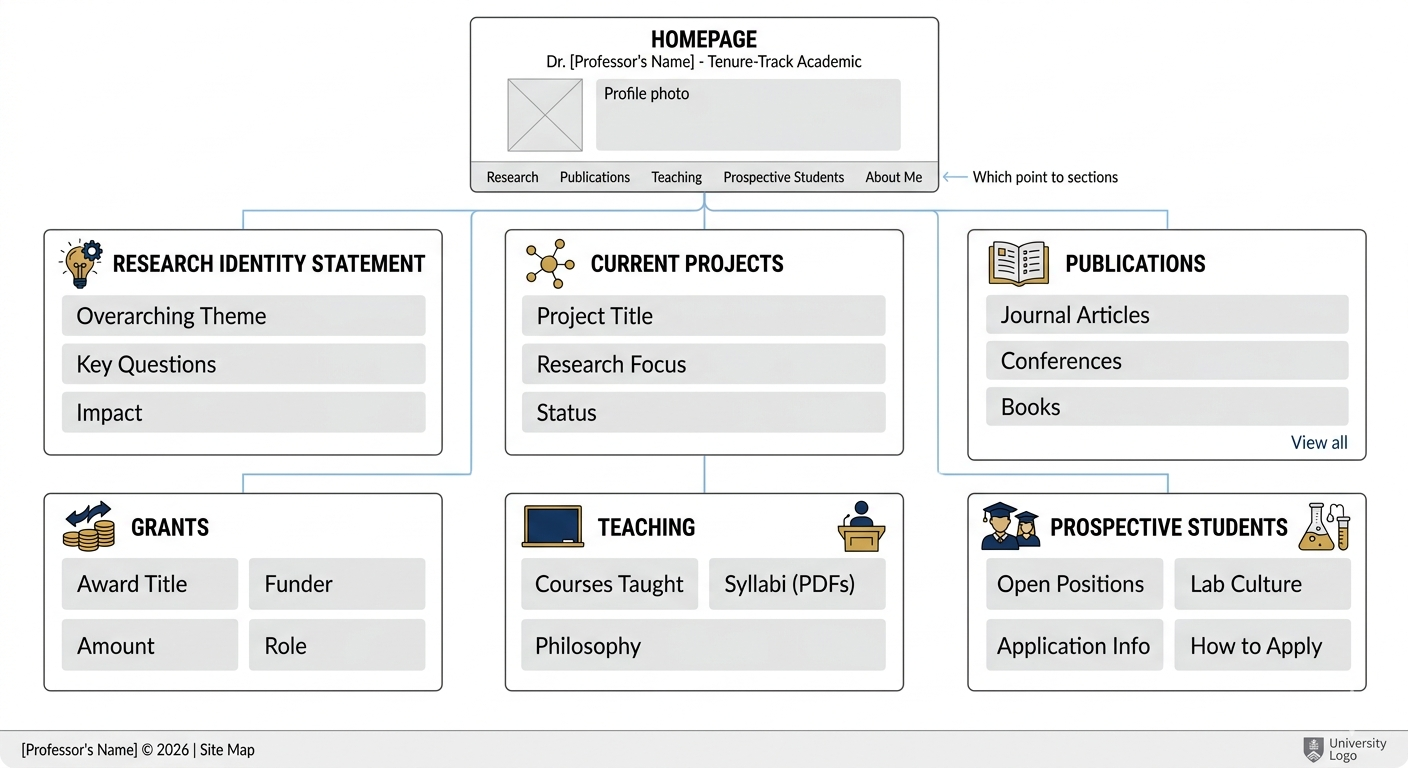
Essential Section 4: Grants and Funding
List your grant funding, including grants that are applied for or pending where appropriate. Many tenure-track faculty undersell this section because individual grants feel small relative to the research funding of senior colleagues. But a grant history — even early-stage — signals to collaborators and potential students that your research programme is externally validated and funded.
Include the funding body, the grant title, your role as PI or co-investigator, the amount if publicly disclosable, and the duration.
Essential Section 5: Teaching
Include a teaching section that lists current courses and connects them, where genuinely applicable, to your research programme. For tenure-track faculty in teaching-heavy institutions, this section also functions as evidence of professional contribution beyond research.
The most effective teaching sections go slightly beyond a course list: a sentence or two describing your pedagogical approach or research-teaching integration signals intellectual investment in teaching that distinguishes you from colleagues who treat the teaching section as a compliance exercise.
Essential Section 6: Prospective Students
This section is disproportionately important for tenure-track faculty who are actively building a lab for the first time. It should be explicit about what you are looking for, what the lab environment is like, and how prospective students should approach you.
If you are in early recruitment stages and genuinely uncertain about funding availability, say so honestly the best prospective students respect transparency far more than vague optimism. An honest statement about funding prospects, what types of support you can offer, and what the realistic experience of being in your lab at this stage of its development looks like will attract the right students and save both parties the time of a poor match.
Key Insight: Research on graduate student decision-making consistently finds that early-career faculty with clearly articulated research programmes and explicit prospective-student pages attract stronger PhD applications than faculty of equivalent seniority without this content even when the latter have more publications. Clarity and specificity about research direction and the lab experience matter more to strong prospective students than accumulated publication counts.
Is Your Tenure-Track Website Helping or Hurting Your Research Programme?
Most tenure-track faculty are building their website reactively updating it in the week before a grant deadline or after a journal rejection prompts a review of their online presence. A website built this way reflects the pressures of the moment, not the strategic communication of a developing research programme. If your website is not actively supporting your recruitment, collaboration, and funding objectives, it is almost certainly working against them.
→ Book a free review of your tenure-track academic website
Frequently Asked Questions
How polished should a tenure-track website look?
It should look professionally designed and completely current. At this stage of your career, your website is a primary professional credential. A visually amateur or clearly outdated site signals professional carelessness that can undermine the impression made by strong publications. It does not need to be expensive — a well-configured Webflow or Squarespace template with quality photography and careful writing is entirely sufficient.
Should I list my doctoral supervisor on my website?
Acknowledge your doctoral training in your biography section, but your website's structural emphasis should be your independent research programme, not your doctoral lineage. A website that leads prominently with your supervisor's name is communicating the wrong things about your independence as a researcher.
When is the right time to build a lab website versus maintaining just a personal site?
When you have a clearly defined lab identity a name, a consistent research agenda, and at least two to three members, a lab website becomes more appropriate than a personal site. In the first year or two of a tenure-track appointment, a personal research website that clearly communicates your independent research programme is usually sufficient and is often more credible than a half-formed lab site.
How much does the website matter relative to publications for tenure?
Publications are the primary driver of tenure outcomes. But the website influences the conditions that produce publications: collaboration networks, grant funding, graduate student quality, and conference invitations. A website that is genuinely working for your career will, over time, compound into measurably better conditions for your research programme.
Should I include public engagement or commentary writing on my tenure-track website?
Yes, in a dedicated section. Public engagement is increasingly valued by both institutions and funders. A section for media appearances, public lectures, or commentary writing kept appropriately brief and secondary to your research and publication content communicates the breadth of your scholarly engagement without overpowering the academic substance of the site.
.gif)


