

Initial Summary
Most startup websites are built in the wrong order. A founder picks a template they like, writes some copy, adds a contact form, and launches. Six months later they wonder why no one is converting. The problem isn't the template. It's that the website was built as a design exercise rather than a strategic asset and without a clear strategy, even a beautiful site does nothing for growth.
A startup website isn't a brochure. It's the most scalable sales tool your company has: working around the clock, qualifying visitors, building credibility, and creating the conditions for a first conversation. This guide covers the strategic thinking that makes startup websites actually work, not just look good and gives you the frameworks to build one with clear commercial intent from day one.
Whether you're pre-revenue, post-seed, or approaching a Series A, your website strategy should be a deliberate response to where you are in the company's journey.
The site that works for a pre-launch stealth startup looks nothing like the site that converts for a growth-stage B2B company, and treating them as interchangeable is one of the most common and expensive mistakes founders make.
Why Most Startup Websites Underperform
Before building strategy, it's worth naming the failure modes directly, because they're almost universal:
Founder-perspective copy. The website talks about what the company has built, not what the customer's problem is. The founder knows the product deeply and writes about features. The customer doesn't know the product exists and is searching for solutions to problems. These are different languages, and a website written in the first rarely reaches the second.
No clear conversion goal. What is the website supposed to make visitors do? If the answer is "learn about us," the website will perform exactly that generate awareness and produce no leads. Every page should have a specific, measurable conversion goal: a demo booked, an email captured, a case study downloaded, an investor enquiry submitted.
Built for today, not for six months from now. Startup websites are often built to reflect the current product and current stage, with no structural capacity to evolve as the company grows. Then the team wins two enterprise clients, raises a round, and realises the site communicates a story that no longer matches reality and another rebuild begins.
No SEO foundation. A website that generates no organic traffic is entirely dependent on paid acquisition, outbound effort, or referrals for every visitor. The compounding long-term value of a website that ranks for the right keywords is enormous, and it starts from how the site is built, not from content added later.
Key Insight: Your website is your cheapest, most scalable salesperson. But only if it has a clear job description.
Step 1: Define the Website's Job Before Building Anything
The first question is not "what should our website look like?" It is "what do we need the website to do, for whom, by when?"
Use SitesGo here as an example of a startup that is crystal-clear about its job definition. Their site does exactly one thing: convert academics into web design clients. The homepage opens with "#1 Website Agency for Academia" the ICP is in the headline, the CTA is a 20-minute free consultation, and nothing on the page serves any other audience. It's a textbook example of a site that has answered "what is this website supposed to make visitors do?" before a single design decision was made.

The answer depends on your stage, your go-to-market motion, and your current bottleneck:
If your bottleneck is investor awareness: The website needs to communicate your thesis, your team, and your traction concisely enough for an investor to make an initial assessment without a call. The conversion goal is an investor enquiry or a meeting request.
If your bottleneck is the enterprise pipeline: The website needs to communicate the specific problem you solve, the evidence that you solve it well, and a clear path to a first conversation. The conversion goal is a demo request or a contact form submission from a qualified decision-maker.
If your bottleneck is talent: The website needs to communicate your research culture, your team, your funding, and your mission in a way that makes talented people want to work there. The conversion goal is a job application or a direct approach.
If your bottleneck is awareness: The website needs an SEO and content strategy that builds organic traffic over time, so that people searching for your category find you before they find your competitors. The conversion goal is email capture, a resource download, or direct contact from a warmed-up visitor.
Most early-stage startups try to solve all four simultaneously with a single homepage and wonder why none of them convert well. Prioritise. Then build.
Step 2: Nail the Homepage – The Five Elements That Always Need to Work
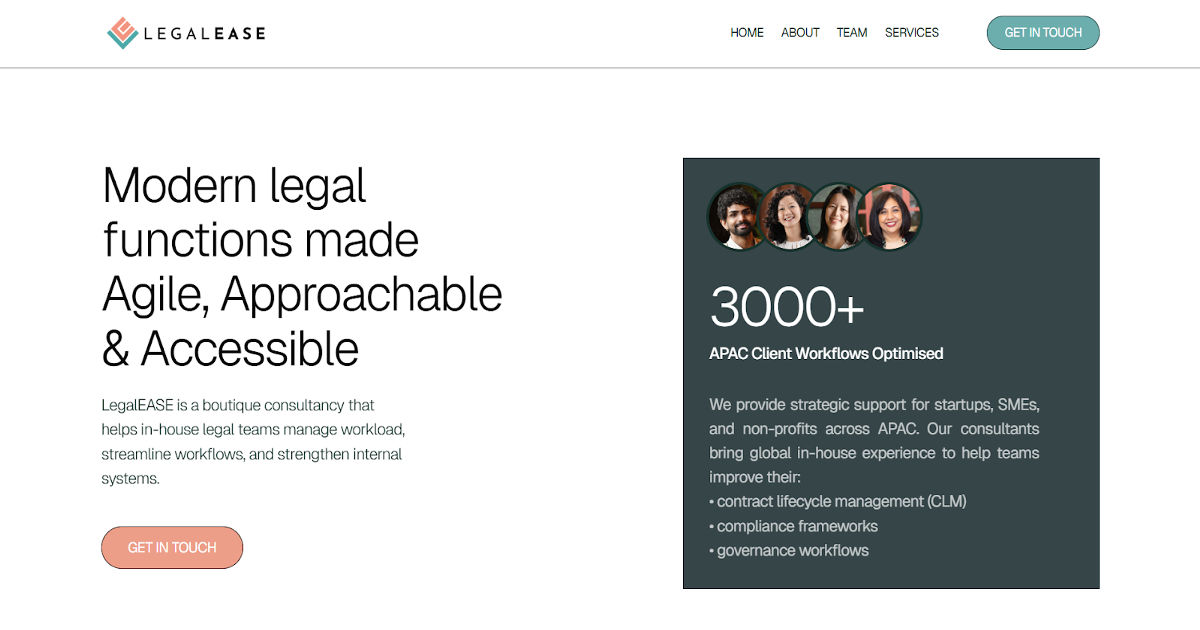
For example, Legalease.sg reinforces credibility by clearly showcasing its legal-tech positioning and trust signals upfront demonstrating real-world validation rather than relying on generic marketing claims.
Whatever else varies by stage and strategy, every startup homepage needs five elements to work properly:
1. A headline that names the problem and the solution in one sentence. Not your product name. Not your category. The problem you solve and who you solve it for. "We help enterprise procurement teams reduce supplier onboarding time by 60%" is a headline. "The future of intelligent procurement" is not.
2. A subheadline that adds specificity. One sentence that answers the next question the visitor has is how? for whom? and closes the gap between "that sounds interesting" and "that might be relevant to me."
3. Social proof above the fold. Logos of customers, investors, press mentions, or partner institutions immediately below the headline. Before a visitor reads a word of your product description, they are asking "is this real and are other credible people trusting it?" Answer that question before they ask it.
4. A single, unmissable CTA. One primary call to action on the hero, not three options. "Book a demo," "Get early access," "Talk to us." Visitor attention is scarce; giving them three equally prominent options is a conversion optimization mistake that many startup sites make and almost none fix.
5. Evidence of the claim. Whatever your headline promises, the section immediately below it needs to provide evidence. A customer result, a benchmark number, a case study teaser, a pilot outcome. Claims without evidence are marketing. Evidence without claims is documentation. You need both, in that order.
Step 3: Structure That Scales With Your Company
The most strategic thing a startup can do when building its website is make deliberate choices about structure because structure determines how the site can grow without being rebuilt every six months.
Core pages every startup needs:
The homepage handles first impressions and broad positioning. The problem/solution page gives visitors who don't immediately understand the category enough context to evaluate fit. The product page shows what you've actually built. The customers or case studies page provides evidence of commercial traction. The team page establishes who's building it and why they're qualified. The pricing or engagement page removes ambiguity about how to work with you. The blog or resources section builds SEO authority over time.
Pages most startups add too late:
A dedicated investors page (or at minimum an investors section) that filters inbound appropriately and communicates stage, round size, and thesis clearly. A press or media page that makes it easy for journalists to write about you accurately. A partners page that makes the commercial ecosystem visible to enterprise buyers who are evaluating ecosystem fit before evaluating product fit.
Modular page structure is worth the upfront investment. Building each page as a set of reusable content blocks rather than bespoke one-off designs means the marketing team can update and extend the site without a developer. This is the difference between a website that grows with the company and one that requires a full rebuild every twelve months.
Step 4: Credibility Architecture – Building Trust Before You're Famous
An early-stage startup asking an enterprise buyer to trust it with a mission-critical workflow has a credibility problem that no amount of good copy can fully solve. But credibility can be engineered through the architecture of the website itself.
Before we go all in on impact, let’s take the example of iGrow Partners. Their positioning leans heavily on clearly articulated partnerships and ecosystem credibility—anchoring trust in visible institutional relationships rather than abstract claims. It’s a strong example of why named enterprise partners and recognizable affiliations outperform generic testimonials in the credibility stack.

The credibility stack, in order of impact:
Named customer logos beat everything else. A single recognisable enterprise client name displayed with permission does more trust-building work than any amount of copy about your product's quality.
Case studies with specific outcomes beat testimonials. "We reduced their processing time by 43% over 90 days" is more credible than "Amazing team, great product."
Media coverage beats self-description. Being described by a credible third party TechCrunch, Wired, Bloomberg, a respected industry publication is independently verifiable and thus more credible than anything you say about yourself.
Research and publications beat marketing claims in technical markets. If your product is built on novel science or methodology, published research, white papers, or technical reports signal intellectual seriousness that a feature list cannot.
Awards and recognition beat self-proclamation. "Winner, Startup of the Year, TechCrunch Disrupt 2024" or "Backed by [Tier-1 investor name]" are third-party validations. Use them visibly.
Team credentials beat team headcounts. In early-stage startups, a team page that clearly shows where co-founders trained, where they previously worked, and what they've previously built is a credibility multiplier for enterprise buyers evaluating vendor risk.
Step 5: Conversion Design Making the Website Actually Produce Leads
A startup website that generates traffic but no leads has a conversion problem, not a traffic problem. Conversion design is about removing every obstacle between a qualified visitor's intent and the action you want them to take.
Match the CTA to the buying stage. A visitor who has never heard of your company is not ready to "Book a Demo"; they're ready to read a case study or download a guide. A visitor who has read three pages of your website and spent twelve minutes on it might be ready for a call. Staging your CTAs to match intent "Learn more" → "See how it works" → "Talk to us" produces meaningfully higher conversion rates than a single CTA applied uniformly across the site.
Reduce form friction ruthlessly. Every additional field on a lead capture form reduces conversion rates. For most startup use cases, Name, Email, Company, and Message is sufficient for an initial enquiry. Full qualification can happen on the call.
Social proof proximate to conversion points. Place a customer logo, a specific result, or a short testimonial immediately adjacent to your CTA buttons. The moment of conversion is when purchase anxiety is highest; reducing it with proximate evidence of others' trust is one of the highest-ROI design changes a startup can make.
Exit intent and scroll-depth triggers. Visitors who scroll more than 70% of a page but don't convert are signalling interest without acting. An exit intent prompt or a scroll-triggered sidebar with a specific, relevant offer (a case study, a live demo invitation, a short form) catches a percentage of these visitors who would otherwise leave without converting.
Step 6: SEO From Day One, Not From Day 90
The single most common SEO mistake startups make is treating it as something to "add later" after the site is built, after the product is launched, after there's someone to own it. By that point, the site's architecture has locked in structural decisions that are expensive to reverse, and months of potential compounding have been lost.
Domain authority takes time to build. A startup that launches its website in January and begins producing relevant, well-structured content immediately will have meaningfully more organic search visibility by the following year than one that waits until September to "start SEO." The compounding returns are real and front-loading the investment is almost always worth it.
Target the problem keywords, not the category keywords. Your potential customers are searching for solutions to problems, not for your product category. A procurement automation startup should target "how to reduce supplier onboarding time" and "procurement bottlenecks enterprise" before targeting "procurement automation software." Problem keywords capture buyers earlier in the consideration cycle and face less competition.
Technical SEO is the foundation. Page speed, mobile optimisation, structured data, clean URL structure, canonical tags, and proper internal linking are not advanced tactics they are baseline requirements. A startup website built on a modern platform like Webflow or Next.js with these basics in place from day one will outperform a content-rich site with poor technical foundations in every organic search that matters.
Stage-Specific Strategy: What Changes as You Grow
Use iGROWPartners here as an example of the seed/growth stage done right, an established Singapore consultancy that uses its website primarily to convert HR directors and institutional buyers, with case study content (C2D2 framework, 86% ACC certification rate, ministry client references) doing the qualification work before anyone picks up the phone. One paragraph example after the seed stage description.
Pre-launch / Stealth stage: The website's only job is to capture early interest and signal that something real is being built. A clean landing page with a compelling thesis statement, a form for early access or investor interest, and clear team credentials is sufficient. Don't overbuild. Do invest in the headline and the credibility signals.
Post-launch / Pre-seed stage: The website needs to be a working commercial tool for the first time. Lead with the problem, show the product, establish the team, and create a clear path to a first conversation. Every page should have a conversion goal.
Seed stage: The website should be driving inbound alongside outbound. This is when SEO investment begins to matter, when case studies from early customers need to be developed and published, and when the investor section needs to be built properly in advance of the next raise.
Series A and beyond: The website is a marketing channel, not just a company overview. Content marketing, SEO, and conversion rate optimization become full-time concerns. The site needs to communicate scale, team size, customer names, market position, press coverage in a way that matches the company's actual growth.
Your site might be getting attention but is it moving people forward?
We’ll identify the step where interest turns into hesitation.
The Patterns That Separate Startup Websites That Work
Pattern 1: Problem First, Product Second Every page leads with the customer's problem before describing the solution. This sequencing builds empathy before asking for trust.
Pattern 2: Specific Evidence Over General Claims Numbers, names, outcomes, and citations outperform adjectives at every stage of the customer evaluation process.
Pattern 3: One Primary Conversion Goal Per Page Each page has a single primary CTA. Multiple equally prominent options reduce conversion rates across the board.
Pattern 4: Credibility Visible Within Five Seconds Customer logos, investor names, press mentions, or award recognition appear above the fold on the homepage. Credibility that requires scrolling to find is credibility that most visitors never encounter.
Pattern 5: Structure Built to Scale The site's information architecture is designed with the next twelve months in mind, not just the current product. New case studies, new team members, new product lines, and new press coverage can all be added without a rebuild.
Build a Startup Website That Works as Hard as You Do
SitesGo builds websites for startups, deep-tech companies, and university spinoffs designed with commercial intent, built to convert, and structured to grow with your company from seed stage to Series A and beyond.
Frequently Asked Questions
How long should a startup website take to build?
A well-structured startup website with five to eight pages homepage, product, customers, team, pricing, and blog can be built in two to three weeks on a modern platform. The limiting factor is usually content: collecting customer logos, writing copy, and producing case study material takes longer than the technical build. Starting the content production process before choosing a platform saves significant time.
Should a startup website have pricing?
It depends on your go-to-market motion. For product-led growth or lower-ticket B2B, transparent pricing reduces friction and improves conversion quality. For enterprise sales where pricing is customised by deal size and configuration, a "Contact us for pricing" approach is standard and expected. Hiding pricing entirely for a self-serve product is almost always a mistake.
How important is a blog for an early-stage startup?
As a compounding SEO asset, very important but only if it's maintained. A blog with two posts from eighteen months ago is worse than no blog at all. If you can commit to one substantive post per month, the long-term SEO return is significant. If you can't, focus on the core commercial pages first and add the blog when you have the capacity to run it properly.
What platform should a startup website be built on?
Webflow is the current standard for startups that want design flexibility, good performance, and a CMS that non-developers can manage. For very early-stage companies that need to move fast, Framer is a good alternative. WordPress remains viable for content-heavy sites but requires more ongoing maintenance. The question isn't which platform is objectively best it's which platform your team can actually maintain without constant developer intervention.
How much should a startup spend on its website?
Enough to communicate the credibility your stage requires. A pre-seed startup needs a clean, fast, credible site not a $50,000 bespoke build. A Series A company pitching enterprise customers needs a site that matches the professionalism of the companies it's selling to. The website is often the first thing a prospect checks after a referral; the cost of under-investing is every deal that quietly didn't progress because the site didn't reinforce the pitch.
.gif)


