

Initial Summary
Credibility is the resource a startup website has to manufacture from scratch. An established company has brand recognition, a track record, and a reputation that precedes every visitor's arrival on the website. A startup has none of these things. Every visitor arrives sceptical — because scepticism is the rational response to a company that has not yet proven itself. The startup website's fundamental job is to convert that skepticism into enough confidence for the visitor to take the next step: book a demo, request a proposal, make an introduction, or write a cheque. This article explains the specific mechanisms by which startup websites build credibility, the mistakes that undermine it, and the patterns that the most effective early-stage company websites use.
Why Startup Credibility Is Different From Established Company Trust
An established company's website can rely on recognition. When you land on the Salesforce or McKinsey website, recognition does much of the credibility work before you have read a single sentence. A startup website cannot borrow any of this capital.
What startup credibility is built from, instead, is a combination of social proof evidence that credible others have already validated the company specificity detailed, verifiable claims that signal the team knows what it is doing consistency a polished, professional presentation that signals attention to detail and transparency honest, clear communication that signals the company has nothing to hide.
Each of these mechanisms works differently and addresses different types of visitor scepticism. Understanding which credibility gap your website is most likely to suffer from and addressing that gap first is more effective than trying to layer every credibility signal on every page.

Credibility Mechanism 1: Social Proof
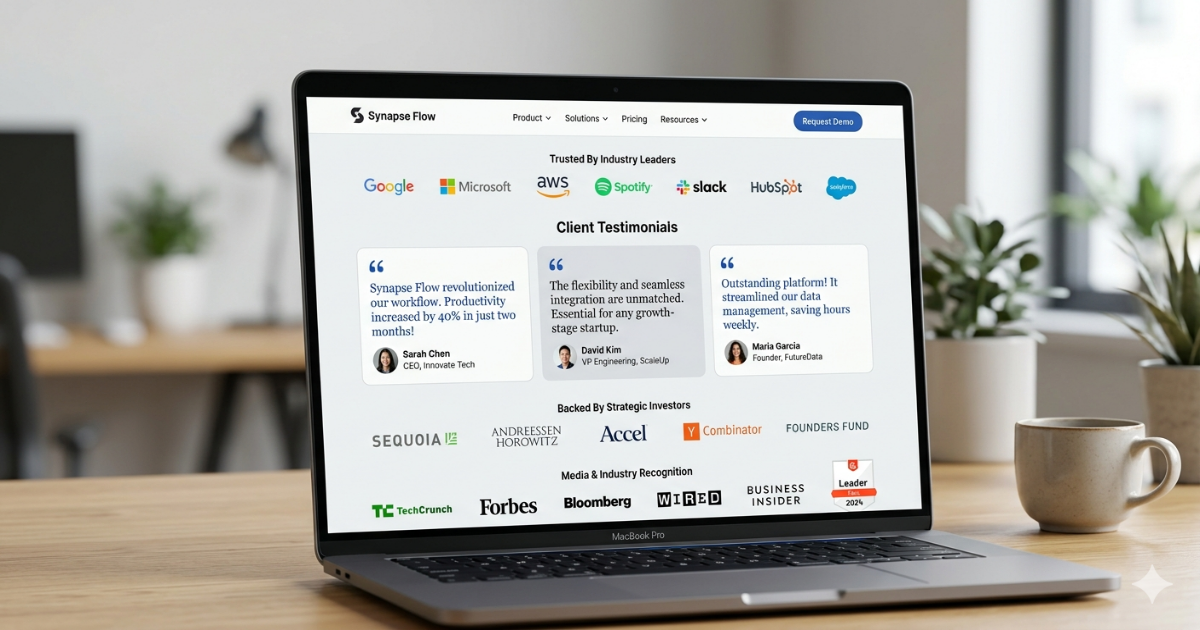
Social proof is the most powerful credibility signal on a startup website because it does not require the visitor to take your word for it. When a credible third party, an investor, a client, an accelerator, a press outlet has publicly associated their credibility with your company, that association transfers.
Named client testimonials with specific outcomes are the highest-value social proof an early-stage startup can display. A quote from the Head of Operations at a recognisable company, describing a specific measurable result, is far more persuasive than a general endorsement. "Working with [Company] reduced our onboarding time from 14 days to 3" converts at a fraction of the same rate as "A great partner that really understands our business."
Client logos communicate that credible organisations have vetted the company, even without testimonials. The bar for logo-level social proof is lower than for named testimonials use logos broadly where permission has been given.
Investor logos are a significant credibility signal for funded startups, particularly for enterprise buyers who associate investor-vetted companies with reduced commercial risk.
Accelerator and programme affiliations — Y Combinator, Antler, SGInnovate, NUS Enterprise — function as expert social proof. These affiliations belong on the homepage.
Press and media coverage in the form of a "Featured In" section with media outlet logos communicates external validation of the company's relevance, even from specialist trade publications.
Key Insight: Navigation design is where most academic websites fail their actual users most consistently. Navigation menus with eight or more items force every visitor to scan and decide before they can proceed, a cognitive tax that good navigation design eliminates entirely. The most effective academic website navigation menus have five or six items maximum, labelled in plain language that any visitor would understand instantly, with no ambiguity about what is behind each link. "Research" is a clear label. "Initiatives" is not. "Publications" is clear. "Scholarly Output" is not. Navigation clarity is a design decision with direct consequences for how effectively the site serves its purpose.
Credibility Mechanism 2: Specificity
Vague claims are the fastest way to destroy credibility on a startup website. "We help businesses grow faster" is not a claim — it is a platitude. "We reduce sales cycle length by an average of 28% for B2B SaaS companies with deal sizes above USD 50,000" is a claim that can be evaluated, remembered, and shared.
Specificity builds credibility because it signals that the team has done the work. A company that knows its impact metric precisely — not "faster" but "28% faster" — is a company that has run the analysis. A company that can describe its target customer precisely has done the customer research. Specificity in claims is the outward signal of rigour in the underlying work.
The rule of thumb: every benefit claim on a startup website should have a number attached to it, or should be replaced by a specific statement of what the product does rather than a generalised claim about the outcome. "We automate the weekly reporting process that takes your team 4 hours" is specific. "We save you time" is not.
For every sentence on your homepage that makes a claim about your product or its impact, ask: is this statement falsifiable? Could a sceptical visitor disagree with it? If the answer to both questions is no — if the claim is too vague to be evaluated or disproved — the sentence is contributing noise, not credibility.
Credibility Mechanism 3: Design Consistency and Quality
Design quality is a credibility signal before a word is read. Research by Stanford's Web Credibility Project found that design quality is the most significant factor in initial website credibility assessment — surpassing all other factors including content quality in initial evaluations.
For startups, this means that a visually amateur website — one with inconsistent typography, stock photography that clearly came from the same five sites every other startup uses, or a mobile layout that breaks — is actively working against your credibility regardless of how strong the underlying product is.
The standard a startup website needs to meet is not parity with the most sophisticated enterprise software companies. It is the standard of a credible, professionally serious organisation that pays attention to detail. This is achievable on a premium template with thoughtful customisation — it does not require a large design budget.
What to avoid: template defaults left unchanged from a generic template, mobile layouts that have not been tested, and typographic inconsistencies that signal the site was assembled without a consistent design brief.
Credibility Mechanism 4: Transparency
Startup websites that try to seem larger or more established than they are tend to produce the opposite effect: savvy visitors detect the performance and become more sceptical, not less.
Transparency — being honest about where the company is in its journey — is more credible than performing a maturity the company does not have. An early-stage startup does not need to pretend it has enterprise clients if it has a strong pilot. It does not need to hide its team size if the team is small but exceptional. The credible presentation of what you actually are — clearly explained, with honest context — is more persuasive to a sophisticated visitor than an attempt to appear something you are not.
Specific transparency practices that build credibility: be honest about the company stage on the About page, acknowledge pilot status rather than overstating client relationships, and if pricing is available, consider displaying it rather than hiding behind "contact us for pricing" — which signals pricing anxiety to sophisticated buyers.
Key Insight: Analysis of startup website conversion rates across B2B categories consistently finds that websites which include a clear About section with honest company stage information acknowledging early-stage status while providing compelling evidence of progress convert at higher rates with enterprise buyers than websites that obscure company stage. Enterprise procurement teams are experienced at identifying the performance of maturity; honesty accelerates trust.
Does Your Startup Website Build Credibility or Undermine It?
Most early-stage startup websites were built to look impressive, not to build credibility. They have beautiful hero sections and no testimonials. They have feature lists and no specificity. They have stock photography and no real team photos. If your website is not generating the volume and quality of qualified leads your product deserves, the gap is almost always in the credibility architecture — not the design, the copy, or the offer.
→ Get a free conversion and credibility audit of your startup website
Frequently Asked Questions
What if we don't have any named clients yet — how do we build credibility without social proof?
Specificity and transparency become more important when social proof is limited. Be specific about your technology, your founding team's credentials, any institutional validation such as grants or accelerator acceptance, and the specific problem you are solving. A startup with no clients but a highly credible founding team, a demonstrably real problem, and an honest account of its current stage can generate investor and early-client interest without relying on social proof.
How do we get testimonials from clients who don't want to be publicly named?
Try asking for permission to use their company name and a general title — for example, "Head of Operations, global logistics company" — without the individual's name. Many clients who decline full attribution will accept sector-level attribution. If a client declines entirely, a case study framed as an anonymised example with specific metrics is more credible than a generic unnamed quote.
Should we display pricing on our startup website?
For self-serve and SME-focused products, yes. Pricing transparency reduces friction and filters out non-qualified leads, saving sales time. For enterprise products with complex, custom pricing, a clear pricing page that explains the structure and invites a conversation is more credible than hiding pricing entirely. "Contact us for pricing" with no structure signal is a conversion barrier for enterprise buyers who need to scope budget feasibility before engaging.
Is design quality really as important as credibility signals like testimonials?
Both matter at different stages of the visitor journey. Design quality affects the initial five-second credibility impression — whether a visitor stays or leaves before engaging with any content. Testimonials and specificity affect the subsequent evaluation — whether a visitor who stays is persuaded to take the next step. A visually poor site loses visitors before testimonials can do their work. A visually polished site without testimonials struggles to convert visitors who stay.
What is the biggest single credibility mistake startup websites make?
Making claims they cannot substantiate. A homepage that says "the fastest solution in the market" or "trusted by thousands of businesses" without supporting evidence is not impressive — it triggers scepticism in every sophisticated visitor. Every claim should either have a specific number attached to it, a named reference to support it, or be replaced by a verifiable factual description of what the product does.
.gif)


