

Initial Summary
A solo lawyer's website exists in a uniquely high-stakes credibility environment. Legal services are purchased at moments of significant personal or commercial stress. A client seeking a solo practitioner is often navigating a dispute, a transition, or a risk they cannot fully evaluate on their own. In this context, the website's job is not to impress with visual sophistication: it is to communicate, quickly and unambiguously, that this lawyer understands the specific problem the client is dealing with, has the expertise to handle it, and can be trusted with something that genuinely matters. This guide covers everything a solo lawyer needs to build a website that generates qualified enquiries, establishes credibility before the first call, and positions the practice effectively in Singapore's competitive legal market.
The Solo Practitioner's Credibility Challenge
Solo law practices face a specific credibility challenge that differs from both large firm websites and corporate lawyer websites. Without the institutional credibility of a large firm — the brand recognition, the client roster, the international network — a solo practitioner's website must do more work to establish trust. But without the complexity of a large firm's service offering, the solo practitioner's website can also be more focused, more personal, and more effectively tailored to a specific client and matter type.
The most effective solo lawyer websites exploit this advantage: they are more specific about who they serve and what they handle, more personal in how the lawyer is presented, and more direct about the process of working with them. The credibility of a solo practice comes from depth of expertise and quality of personal attention — and a well-designed website can communicate both.
Section 1: Practice Area Focus — The Clarity That Converts
The single most impactful design decision for a solo lawyer website is the decision about focus. A solo lawyer who attempts to communicate competence across eight different practice areas on a single website communicates competence across none of them convincingly. A lawyer who communicates specific, deep expertise in two or three tightly related practice areas is far more credible — and far more likely to receive enquiries from the right clients.
This is not a decision about limiting your actual practice. It is a decision about how to position your website. The website should lead with your strongest, most differentiated areas of practice — the work you do best, the matters you are most experienced in, and the client situations you are most suited to handle.
The Positioning Statement: The homepage should include a clear practice positioning statement that specifies what you practise, for whom, and at what scale or complexity of matter. "I advise Singapore-based SMEs and family businesses on contentious commercial disputes and employment matters" is a positioning statement. "I am an experienced Singapore lawyer handling a wide range of legal matters" is not.

Section 2: Homepage Design — The First Thirty Seconds
A prospective legal client landing on your website for the first time has specific, predictable questions. Designing the homepage around these questions — in the order clients ask them — is the most effective approach to solo lawyer homepage design.
The questions, in order: Does this lawyer handle my type of legal matter? Does this lawyer have experience with situations like mine? Is this lawyer based in Singapore and available to take on new clients? How do I get in touch or make an initial appointment?
A homepage that answers these questions in order, clearly and without requiring the visitor to search for the information, will convert a higher proportion of first-time visitors into enquiries than a homepage designed around any other principle.
Photography: A solo lawyer's website should include a professional photo of the lawyer — not stock photography of a gavel or a scale of justice. Legal clients are choosing a person, not a service. A clear, professional headshot or environmental portrait in your office is the single most personal credibility signal you can include, and it is often what distinguishes a solo practitioner's site from an impersonal large-firm page.
Key Insight: Research on legal service purchasing decisions consistently finds that potential clients spend more time on a law firm or solo practitioner website if they can see a photo of the lawyer they will be working with. For solo practitioners, the personal relationship is the product and a professional photo communicates the humanity of that relationship more effectively than any amount of credentials text. A professional photographer session typically costs SGD 300–800 and produces assets used across the website, LinkedIn, and all marketing materials for years.
Section 3: Practice Areas Page — Depth Over Breadth
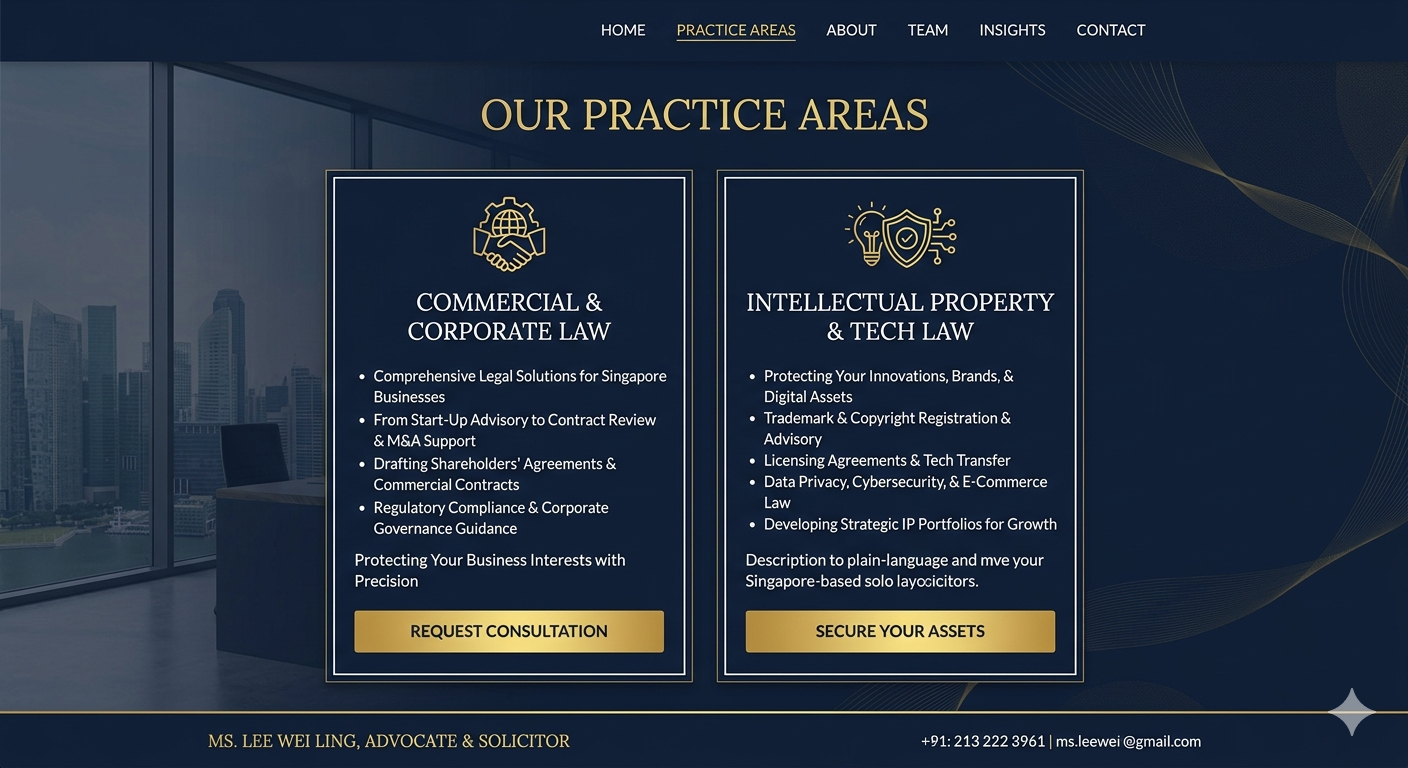
The practice areas page is where a solo lawyer website makes or loses its credibility with legally sophisticated visitors — in-house counsel evaluating a referral, business owners assessing competence for a commercial matter, or individuals trying to determine whether their situation falls within the lawyer's expertise.
For each practice area, the page should include a clear description of the types of matters you handle, specific examples of the situations that typically trigger a client to seek this type of advice, your specific experience and approach in this area, and any notable outcomes or relevant credentials.
The writing should be in plain language — not legal boilerplate — and should be written from the client's perspective. "If your business is facing a supplier dispute that has become unmanageable internally" is client-perspective writing. "I handle commercial disputes across a range of sectors and complexity levels" is lawyer-perspective writing. The first builds connection; the second builds distance.
For most solo practitioners, two to four practice areas is the right number. More than four makes the website feel unfocused. Fewer than two may make the site feel too narrow unless you are genuinely a highly specialised niche practitioner, in which case a single practice area presented with great depth is a strong positioning choice.
Section 4: Credentials and Experience
A solo lawyer's credentials section should include the following, clearly and without over-inflating.
Admitted jurisdictions — where you are called to the bar, clearly stated. Academic qualifications — law degree institution and year, any relevant postgraduate qualifications. Previous practice experience — the firms you have previously worked at if credible in the relevant context, the areas you practised in, and the approximate level of seniority you reached. This is particularly valuable if you trained or worked at a recognised firm before going solo, as it provides borrowed institutional credibility. Representative matters — without breaching confidentiality, a brief description of the scale and type of work you handle. Publications, speaking engagements, and bar association activities add credibility beyond the basic credential list.
Section 5: Client Process Transparency — The Differentiator Most Solo Lawyers Miss
One of the most consistently effective elements of a solo lawyer website — and one of the most consistently absent — is a clear explanation of what the process of working with you actually looks like.
Legal clients are often first-time users of legal services for the specific matter type they are facing. They are anxious about the process, the timeline, and the cost. A lawyer who clearly explains what a first consultation involves, how the engagement is structured, what communication to expect, and how fees are calculated removes a significant barrier to enquiry.
This is not a comprehensive terms of engagement document. It is a brief, plain-language narrative: "When you contact me, I will respond within one business day to arrange a brief initial call. I offer an initial 30-minute consultation at a fixed fee of [amount] to assess your situation and provide initial guidance. From there, I will provide you with a clear scope and fee estimate before we proceed."
This level of transparency is unusual in the legal industry, which is precisely why it is so effective as a differentiator.
Key Insight: A study of legal service website enquiry rates found that solo practitioners and small law practices who include a clear, step-by-step explanation of their engagement process including fee transparency receive significantly more qualified enquiries than comparable practices without this content. The transparency functions as a self-selection filter: clients who are price-sensitive or process-anxious either find what they need or self-select out before a call, making every enquiry the lawyer receives more likely to be a genuine fit.
Is Your Law Practice Website Generating the Enquiries You Need?
Most solo lawyer websites are built once, in a hurry, and updated only when something is clearly wrong. They don't speak in the client's language, they bury the practice focus under vague positioning statements, and they make it harder than necessary to make first contact. If your website is not generating a consistent flow of qualified enquiries from the types of matters you want to be handling, the gap is almost always in how clearly the site communicates your focus, your experience, and your process.
→ Book a free website review for your law practice
Frequently Asked Questions
Do I need to comply with Singapore Law Society advertising rules on my website?
Yes. Singapore lawyers are subject to the Law Society of Singapore's Publicity Rules under the Legal Profession (Publicity) Rules. These rules govern what claims you can make about your qualifications, experience, and outcomes. Before publishing your website, review the current Publicity Rules on the Law Society website in particular, the restrictions on comparative claims, past client testimonials, and outcome guarantees. When in doubt, consult the Law Society's practice guidelines directly.
Should I include client testimonials on my law practice website?
Testimonials on Singapore lawyer websites are subject to Law Society Publicity Rules. Review the current rules before including client testimonials — the rules have evolved in recent years and the position should be verified before publication. If testimonials are permitted within the rules, they are highly effective credibility signals for solo practitioners. If they are restricted, third-party directory profiles are an alternative channel for client reviews.
How should I handle fee transparency on my website?
Provide as much transparency as your practice type permits. For fixed-fee matters, straightforward employment contracts, will drafting, standard corporate filings displaying your fee schedule removes friction and filters enquiries effectively. For complex or time-based matters, a range or a clear explanation of your billing structure is more useful than no information at all.
What is the most important thing to get right on a solo lawyer homepage?
The practice positioning statement the two to three sentence description of what you practise, for whom, and at what scale. Everything else on the homepage builds on this foundation. A vague positioning statement produces vague enquiries; a specific positioning statement produces qualified ones.
How do I compete with larger firms on website presence?
Compete on focus, not breadth. A solo practitioner can credibly claim deeper expertise in a specific area than a large firm that handles everything. A clearly focused website that communicates genuine depth of expertise in two or three practice areas will generate better-fit enquiries than a website that tries to match the breadth of a large firm — and typically converts at a higher rate with clients who are the right fit for solo practice.
.gif)


