

Initial Summary
A research lab website that is built around the wrong content does two kinds of damage: it fails to attract the visitors it should attract, and it actively misleads the visitors it does attract. Most research lab websites are built without a content strategy they accumulate pages organically, list publications because that seems obvious, and end up as a disorganised archive that serves no one particularly well. This article maps out the content that every research lab website needs, explains what each section should accomplish, and identifies the most common content gaps that undermine otherwise well-designed lab sites.
Why Content Strategy Precedes Design
The most common mistake research labs make when building or redesigning their website is beginning with design. They choose a template, select colours, and place placeholder content only to realise, when the design is finalised, that they are not sure what they actually want to say.
Content strategy should drive every structural decision. Before any visual design choices are made, a lab should have answered: Who are the primary audiences for this website? What does each audience need to find quickly? What impression do we want each audience to leave with? The answers to these questions determine which content sections are essential, how they should be ordered, and how much depth each requires.
For most research labs, the primary audiences are prospective graduate students and postdoctoral fellows, peer researchers and potential collaborators, grant funders and institutional leadership, and in many fields journalists and policy audiences. Each needs to find different content, quickly.

The Essential Content Sections
1. A Clear Research Mission Statement
Every research lab website needs a homepage statement that answers, in plain language, the question: "What does this lab study, and why does it matter?"
This is not the place for technical precision or exhaustive qualification. It is the place for a two to three sentence articulation of the lab's core scientific or scholarly mission, written at a level that an intelligent non-specialist can understand and find compelling. This statement anchors every other content decision on the site if a prospective content element cannot be connected to this statement, it probably does not belong on the homepage.
The most common failure here is defaulting to technical jargon. A homepage that opens with "our lab investigates the spatiotemporal dynamics of epigenetic regulatory networks in post-mitotic neural progenitor cells" communicates rigour to a narrow peer audience and nothing at all to everyone else. The technical precision belongs in the research section; the homepage belongs to the mission.
2. Research Areas
A dedicated research areas section is the intellectual core of a lab website. It should go deeper than the homepage mission statement, providing a substantive description of each major research thread the lab pursues.
Each research area description should include a plain-language introduction to the research question, a brief explanation of the lab's specific approach or methodology, the significance of the question, and links to the most relevant publications for visitors who want the technical detail.
Organising this section thematically rather than chronologically is essential. A visitor arriving with a specific research interest should be able to identify which of the lab's work streams is most relevant to them within thirty seconds.
Key Insight: Research on how prospective PhD students choose research labs consistently finds that the quality and clarity of the lab website's research areas section is among the top three factors in deciding whether to reach out to a PI. A vague or incomplete research areas page signals that the lab may be poorly organised or that the PI is not invested in graduate mentorship regardless of the lab's actual publication record.
3. Team Page
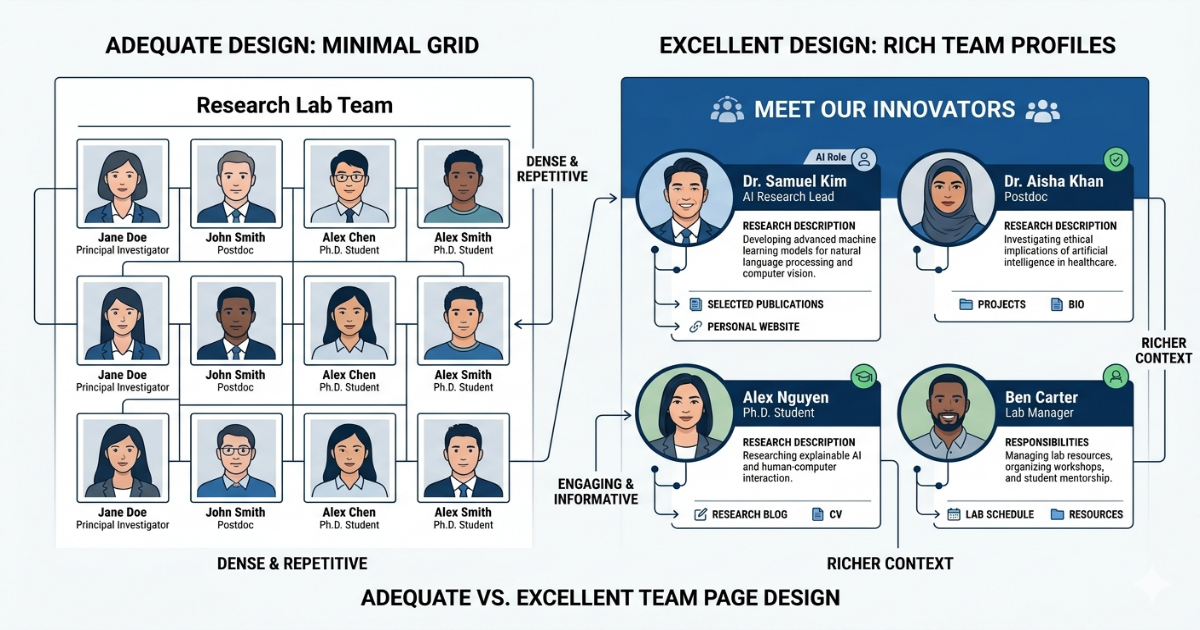
The team page is one of the most visited pages on any research lab website and one of the most commonly neglected. A team page that lists names and titles with headshots is the minimum. A team page that works as a recruitment and credibility tool does considerably more.
Each team member entry should include a current professional photo, their full title and role in the lab, a brief description of their specific research focus within the lab's broader agenda, and links to their personal website or institutional profile where available. For postdoctoral fellows and graduate students, a sentence describing their background or how they came to join the lab adds a human dimension that serves recruitment purposes.
4. Publications
A publications list is expected on every research lab website. But a publications list that is merely complete is not particularly useful a list that is navigable and contextualised is.
The strongest research lab publication sections share three characteristics. First, they are organised thematically, not just chronologically. Second, they include a brief, plain-language annotation for each major paper one to two sentences describing what the paper found and why it matters. Third, they provide accessible links to PDFs, preprints, or publicly accessible versions so that a visitor who wants to read the actual work is not blocked by a paywall before they have decided whether to invest.
5. A "Join the Lab" or "Opportunities" Page
This is the most commonly missing essential page on research lab websites. A clear, specific opportunities page signals to prospective lab members that the PI has thought carefully about recruitment and mentorship and reduces the friction of applying by answering the questions that most applicants have before sending an email.
An effective opportunities page should specify what positions are currently available, what career stage they are aimed at, what skills or background the lab is looking for, and what a prospective applicant should include when reaching out. If no positions are currently available, a brief note explaining this and inviting exceptional candidates to express interest regardless is more useful than a missing or outdated page.
6. Contact Information
A contact page should include a direct email address for the PI, a physical address for the lab, and any specific instructions for reaching out. Do not make it difficult to contact the lab. A contact form that requires visitors to create an account, or a "contact us through the university portal" instruction, is a barrier that prospective collaborators and graduate students will not bother to clear.
Content That Is Commonly Included But Often Done Poorly
News and Updates: Many lab websites include a news section that started strong and then went quiet. A news section with the most recent post dated three years ago is worse than no news section it signals inactivity. Either commit to updating the news section at least quarterly, or do not include it.
Lab Alumni: An alumni section is underused as a recruitment tool. A well-maintained alumni section that shows where former lab members have gone what positions they hold, at what institutions is one of the most persuasive things a research lab can include on its website for prospective PhD students and postdoctoral fellows. It answers the question they most want answered but rarely ask directly: what happens to your lab members after they leave?
Key Insight: An audit of research lab websites at major research universities found that labs with an accessible "Join the Lab" page with specific, current information received three to four times as many unsolicited graduate student enquiries as equivalent labs without such a page. The single highest-impact content addition for labs actively recruiting is a clear, specific, currently-accurate opportunities page.
Does Your Research Lab Website Have the Content It Needs?
Most lab websites are missing at least two of the content sections described above and the sections that are present are often out of date. If your site is not generating the graduate applications, collaboration enquiries, and media contacts your research deserves, the gap is almost always in the content, not the design.
→ Get a free content audit of your research lab website
Frequently Asked Questions
How long should each research area description be?
Two to four paragraphs on the research areas page, with a brief one to two sentence summary on the homepage linking to it. The research areas page can afford more technical depth than the homepage visitors who navigate to it have already indicated a substantive interest in the lab's work.
Should I include unpublished work or work in progress on the website?
Yes, with appropriate caveats. A current projects section that describes ongoing research questions without prematurely publishing findings is genuinely useful for prospective collaborators and graduate students. It communicates the lab's active research direction more accurately than a publications list alone.
How do I handle the team page when members join and leave frequently?
Designate one person in the lab responsible for updating the team page whenever membership changes. A team page that is outdated by more than a few months creates a poor impression. If you cannot maintain a detailed team page, a simpler version a brief current roster without detailed profiles is preferable to an inaccurate detailed one.
Should the website include a separate page for each project?
For large, multi-year projects that have generated multiple publications and involve multiple collaborating institutions, a dedicated project page is appropriate. For most ongoing lab research, thematically organised research area descriptions are sufficient and easier to maintain.
What is the most important single content addition for a lab website that is currently lacking?
A clear, current "Join the Lab" page with specific information about available positions and how to apply. This consistently produces the highest return on content investment for labs actively recruiting.
.gif)


