

Initial Summary
Quantum computing companies occupy an unusual position in the technology landscape: they are building genuinely revolutionary technology, but they are doing it in a field where most potential customers, investors, and partners lack the technical background to evaluate what they're seeing. A quantum computing company website must simultaneously communicate scientific credibility to expert audiences and make a compelling, accessible case to the far larger population of investors, enterprise buyers, and policy stakeholders who will fund and commercialise this technology. This guide breaks down how to build a quantum computing company website that achieves both.
The Unique Communication Challenge of Quantum Computing Websites
Almost every technology company faces the challenge of explaining complex technology to non-technical audiences. Quantum computing companies face an extreme version of this problem. Quantum mechanics is genuinely counterintuitive — even educated, technically literate audiences struggle with superposition and entanglement at a conceptual level. The risk for quantum computing company websites is bifurcation: a site written for physicists that loses every potential investor, or a site full of accessible analogies that loses every potential technical hire and research collaborator.
The best quantum computing company websites solve this by layering their content. The homepage communicates a clear, accessible mission and value proposition. A click deeper reveals progressively more technical content for visitors who want it. This layered architecture respects the intelligence of all visitors while ensuring no one is alienated by content pitched at the wrong level.
A second challenge is credibility. The quantum computing field has attracted significant hype and significant capital, and experienced investors and enterprise buyers are increasingly sceptical of claims that outrun demonstrated capability. A quantum computing company website that makes credible, specific, evidence-backed claims, even modest ones is more persuasive than one that makes expansive claims without supporting detail.
What a Quantum Computing Company Website Must Communicate
Before considering design or platform, clarify the four things every quantum computing company website must communicate clearly:
1. What problem do you solve? Not "what is quantum computing" but specifically: what computational problem — in drug discovery, materials simulation, financial optimisation, logistics, or another domain — does your technology address, and for whom?
2. Where are you on the technology roadmap? Quantum computing is a spectrum from early research to near-term NISQ (Noisy Intermediate-Scale Quantum) applications to long-term fault-tolerant systems. Investors and enterprise buyers need to understand where your company sits on this spectrum and what the realistic timeline to commercial deployment looks like.
3. What is your technical differentiation? Superconducting qubits, trapped ions, photonic systems, topological qubits — these represent fundamentally different technical approaches with different performance characteristics and commercialisation timelines. Your website needs to articulate your approach and why it is the right bet.
4. Who is on the team? In deep-tech, team credibility is often the most important signal for early-stage investors. PhD credentials from world-leading quantum computing groups are significant trust signals that should be displayed prominently, not buried in a careers page.
Key Insight: According to McKinsey's 2023 quantum technology report, quantum computing is expected to generate between USD 450 billion and USD 850 billion in value by 2040 across pharmaceuticals, chemicals, finance, and logistics. For companies operating in this space, the ability to communicate clearly which part of this value chain they are positioned to capture is a critical differentiator for investor and enterprise sales conversations and the website is where that communication begins.
Homepage: The First 10 Seconds
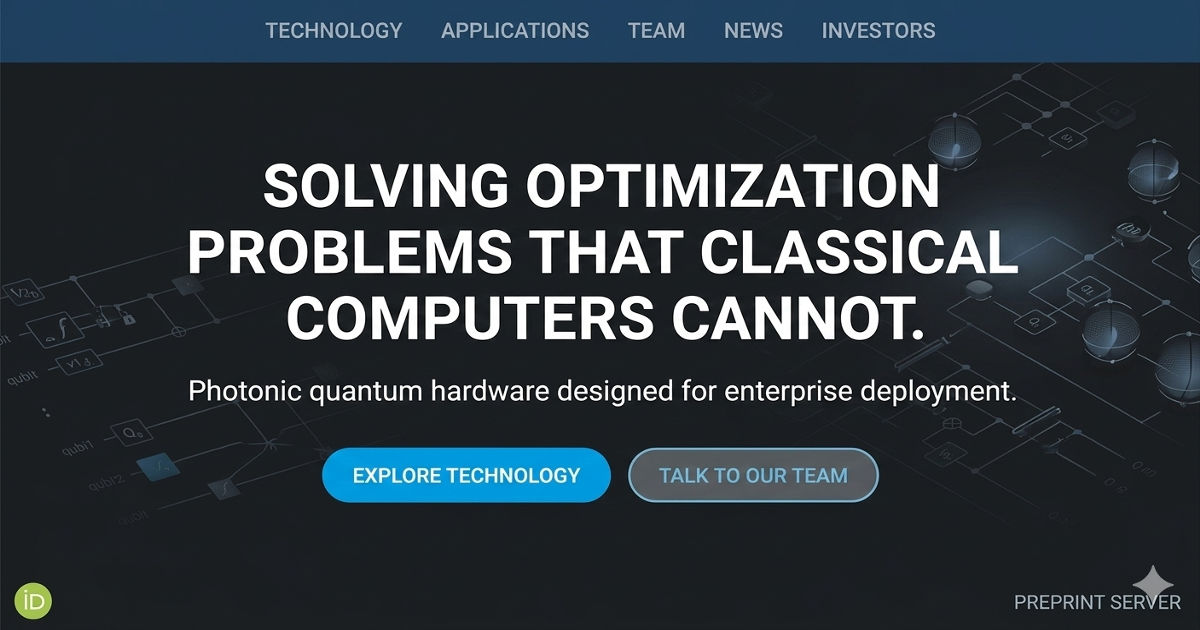
A quantum computing company homepage has approximately ten seconds to achieve three things: communicate the company's mission at a level accessible to a non-physicist, signal technical credibility, and create enough curiosity to keep the visitor engaged.
Hero section best practices:
- Mission-first headline: Lead with a problem and a promise, not a technology. "Making drug discovery a thousand times faster" lands harder than "Developing fault-tolerant quantum processors." The headline can be followed immediately by a one-sentence technical descriptor for the audience who wants it.
- Avoid "we are changing the world" generalities. Quantum computing has attracted significant capital and significant hype. Sophisticated audiences are immune to unsupported superlatives. Specificity, even modest specificity reads as more credible.
A single, unambiguous call to action. The primary CTA on a quantum computing homepage is almost always either "Schedule a Demo," "Explore Our Technology," or "Contact Us." Don't give visitors five options.
Technology Page: Balancing Depth and Accessibility
The technology page is where quantum computing companies most commonly make mistakes in both directions — either too shallow for technical audiences or too dense for everyone else.
The most effective approach is a three-layer structure:
Layer 1: Plain-language overview. Two to three paragraphs explaining the company's approach in terms of the problem it solves and the advantage the technology provides. No equations. No assumption of prior quantum mechanics knowledge.
Layer 2: Technical architecture summary. Describe your qubit modality, your current qubit count and coherence times, your error correction approach, and your path to fault tolerance. This audience has done their homework; give them the information they need to evaluate your technical claims.
Layer 3: Deep technical content. Link to published papers, preprints, technical white papers, and benchmark results. If your company has published in Nature, Physical Review Letters, or Science, these citations are your strongest possible credibility signals. Display them prominently.
Does your technology page currently reads as a single wall of technical text?
It may be worth testing a segmented layout, a plain-language tab and a technical-detail tab side by side so visitors can self-select the depth that suits them.
→ Book a free call to get your website reviewed!
Applications Page: Connecting Technology to Commercial Value
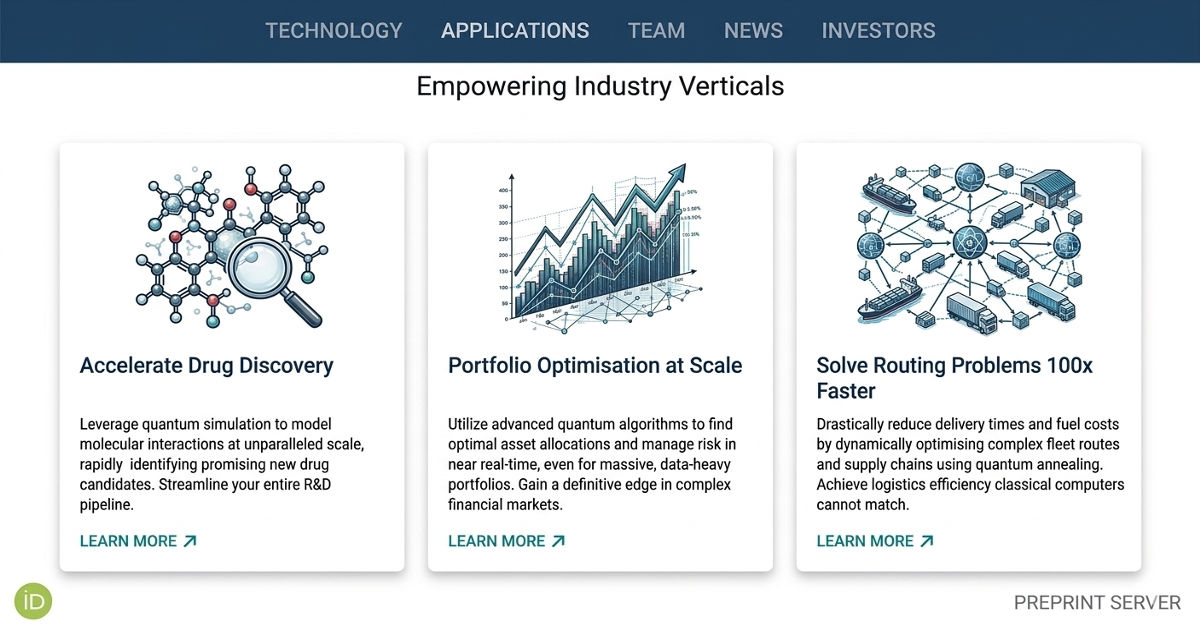
The applications page is often the most important page for enterprise sales conversations. It needs to answer the question that every potential customer is asking: "What can your technology do for me, specifically, in the near to medium term?"
Best practices for quantum computing applications pages:
- Segment by industry vertical. Pharmaceuticals and life sciences (molecular simulation, protein folding), finance (portfolio optimisation, risk modelling), logistics and supply chain (combinatorial optimisation), materials science (catalyst discovery). Each vertical has a distinct buyer persona with different technical sophistication and different purchasing processes.
- Be honest about timelines. The NISQ-era advantage for certain optimization problems is achievable now. Fault-tolerant quantum advantage for the full range of promised applications is years away. Overselling timelines damages trust with the sophisticated buyers and investors you most need to reach.
Include specific use cases with quantified outcomes where possible. "We ran [specific algorithm] on [specific problem class] and achieved a [X%] performance improvement over the best classical alternative at problem sizes above [Y]" is far more persuasive than "quantum advantage in financial optimisation."
Team Page: Deep-Tech Credibility Signals
In quantum computing, the team page carries more weight than in almost any other technology sector. Quantum hardware development requires rare expertise — there are fewer than a few thousand people in the world with the specific combination of physics training, engineering skill, and experimental experience needed to build competitive quantum systems. Investors know this. Enterprise buyers know this.
Team page best practices for quantum computing companies:
- Lead with PhDs and institutional affiliations. "PhD in Quantum Physics, MIT" or "Former quantum researcher, Google Quantum AI / IBM Quantum / IonQ" are significant trust signals. Display them prominently.
- Include research publication links. For technical team members with peer-reviewed publications, link to their Google Scholar profiles or a selection of key papers.
- Include advisors and board members. In early-stage quantum companies, the advisory board often includes some of the most recognisable names in quantum science. These affiliations should be displayed on the team page.
- Show the team as a team. A group photo or team culture section is more persuasive to prospective hires and to investors evaluating execution risk than a grid of isolated headshots.
Key Insight: A 2023 analysis of quantum technology investment patterns found that team composition and publication track record were the two most frequently cited factors in early-stage quantum investment decisions — ahead of market size, IP position, and go-to-market strategy. For quantum computing companies, the team page is not a formality; it is a core part of the fundraising pitch.
Investor Relations Page: What Quantum Investors Expect
Quantum computing companies raising capital need to decide how much investor-specific content to include on their public website. The minimum viable approach includes a brief company overview written for a non-technical investor, a contact route for investment inquiries, and links to any significant published milestones, grants, or awards.
More mature companies may include a dedicated investor page with links to press releases, a curated set of technical and market validation documents, and a timeline of company milestones. Avoid putting anything on the public investor page that is not appropriate for broad public disclosure detailed financial projections, pre-public fundraising terms, or non-public technical performance data should not be on the public site.
Is Your Quantum Computing Website Losing Investors Before They Reach Your Pitch Deck?
Most quantum computing company websites communicate either to physicists or to the general public — and lose everyone in between. The investors and enterprise buyers who will fund and deploy your technology are sophisticated, sceptical, and time-constrained. Your website has ten seconds to earn more of their attention.
-> Request a quantum computing website strategy review
Frequently Asked Questions
Should a quantum computing company explain quantum mechanics on their website?
Only at a surface level, and only if it directly serves the visitor's needs. Brief, accessible explanations of the relevant concepts — superposition, entanglement, qubit — can help non-specialist visitors orient themselves. But these explanations should be brief (a paragraph at most) and framed in terms of what the technology can do rather than how quantum mechanics works. The goal is accessibility, not education.
What is the most important page on a quantum computing company website?
For most quantum computing companies, the homepage and the technology page carry the most weight. The homepage must pass the ten-second test for every audience; the technology page must satisfy the credibility requirements of technically literate investors and enterprise buyers. However, for companies actively recruiting, the team page and careers page may have the highest traffic and conversion importance.
How should a quantum computing company handle the "overhype" problem?
With specificity and honesty. The quantum computing field has suffered from a credibility problem created by oversold timelines and vague capability claims. The most persuasive approach is to be specific about what your technology can do now, honest about what it cannot yet do, and clear about the technical milestones on your roadmap. Sophisticated investors and enterprise buyers will respect this more than expansive claims that can't be verified.
Should a pre-revenue quantum computing startup have a website?
Yes, from day one of public existence. Even before commercial deployment, a quantum computing startup's website serves critical functions: recruiting world-class talent (the most constrained resource in the field), establishing credibility with potential investors and grant bodies, and building awareness with the enterprise buyers who will eventually be their customers. A clean, minimal site with a clear mission, team page, and contact route is sufficient for a pre-revenue company.
How often should a quantum computing company update their website?
At minimum, the news or updates section should be updated whenever the company reaches a significant milestone: a new funding round, a published paper, a new partnership, a new team member at the leadership level, or a product or capability announcement. Active, current content signals to investors and enterprise buyers that the company is executing against its roadmap.
.gif)


