

Initial Summary
A legal consultant in Singapore operates in one of the most credibility-sensitive professional markets in Asia. Clients, whether a fintech founder navigating MAS licensing, a multinational structuring an acquisition, or a family managing an estate dispute arrive at your website already anxious. They have a legal problem, the stakes feel high, and they need to know within seconds whether you are the right person to trust with it. A legal consultant website has to communicate expertise, clarity, and approachability simultaneously and in Singapore's bilingual, multicultural professional environment, it has to do so for clients whose expectations of legal professionalism vary significantly. This guide covers how to build a site that earns that trust before the first phone call.
Why Legal Consultant Websites in Singapore Are Different
The legal market in Singapore sits at a unique intersection. It is simultaneously one of the most internationally sophisticated legal environments in Asia, home to major arbitration centres, cross-border M&A work, and complex regulatory matters and a market where a significant proportion of legal services are sought by individuals and SMEs navigating straightforward but stressful situations for the first time.
This dual market means a legal consultant website often needs to speak to two very different client profiles without confusing either. The corporate general counsel evaluating you as outside counsel has fundamentally different evaluation criteria from the entrepreneur trying to understand whether they need a lawyer for a shareholder dispute. Your site's structure, tone, and content depth should reflect whichever of these audiences represents your core practice and acknowledge the other where relevant.
Singapore's regulatory landscape also shapes what a legal website can and cannot say. The Legal Profession Act and the Legal Profession (Professional Conduct) Rules impose specific constraints on how legal practitioners can advertise, solicit business, and make claims about outcomes. Your website must operate within these boundaries which means no guaranteed results, no comparative claims against named competitors, and careful language around testimonials and case outcomes. Working within these constraints is not a limitation; it is an opportunity to differentiate through genuine substance rather than marketing hyperbole.
Key Insight: Most legal websites in Singapore communicate what the lawyer has done. The best ones communicate what the client can expect and that shift in orientation, from credential display to client-centred clarity, is where most of the conversion opportunity lies.
The Homepage: Clarity Before Credentials
Legal consultant homepages in Singapore have a tendency to lead with credentials, call to the Bar, years of practice, university attended before ever communicating what problem they solve. This is the wrong order for the majority of visitors, who arrive with a specific situation in mind and need to know immediately whether you handle matters like theirs.
Lead with practice area, not biography. "I advise Singapore-based technology companies on employment, equity, and commercial contracts from incorporation to Series A" tells a prospective client everything they need in one sentence. "Experienced commercial lawyer with over fifteen years at the Singapore Bar" tells them very little.
Make the first paragraph client-facing, not firm-facing. The most common mistake on legal homepage copy is writing about the firm rather than about the client's situation. "We are a boutique firm specialising in commercial disputes and international arbitration" is a statement about you. "If you are facing a commercial dispute with a counterparty in Singapore or across ASEAN, here is how we can help" is a statement about the client. The second version produces better engagement and better conversion.
A clear, low-friction primary CTA. "Book a consultation" or "Schedule a free 30-minute call" performs better than "Contact us" across legal websites consistently. It names what happens next. For clients in a stressful legal situation, that clarity is reassuring rather than presumptuous.
Practice area navigation, not firm structure navigation. Organise your navigation around what clients search for Employment Law, Corporate & Commercial, Dispute Resolution, Family & Estate not around your internal firm structure. Clients don't know or care whether your corporate team and your disputes team are separate practice groups.
Practice Areas: Writing for the Client Who Doesn't Know Legal Vocabulary
The practice area pages are where most legal websites lose their non-specialist visitors entirely. Dense descriptions of legal doctrine, references to specific statutes without explanation, and jargon-heavy paragraphs about "tortious liability" and "privity of contract" serve lawyers, not clients.
Lead each practice area page with the situation, not the doctrine. "If a key employee has left your company and taken confidential client data or trade secrets, you may have grounds for urgent injunctive relief and a damages claim. This is what that process typically looks like." This opening serves a client who has just experienced exactly this situation. It uses one piece of legal vocabulary (injunctive relief) but explains it immediately in context.
Explain what the engagement actually involves. How many meetings does a typical matter require? What documents will the client need to produce? What is the approximate timeline for this type of matter? What does the client need to do at each stage? These practical questions are what most clients want answered and most legal websites never address.
FAQs are conversion tools, not afterthoughts. A well-structured FAQ section at the bottom of each practice area page answering the questions clients actually ask before picking up the phone reduces the barrier to initial contact significantly. Clients who already know the answer to "how much does this typically cost?" and "how long does this take?" are more likely to book a consultation than clients who must ask these questions cold.
About Page: The Human Behind the Credential
Legal clients in Singapore are making a trust decision, not a procurement decision. They are not buying a commodity; they are choosing a person to navigate a situation that is stressful, consequential, and often unfamiliar. The About page is where that person becomes real.
Lead with the professional chapter most relevant to your target client. If you spent eight years at a Magic Circle firm handling cross-border M&A before going independent, that context is your most important credential for corporate clients. If you trained at the Attorney-General's Chambers before moving into private practice, that is what matters most to clients dealing with regulatory or enforcement matters. Lead with the credential that your target client will find most reassuring.
The reason you practice matters. Why did you choose this area of law? Why did you go independent rather than stay at a firm? These questions answered genuinely and specifically are among the most trust-building content on a legal website. Clients choose lawyers they feel they can talk to. A genuine answer to "why this works" is a more reliable signal of values alignment than any credential.
Call to the Bar, accreditations, and memberships. In Singapore, your call to the Bar, any specialist accreditations (SIAC arbitration, family law specialist accreditation), and professional body memberships (Law Society of Singapore, Singapore Academy of Law) belong clearly on the About page. These are the credentials clients and corporate referrers use to verify standing.
Languages spoken. Singapore's multilingual professional environment makes this genuinely important. A Chinese-speaking lawyer handling estate matters for a Mandarin-dominant family, or a lawyer fluent in Bahasa Indonesia for cross-border ASEAN transactions, has a meaningful differentiator worth stating clearly.
Case Outcomes and Testimonials: Navigating the Rules
Singapore's professional conduct rules impose specific constraints on how legal practitioners can present past work. You cannot guarantee outcomes, cannot use client testimonials in ways that solicit business in breach of the rules, and cannot make comparative claims against other practitioners. What you can do carefully and usefully is communicate the texture of your experience.
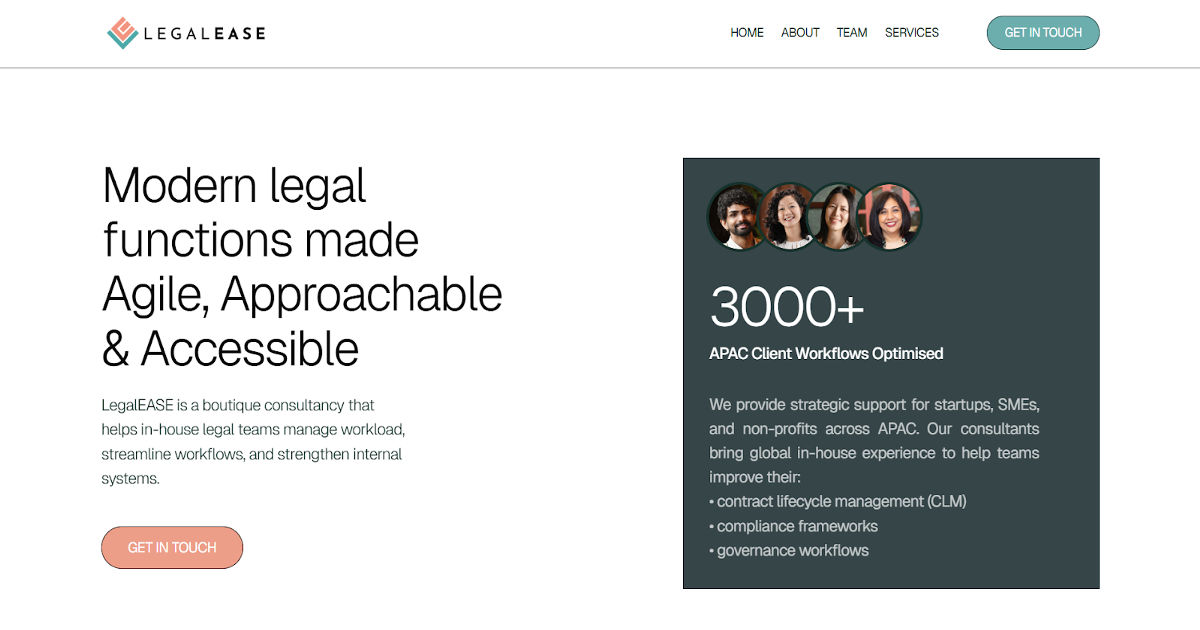
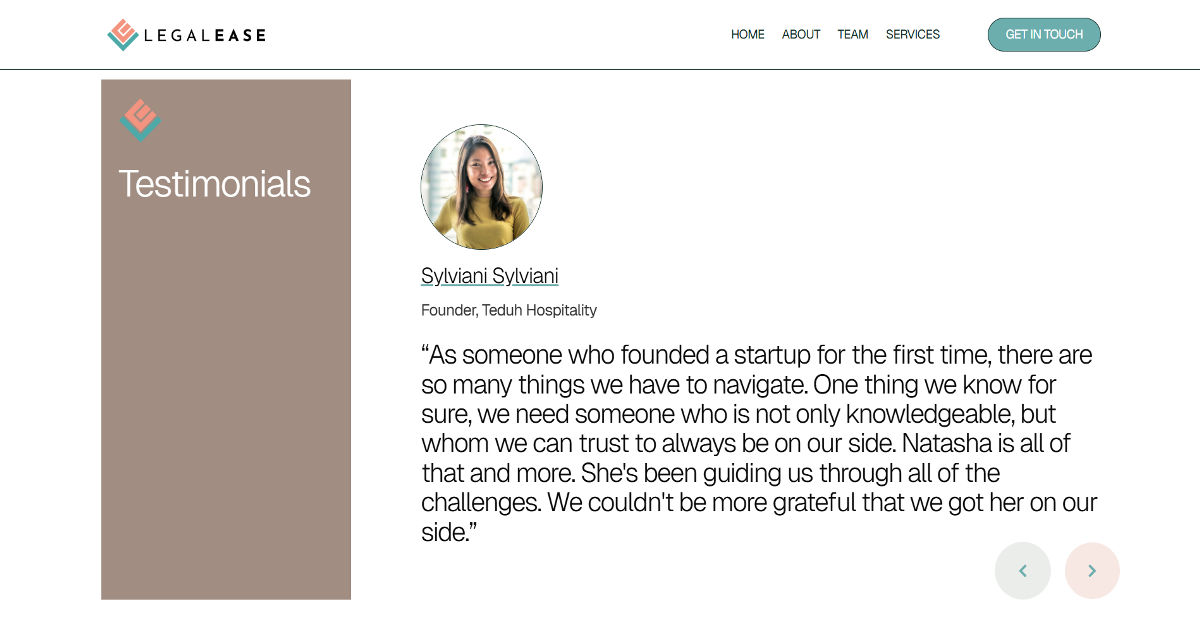
This is the single most important insertion point for LegalEase across the whole article. Their testimonials section is a masterclass in navigating the conduct rules correctly: all named clients (Duke-NUS, Nature Society Singapore, Sumitomo Pharmaceuticals APAC), specific outcomes described ("built her entire department from scratch," "coordinated strategic planning and branding projects," "implemented streamlined workflows, developed standardized legal templates"), and zero outcome guarantees or comparative claims anywhere. Use them as the primary live Singapore example for this entire section
Does your website read like expertise or marketing?
We’ll review it from a client-trust perspective and show where credibility signals are missing.
Matter descriptions without outcomes. Describing the type and complexity of matters you have handled "advised on the employment restructuring of a 300-person Singapore operation for a US-headquartered technology company". Communicates experience without implying guaranteed outcomes. This form of matter description is commonly used by law firm websites and individual practitioners alike.
Sector experience sections. Grouping your experience by sector rather than by outcome "financial services," "technology and media," "real estate and construction" tells corporate clients which industries you understand deeply without running into the outcome-guarantee prohibition.
Third-party recognition. Rankings in legal directories (Chambers Asia-Pacific, The Legal 500 Asia Pacific, Asialaw) are third-party validations that can appear on your website as factual statements. "Recommended in Chambers Asia-Pacific 2024 for Employment" is a credibility signal that operates within the conduct rules and carries significant weight with sophisticated clients and corporate referrers.
Key Insight: The conduct rules around legal advertising in Singapore are a floor, not a ceiling. Operating within them with genuine substance specific matter experience, sector depth, third-party recognition is significantly more effective than trying to work around them with vague or technically compliant puffery.
SEO for Legal Consultant Websites in Singapore
Most legal work in Singapore still arrives through referrals and directory listings but this is changing. An increasing proportion of individual clients and SME founders begin their search online, and a growing number of in-house counsel use web search to build shortlists before approaching referral networks. Organic search visibility for the right queries is a compounding asset that most Singapore legal consultants have underinvested in.
Practice area + Singapore keyword combinations convert well. "Employment lawyer Singapore," "shareholder dispute Singapore," "MAS licensing advice Singapore" these are searches made by people actively looking for legal help, not people browsing. A legal website that ranks even on page two for these queries generates qualified inbound that most referral networks don't fully cover.
Location-specific content compounds over time. A practice area page that includes a section specifically on Singapore's Employment Act, or on SIAC arbitration procedures, or on MAS licensing requirements for digital payment token services, ranks for the specific searches Singapore-based clients make and signals to those clients that you understand their specific regulatory environment.
Legal FAQ content drives organic traffic. "What happens if my employer doesn't pay me notice pay in Singapore?" or "How do I challenge a wrongful dismissal in Singapore?" are questions people actually search. A legal consultant who has written a clear, substantive answer to ten of these questions on their website will rank for all ten and each ranking is a permanent source of qualified visitor traffic.
The Design Patterns That Make Legal Websites Convert
Pattern 1: Trust Signals Visible in the First Scroll
Bar admission year, legal directory recognition, professional body memberships, and any notable firm affiliations should appear within the first scroll of the homepage. Legal clients are evaluating whether you are credentialed before they evaluate whether you are the right fit.
Pattern 2: Mobile-First for the Stressed Client
A significant proportion of legal enquiries are made on mobile often immediately after a triggering event (a letter before action received, a sudden dismissal, a contract dispute escalating). A website that is difficult to navigate on a phone, or that takes more than three seconds to load on mobile, loses these high-intent visitors at the moment of highest urgency.
Pattern 3: Contact Options That Reduce Friction
Alongside a contact form, a direct phone number and a direct email address should be visible on every page. Some clients in stressful legal situations want to speak to a person, not fill in a form. Providing multiple clear contact pathways i.e. phone, email, contact form, and a booking link for those who prefer to schedule asynchronously serves the full range of client preferences.
Pattern 4: Plain Language as a Differentiator
In a market where most legal websites are written in dense professional prose, a website that explains legal concepts in plain, accessible language without being condescending stands out dramatically. Plain language is not unprofessional, it is a demonstration of the communication skill clients are hiring for.
Pattern 5: Custom Domain With Your Name
yourname.com or yourpracticename.com.sg not a hosted profile on a legal directory platform is the baseline for a professional Singapore legal practice. A custom domain is yours regardless of where you practice, signals seriousness, and accumulates search authority over time.
Is Your Legal Website Working as Hard as You Are?
SitesGo builds websites for legal consultants, independent practitioners, and boutique law firms in Singapore designed to communicate expertise clearly, earn trust before the first call, and convert the right clients.
Frequently Asked Questions
What can and can't a Singapore lawyer include on their website under the conduct rules?
The Legal Profession (Professional Conduct) Rules 2015 permit legal practitioners to maintain a website describing their practice areas, experience, and qualifications. What is prohibited includes: guaranteeing outcomes, making comparative claims against named competitors, and using testimonials in ways that amount to touting. Factual statements about matter experience, third-party directory recognition, and professional qualifications are all permissible. When in doubt, the Law Society Practice Direction on marketing and publicity provides specific guidance.
Should a Singapore legal consultant list fees on their website?
For fixed-fee services (straightforward wills, standard employment contracts, simple incorporations), listing a fee or fee range significantly reduces the barrier to first contact and pre-qualifies clients by budget. For complex matters where fees depend on scope, a "fees vary by complexity contact me for an initial discussion" approach is standard and appropriate. Complete silence on fees is increasingly a disadvantage as clients have been trained by other professional services categories to expect at minimum a range.
How do legal directories like Chambers and Legal 500 affect my website strategy?
Legal directory recognition particularly in Chambers Asia-Pacific and The Legal 500 Asia Pacific carries significant weight with sophisticated corporate clients and in-house counsel who use directories as a primary evaluation tool. If you are ranked, this recognition should appear prominently on your homepage and About page. If you are not yet ranked, submitting for consideration and building the documented matter experience that supports a submission is a long-term investment in both directory visibility and website credibility content.
How often should a legal consultant update their website?
At minimum, annually to ensure practice area descriptions remain accurate as your work evolves, to add new directory recognitions, and to update any regulatory content that refers to legislation that has been amended. For consultants using their website for SEO, monthly content additions (new FAQ answers, new practice area blog posts, new regulatory commentary) compound significantly over time.
.gif)


