

Initial Summary
Citations are the academic currency of credibility. They determine h-indices, fuel promotion cases, attract collaborators, and signal to grant committees that a body of work is being built upon. Yet the majority of researchers publish papers and then leave citation growth entirely to chance no strategy, no promotion, no optimisation. This guide walks through the most effective, evidence-grounded approaches to increasing citation visibility, from technical fixes that take twenty minutes to sustain practices that compound over a career.
If you've ever noticed a colleague's paper with comparable quality to yours, accumulating far more citations, the gap is rarely about the science. It's almost always about visibility.
Why Citation Visibility Is Not Automatic
The average academic paper receives fewer than ten citations in its lifetime. A significant portion receive none at all. The volume of published research has grown so dramatically that discoverability is now a genuine competitive challenge, separate from quality.
Search engine optimization, strategic networking, open access, and a professional online presence are not peripheral concerns for researchers; they are the mechanisms by which good work actually reaches the people who would build on it.
Key Insight: A paper that doesn't get read doesn't get cited. Increasing citation visibility starts with increasing readership, not with writing differently.
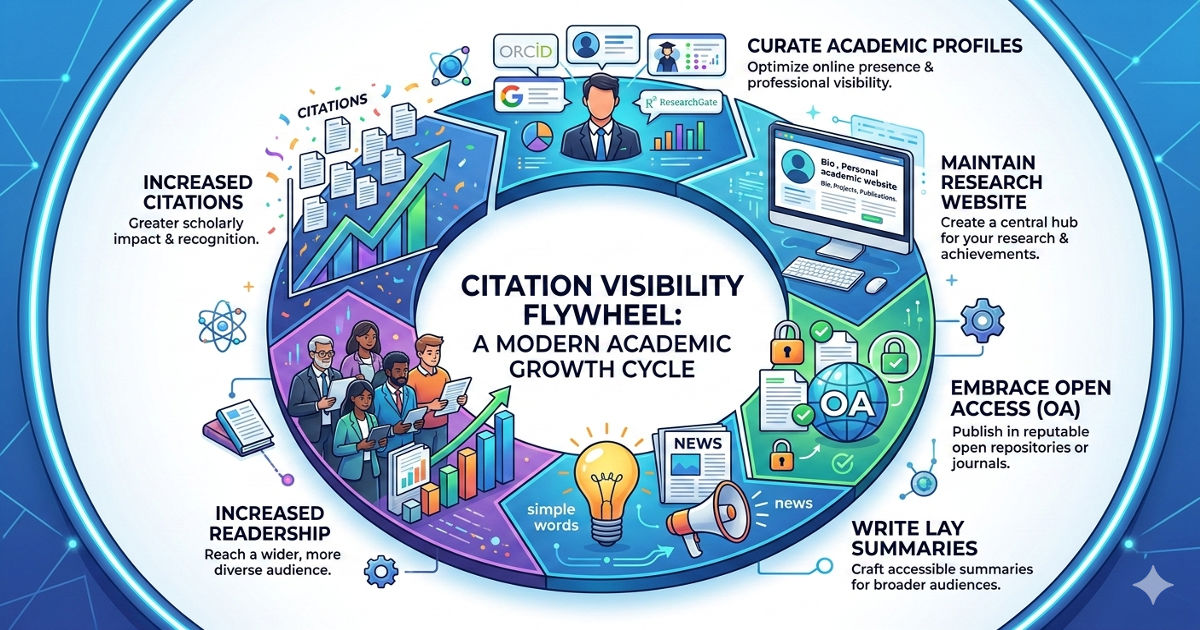
1. Claim and Complete Every Academic Profile
The single highest-leverage, lowest-effort action most researchers can take is making sure their academic profiles are complete, accurate, and linked to one another.
- Google Scholar: Claim your profile, set it to public, and verify that every paper is correctly attributed to you. A common and silent citation-killer is papers appearing under a slightly different author name that never get linked to your main profile.
- ORCID: Register for an ORCID ID if you haven't already. It's becoming a standard identifier across funding bodies, journals, and institutional systems, and it ensures your work is correctly attributed across databases.
- ResearchGate and Academia.edu: These platforms have meaningful organic search traffic. Uploading full-text PDFs (where your copyright agreement permits) significantly increases the chance that researchers without institutional journal access find your work.
- Semantic Scholar: An increasingly important AI-powered research discovery platform. Claiming your author page and verifying publications improves how your work surfaces in recommendations.
The mistake most researchers make is claiming one profile and neglecting the others. Cross-linking them with your Google Scholar profile linking to your ORCID, your lab website linking to both creates a citation infrastructure that works passively.
Pattern to implement: Block ninety minutes this month to audit every academic profile you appear on. Update photos, affiliations, and linked publications. Then set a quarterly calendar reminder to keep them current.
2. Build and Maintain a Research Lab or Personal Academic Website
Your academic website is the only online space you fully control, and it compounds over time in ways that no third-party platform does.
A research lab website that consistently publishes your papers with full abstracts, accessible plain-language summaries, and downloadable PDFs creates a permanent, search-indexed home for your work that ranks in Google for your research keywords. When journalists, science communicators, policymakers, and researchers outside your direct field look up your topic, a well-maintained lab website puts your work in front of them.
- SEO for papers: Dedicate a page or blog post to each major publication. Use the paper's title, key concepts, and findings as headings. Google indexes these pages and they can rank for searches your target audience is already making.

- Preprint accessibility: Link to your preprints on arXiv, bioRxiv, SSRN, or other relevant repositories. Preprints are cited more often than many researchers expect, and they are permanently accessible even when journal paywalls move.
- Downloadable supplementary materials: Papers that come with accessible code, datasets, and supplementary files get more downstream engagement and engagement precedes citation.
Labs like MathEXLab at NUS link directly to their GitHub, making every paper's associated code immediately findable. This is not just an open science gesture; it is a citation strategy.
Key Insight: Your lab website does citation recruitment work 24/7 whether you've designed it for that purpose or not. An optimised publication page with a PDF download, a plain-language summary, and links to related work is far more effective than a bare citation entry.
3. Publish Open Access Wherever Possible
The open access citation advantage is one of the most consistently replicated findings in bibliometrics. Papers published open access whether through gold OA journals, green OA repositories, or preprint servers receive significantly more citations on average than paywalled equivalents, across disciplines.
- Green open access: Even when your journal agreement doesn't allow full gold OA, most publishers permit you to self-archive the accepted manuscript (the version after peer review, before journal typesetting) in an institutional repository or on your own website. Check your agreement on SHERPA/RoMEO.
- Preprint first: Posting to arXiv, bioRxiv, SSRN, or SSRN before or alongside journal submission extends your paper's discovery window. Citations can accumulate on preprints months or years before the final version appears.
- Institutional repository: Most universities maintain a repository where faculty can deposit their work. This creates a permanently indexed, accessible version of your research independent of journal subscription status.
Pattern to implement: For every paper accepted, immediately post the accepted manuscript to your institutional repository and link to it from your lab website. This takes less than thirty minutes and extends your paper's discoverability permanently.
4. Write and Distribute Lay Summaries
A paper buried in jargon reaches only the researchers who already understand the field well enough to search for it. A plain-language summary of the same paper reaches everyone else including researchers in adjacent fields who might cite your methods, science journalists who might amplify your work, and policymakers who might cite it in reports.
- Blog posts on your lab website: A 300–500 word lay summary of each major paper, published on your research website, creates search-indexed content that ranks for non-specialist search queries and drives traffic to your actual paper.
- LinkedIn articles: Academic LinkedIn is increasingly active. A short post summarising a new paper with a link to the open access version regularly generates thousands of views for researchers with even modest networks.
- Twitter/X threads: Despite platform turbulence, research threads on Twitter/X remain one of the fastest ways to get a paper in front of a large, relevant academic audience. A clear five-tweet thread outlining the question, method, key finding, and implication consistently outperforms simply sharing a link.
- The Conversation: For researchers whose work has clear public relevance, The Conversation publishes expert-written, plain-language articles with full author attribution and journal links. Articles routinely reach tens of thousands of readers.
Pattern to implement: Treat every major paper's publication as a two-stage launch: first, the paper itself; second, a lay summary that goes out simultaneously across your website, LinkedIn, and Twitter. The second stage takes two hours and can multiply your readership tenfold.
5. Engage in Academic Twitter and LinkedIn Communities
Researchers who participate actively in online academic communities consistently find that their work reaches people and geographies it wouldn't otherwise. This is not self-promotion, it is how contemporary research networks function.
- Engage before you share: Comment on and amplify others' work genuinely and regularly. When you publish, the community you've built through authentic engagement shares back.
- Conference live-tweeting: Posting summaries and reflections from conferences puts your name and research interests in front of the followers of every conference hashtag.
- Collaborative threads: Posting "what's the best recent paper on X?" threads builds relationships with researchers in adjacent areas, exactly the researchers most likely to discover and cite your work.
6. Present at Conferences Strategically
Conference presentations remain one of the most effective generators of future citations, because they create personal connections with the researchers most likely to read and cite your work.
- Prioritise field-defining conferences over comprehensive coverage: A single well-delivered talk at the leading conference in your field is worth more than five presentations at peripheral events.
- Archive your slides publicly: Posting conference slides to SlideShare, Zenodo, or your lab website means your talk continues generating interest and paper visits long after the conference ends.
- Follow-up with new connections: Emailing one or two key people you met at a conference with a "great to meet you, here's the preprint we discussed" message converts a handshake into a potential citation.
7. Collaborate Broadly and Strategically
Papers with multiple authors from multiple institutions are cited more on average than single-author papers, partly because each co-author brings their own network to the paper's readership.
- Interdisciplinary collaborations: A methods paper co-authored with a researcher in an adjacent field reaches two distinct citation ecosystems at once.
- International collaborations: Co-authorship with researchers at institutions in different countries consistently produces higher citation rates, likely because it broadens the paper's reach across different academic communities and funding systems.
- Credit data contributors and reviewers appropriately: Being generous in acknowledgements builds goodwill and keeps your work visible to people who might not otherwise encounter your papers.
8. Optimise Paper Titles and Abstracts for Search
Academic search engines Google Scholar, PubMed, Semantic Scholar, Web of Science rank papers partly on keyword matching. A paper with a clever but opaque title that doesn't include its key concepts will consistently rank below a paper whose title and abstract contain the exact terms researchers search for.
- Include your primary concept in the title: If your paper is about carbon sequestration in tropical forests, those words should appear in the title.
- Write your abstract for a reader who found you via search: Assume they don't know your lab and aren't familiar with your specific approach. The abstract should state the question, method, key finding, and implication in that order.
Use keywords strategically: Most journals ask for keywords; choose terms that match how researchers in your field actually search, not how the field formally describes itself.
Pattern to implement: Before submitting, search your paper's key terms in Google Scholar. Look at what titles dominate the results. Your title should be comparable in specificity and keyword density to the papers that rank highly for the searches your ideal readers are already making.
Want to know why some papers of yours get found and others don’t?
We can trace how your work currently appears across search engines, Scholar, and AI answers.
→ Analyze my research visibility
9. Monitor and Respond to Citations
Knowing who is citing your work and why creates opportunities to deepen those research relationships, correct misattributions, and identify the adjacent communities most engaged with your findings.
- Google Scholar alerts: Set up a Google Scholar alert for your name and for each paper's title. You'll receive notifications when new citations appear.
- Reach out to citers: When a researcher cites your work, a brief, genuine email thanking them and asking about their research is well-received more often than academics expect. These exchanges regularly lead to collaborations, invitations to review, and future citations.
- Correct database errors promptly: Missing or incorrectly attributed citations in Google Scholar, Scopus, or Web of Science should be corrected as soon as you notice them. Left unfixed, they can suppress your h-index for years.
The Patterns That Compound Over a Career
Pattern 1: Build Infrastructure First
Profiles, a lab website, and an ORCID ID are the infrastructure layer. Everything else lay summaries, Twitter threads, conference presentations works better when visitors land somewhere they can trust and explore.
Pattern 2: Treat Every Paper as a Launch
Each publication deserves a deliberate release strategy: preprint posted, lay summary written, slides archived, and a social media thread published within the week of acceptance. Researchers who do this consistently see citation curves that differ markedly from those who don't.
Pattern 3: Visibility Compounds
A researcher with strong profiles, a well-maintained lab website, and an active social presence doesn't just get more citations on recent papers, they get citations on older work discovered by people who found them through newer papers. Every visibility investment made today increases the return on every paper you have ever published.
Ready to Build the Website That Powers Your Citation Strategy?
SitesGo builds research lab websites designed to showcase your publications, attract collaborators, and work as a citation-generating asset not just an institutional listing.
Frequently Asked Questions
Does social media activity actually increase citations?
Yes, with caveats. Studies consistently find positive associations between Twitter activity around a paper's publication and subsequent citations, though causality is difficult to establish cleanly. The mechanism is straightforward: social media increases readership, and readership precedes citation. The effect is stronger for papers that have genuine public relevance and for researchers with engaged academic followings.
Is it worth posting to preprint servers if I'm publishing in a prestigious journal?
Almost always yes. Preprints extend your discovery window by months or years, are citable and frequently cited, and are permanently accessible regardless of paywall changes. Most leading journals in most disciplines now accept papers previously posted as preprints. Check your target journal's policy, but the default assumption should be to preprint.
How important is the h-index, and should I optimise for it specifically?
The h-index remains widely used by promotion committees and funding bodies despite its well-documented limitations. Rather than optimising for it directly, focusing on citation visibility for your highest-quality, most distinctive work naturally increases your h-index over time. Gaming it through self-citation or citation rings is detectable and professionally damaging.
Do author names matter for citation rates?
Yes, and this is an underappreciated issue for researchers with names that are difficult to search or for women who change names after marriage. An ORCID ID permanently links all your work regardless of name variations. If you've published under multiple name forms, explicitly cross-link them in your Google Scholar profile.
.gif)


