

Initial Summary
AI writing tools have created genuine anxiety among academics who maintain websites: will using AI for their website content trigger a Google penalty? Will it undermine the credibility they have spent years building? The short answer is that Google penalises low-quality, mass-produced, manipulative content regardless of whether it was written by a human or a machine. High-quality, accurate, genuinely useful content written with AI assistance is not penalised. This article explains exactly where AI adds real value to academic website SEO, where it creates risk, and how to use it in ways that compound your authority rather than undermine it.
What Google Actually Penalises (And What It Doesn't)
The academic anxiety about AI content often conflates two separate things: Google's spam policies and the quality of the content itself. Google's Helpful Content Update, rolled out in 2022 and refined since, penalises content that exists primarily to rank in search results rather than to genuinely help the searcher. The key question Google's algorithms ask is not "was this written by AI?" — it is "does this content demonstrate expertise, experience, authoritativeness, and trustworthiness (E-E-A-T)?"
For an academic professional, the E-E-A-T bar is actually easier to clear than it is for a generic content marketer. A professor writing about their research area has genuine expertise, real experience, and institutional authority that AI-generated content about the same topic would struggle to replicate. When AI tools are used to assist in organising, drafting, or editing content written by someone with genuine expertise, the result tends to score well on E-E-A-T dimensions because the expertise is real, even if the drafting was assisted.
The penalty risk is not AI assistance per se. It is thin, inaccurate, low-effort content, the kind that is most easily produced by AI without substantive human input and most easily detected by readers who find it unhelpful.
Key Insight: Google's Search Quality Rater Guidelines explicitly state that content quality is evaluated on the basis of expertise, experience, authoritativeness, and trustworthiness, not on the method of creation. A peer-reviewed professor using AI assistance to write a well-structured, accurate, and genuinely useful summary of their research area is producing content that scores highly on all four dimensions. An AI-generated page about a topic the site owner has no expertise in scores poorly on all four, regardless of how polished the prose is.
Where AI Genuinely Helps Academic SEO
1. Keyword Research and Search Intent Mapping
One of the most time-consuming parts of academic SEO is understanding how non-specialist audiences prospective students, journalists, policymakers, industry partners search for topics in your research area. The language experts use in published papers is rarely the language that people use in search queries.
AI tools (including Claude, ChatGPT, and specialised SEO tools with AI features like Semrush's AI Toolkit) are genuinely effective at translating technical research topics into the search language that prospective audiences use. A researcher studying "anthropogenic nitrogen deposition in boreal ecosystems" can use AI to quickly map the range of search terms that policymakers, environmental journalists, and conservation organisations use when looking for exactly this kind of expertise.
This translation is one of the most valuable SEO activities an academic can undertake, and AI dramatically reduces the time it requires.
2. Structuring Research Descriptions for Web Readability
Academic writing and web writing are genuinely different disciplines. Academic writing is dense, citation-heavy, and optimised for peer review. Web writing needs to be scannable, front-loaded with the key message, and structured with headings that allow visitors to navigate quickly.
AI tools are excellent at restructuring existing academic content a paper abstract, a grant summary, a research description — into a web-optimised format without changing the substantive content. This is a genuinely low-risk use of AI: the academic provides the expertise and the facts; the AI provides the restructuring and the web-appropriate prose rhythm.
3. Generating and Refining Meta Descriptions and Title Tags
Meta descriptions and title tags are short pieces of text (150–160 characters and 50–60 characters respectively) that appear in search engine results pages. They are among the most important SEO elements on any web page, and most academic websites have either no meta descriptions or ones that are unhelpfully technical.
AI is excellent at generating multiple candidate meta descriptions and title tags for a page, given a description of the page's content and target audience. The academic can review and select the best option applying their judgement about what will resonate with the right audience — rather than writing from scratch.
4. Internal Linking Suggestions
Internal linking connecting related pages on your website to each other is one of the most effective on-page SEO practices and one of the most frequently neglected on academic websites. A well-linked academic website allows search engines to understand the relationship between your research areas, publication pages, and blog posts, improving the overall indexing of your site.
AI tools can review the content of multiple pages on your website and suggest logical internal linking opportunities identifying where a research area page should link to a relevant publication, where a blog post should link to your lab's publications page, and where your homepage should link to your most important research description pages.
5. FAQ Content Generation for Research Pages
FAQ sections on web pages structured as question-and-answer pairs are among the formats most likely to be featured in Google's rich snippets and People Also Ask boxes, which significantly increases search visibility beyond organic ranking positions. They also improve accessibility for non-specialist audiences who want to understand research at a surface level before engaging more deeply.
AI is effective at generating draft FAQ content for academic research pages taking a research description and generating the questions that a non-specialist might plausibly ask. The academic then reviews, corrects, and supplements these drafts with accurate answers. The result is genuinely useful FAQ content produced in a fraction of the time it would take to write from scratch.
Review AI-assisted pages to ensure they meet quality standards
Read each page and ask yourself whether every factual claim is something you can personally verify and whether the content reflects the perspective of a genuine expert rather than a generic summary. If either answer feels uncertain, the page should be revised before it goes live.
→ We’ll help you refine AI-assisted content into expert-level copy!
Where AI Creates Risk for Academic SEO
1. Factual Inaccuracy in Research Descriptions
AI language models hallucinate — they produce plausible-sounding but factually incorrect statements, including false citations, incorrect statistics, and inaccurate descriptions of research findings. For an academic whose professional reputation rests on accuracy, an AI-generated paragraph that misrepresents your own research is not just an SEO problem — it is a credibility problem.
The risk is highest when AI tools are used to generate substantive descriptions of specific research findings, methodology, or conclusions. This is where human review is not optional — it is mandatory. AI can assist with structure and phrasing; the factual substance must come from and be verified by the researcher.
2. Generic Content That Fails the E-E-A-T Test
AI tools trained on publicly available text are very good at producing content that sounds like it was written by an expert. In a field where genuine expertise is easy to verify academic research, this mimicry is particularly dangerous. A page about "how CRISPR gene editing works" written entirely by AI, without substantive input from a researcher who actually works in the field, will typically lack the specific insights, nuanced caveats, and current-state-of-the-field awareness that a genuine expert brings.
This content will not necessarily trigger a spam penalty. But it will rank lower than content from actual domain experts, and it will be apparent to sophisticated readers including journalists, collaborators, and grant reviewers that it lacks the depth of someone who really knows the material.
3. Over-Reliance on AI for Unique Positioning Content
The content that does the most work for an academic website's SEO and conversion research descriptions, lab culture pages, testimonials and case studies, personal bios is the content that most requires a genuine human voice. AI tools produce competent generic prose; they produce poor imitations of a distinctive intellectual voice.
Using AI to draft these pages and then accepting the output with minimal revision is the most common mistake academics make with AI content tools. The result is a website that sounds professional but sounds like no one in particular which is precisely the impression you do not want to make on a prospective PhD student, collaborator, or journalist deciding whether to engage with your work.
Key Insight: A 2024 analysis by Search Engine Land of over 1,200 websites that had received Google Helpful Content Update manual actions found that the common factor was not AI authorship it was low demonstrated expertise relative to the topic claims being made, thin content with minimal original insight, and content that was clearly produced at scale without topic-specific human input. Academic websites with genuine expert content, used correctly with AI assistance, consistently escaped these penalties.
A Practical AI-Assisted Academic SEO Workflow
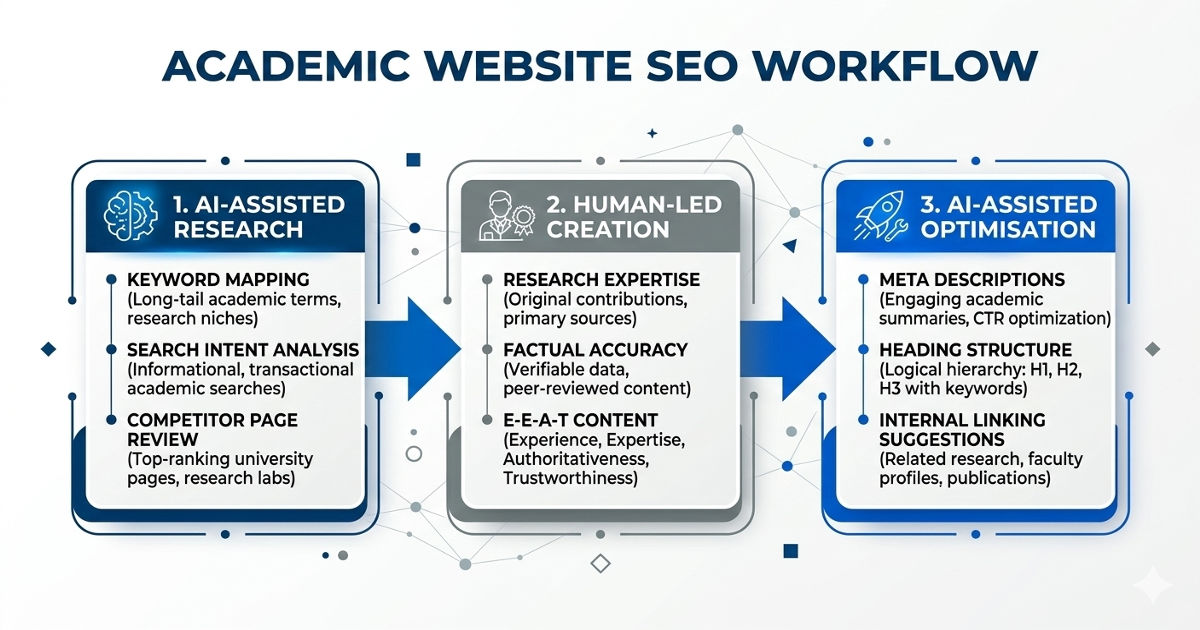
The most effective use of AI for academic website SEO is as an assistant that handles the time-consuming, lower-skill parts of the process while the academic provides the expertise and exercises the judgement.
Research and planning (AI can lead):
- Keyword research and search intent mapping for your research areas
- Analysis of how peer academic websites structure their content
- Generating candidate title tags, meta descriptions, and heading structures
Content creation (human leads, AI assists):
- The academic writes or dictates the substantive content
- AI restructures it for web readability, suggests headers, and refines phrasing
- Human review verifies every factual claim and revises for voice authenticity
On-page optimisation (AI can lead):
- Internal linking suggestions across the site
- FAQ generation (human reviews and corrects for accuracy)
- Image alt text generation for accessibility and SEO
- Schema markup suggestions for academic content types
Ongoing maintenance (AI can lead):
- Identifying pages with thin or outdated content that need updating
- Suggesting content topics based on search query data and competitor gaps

Is Your Academic Website Capturing the Search Visibility It Deserves?
Most academic websites are either entirely absent from search results for the queries their ideal visitors use, or they rank for the researcher's name but nothing else. A systematic AI-assisted SEO audit of your academic website will identify the specific gaps between your content and the search behaviour of the audiences you most want to reach.
→ Request an AI-assisted academic SEO audit for your website
Frequently Asked Questions
Will Google penalise my academic website for using AI-assisted content?
Google does not penalise websites for using AI assistance in content creation. It penalises low-quality, thin, or manipulative content — content that exists primarily to rank in search results rather than to genuinely help the reader. An academic who uses AI to help structure, rephrase, or optimize content that is based on their genuine expertise is not producing the kind of content Google's spam policies target. The key safeguard is substantive human review to ensure accuracy, authenticity, and genuine expertise.
What is the best AI tool for academic website SEO?
Different AI tools are suited to different parts of the SEO workflow. For keyword research and search intent mapping, tools with integrated SEO data (Semrush with its AI features, Ahrefs) are most useful. For content drafting and restructuring, general-purpose AI writing assistants (Claude, ChatGPT, Gemini) are effective when given specific instructions and high-quality source material from the academic. For technical SEO tasks (schema markup, meta description generation), the same general-purpose tools work well with specific prompts.
How do I check whether my AI-assisted academic content is good enough quality for Google?
Use Google's Search Quality Rater Guidelines' E-E-A-T framework as your checklist: Does this content demonstrate real expertise (facts, nuance, specificity that only a genuine expert would know)? Does it reflect real experience (personal insights, lab-specific details, honest caveats)? Is the author identifiable as an authoritative source (clear institutional affiliation, visible publication record)? Is the information accurate and trustworthy? If you can honestly answer yes to all four, the content meets Google's quality standard regardless of how it was drafted.
Can AI help with technical SEO on academic websites, not just content?
Yes. AI is particularly useful for generating schema markup for academic content types including Person schema (for professor profiles), Organization schema (for labs and departments), Article schema (for research blog posts), and FAQPage schema. It is also useful for generating image alt text at scale, which is particularly valuable for academic websites with large numbers of research images, figures, and team photos. These technical elements improve both accessibility and search visibility without the factual accuracy risks of AI-generated substantive content.
Should I disclose AI assistance on my academic website?
There is no current SEO requirement to disclose AI assistance in content creation. Whether to disclose is an academic ethics and professional norms question rather than an SEO question. In a context where your professional reputation for accuracy and intellectual integrity matters which it does for every academic being transparent about using AI assistance for structural and organisational tasks (rather than substantive content generation) is generally advisable. The standard to apply is whether a colleague or student who knew the full process would consider it appropriate.
.gif)


