

Initial Summary
The best consultant website ever built if you study the model that Tom Peters, David Maister, and the generation of independent practitioners who left McKinsey and Bain to build independent practices spent decades refining is not a brochure. It is a demonstration. It proves, through its structure, its content, and the precision of its positioning, that the person behind it thinks more clearly, writes more sharply, and understands the client's problem more deeply than anyone else competing for the same engagement. The firms these consultants left McKinsey, Bain, BCG had already taught them the fundamental architecture: lead with insight, let the intellectual quality of your thinking speak before you ask for a meeting, and make the case for your perspective so compellingly that the client feels slightly foolish for not having thought of it themselves. A great consultant website applies this same logic to digital presence. This guide is structured accordingly.
The MBB Principle Applied to Personal Websites
McKinsey's website doesn't open with a list of services. It opens with insight a podcast episode on AI leadership, a research piece on the future of global supply chains, a framework for thinking about CEO succession. The implicit message is: we have already been thinking about your problem more rigorously than you have, and here is the evidence. Bain does the same. BCG does the same.
This is not accidental. It reflects a fundamental truth about how senior consultants build trust: not by describing what they do, but by demonstrating how they think. And it is the pattern that the most effective independent consultant websites replicate and that most consultant websites get entirely wrong by leading with a services list instead.
The framework that follows is structured in the same sequence a well-architected McKinsey deck would use: establish the problem, demonstrate the insight, present the evidence, make the recommendation, and close with a clear next step.
Key Insight: The single most common mistake on consultant websites is leading with a services list. Services are what you do. Insight is why a sophisticated client should trust you to do it. Lead with your thinking, not your menu.
Section 1: The Positioning Statement – Your "So What" in One Sentence
McKinsey partners who leave to found independent practices face an immediate problem: they can no longer lead with the firm name. The institutional brand that opened doors is no longer theirs. What they discover, often slowly and painfully, is that the firm name was doing positioning work they had never learned to do themselves.
Your positioning statement is the answer to the question every first-time visitor to your website is silently asking: "What is the single most important thing this person does, and why should I trust them to do it for me?"
Most consultant websites answer this question with a job description: "I am a strategy consultant specialising in organisational transformation." This is the consulting equivalent of a McKinsey deck that opens with an agenda slide technically informative and completely inert.
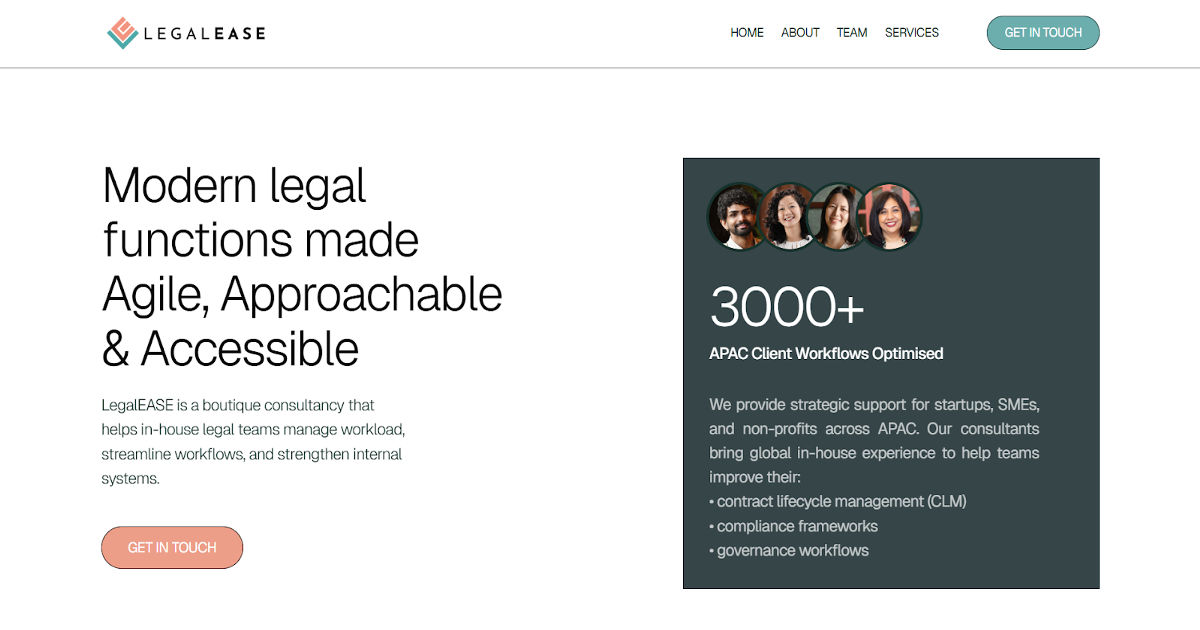
This is the strongest fit. The section argues that most consultant websites answer "what do you do?" with a job description rather than a client-facing problem statement. LegalEase is a perfect live Singapore counterexample their positioning statement does all three things the section says it needs to: it names who they serve (startups, SMEs, and nonprofits priced out of traditional law firms), the specific problem they solve (legal support that's unaffordable at Big Law and too complex to handle alone), and what makes their angle distinctive (senior legal counsel delivered without the cost, complexity, or formality). That's a positioning statement, not a job description.
The most effective positioning statements have three components: who you serve, what specific problem you solve, and what makes your perspective on it distinctive. David Maister ex-Harvard Business School faculty, whose personal site davidmaister.com became the model for how independent consultants could build global authority through writing framed his positioning not around "professional services consulting" but around a single, specific claim: that the trusted advisor relationship is the foundation of all professional service value. That claim was his positioning, his methodology, and his content strategy simultaneously.
Yours should do the same work in one sentence. Not "strategy consulting for technology companies" but "I help Series B technology companies redesign their go-to-market structure before they scale it into a more expensive version of the problem they started with."
Section 2: The About Page – Professional Biography as an Intellectual Argument
The about pages of the most effective consultant websites are not biographies. They are arguments for a point of view. They answer not just "who are you?" but "why does your background give you the right to hold the opinion you hold about this problem?"
Tom Peters, whose personal site tompeters.com remains one of the most studied examples of an independent consultant's web presence, doesn't structure his about page as a CV. He structures it as a narrative about how his thinking developed the McKinsey years, the research that became In Search of Excellence, the specific moment when he concluded that what organisations call "soft" (people, culture, behaviour) is actually the hardest and most important thing and why that intellectual journey makes his perspective on excellence worth paying attention to.
This narrative structure's origin, development, and current conviction is far more persuasive than a chronological list of firms and clients, because it makes visible the reasoning behind the perspective rather than just asserting it.
Your about page should answer four questions in sequence:
What did you do before consulting that gives you standing to consult on this problem? Why did you leave that world and choose to advise rather than operate? What is the central conviction you have developed through that journey that clients consistently find valuable? And what does that mean for the kind of engagement you take on and the way you approach it?
This four-part structure origin, transition, conviction, application transforms a professional biography into an intellectual argument, and intellectual arguments are what senior consulting clients are evaluating when they decide whether to trust someone with a high-stakes problem.
Section 3: The Insight Section – Your Competitive Moat
The McKinsey Quarterly has been published since 1964. Bain's website publishes dozens of research pieces monthly. BCG's Henderson Institute produces economic research. None of these firms are doing this because they enjoy content marketing. They are doing it because the accumulated body of intellectual output is the most durable competitive advantage a consulting firm can build and because clients who have been reading your thinking for two years before they have a problem that matches your capability will call you first when that problem arrives.
For an independent consultant, this logic applies with even greater force. You don't have an institutional brand to substitute for intellectual authority. Your published thinking is your brand.
The insight section has three requirements:
It must be genuinely original, not recycled industry trends, not rephrased research from other firms, but conclusions you have reached through your own client work, your own observation, your own contrarian reading of what everyone else in your field is treating as settled. David Maister's most shared piece, "Strategy and the Fat Smoker," did not recycle conventional management wisdom. It made a specific, uncomfortable argument that most strategy failures are not failures of analysis but failures of will that professionals immediately recognised as true from their own experience.
It must be specific enough to be right or wrong. The most useless consultant content says things that are technically true but practically meaningless "companies need to be more customer-centric" or "leaders must communicate more clearly." The most valuable consultant content makes specific, falsifiable claims that a reader can agree or disagree with based on their own experience.
It must be published on a regular, maintainable cadence. A "Insights" section with four posts from 2022 is worse than no insights section at all. It signals that the consultant started something they couldn't sustain, which raises questions about whether client engagements suffer the same fate.
Not sure if your site is ready yet?
If any of these problems sound familiar, we can quickly tell you what’s holding your site back and what to fix first.
→ Get a quick website assessment
Section 4: The Services or Engagement Model – Translating Expertise into Something Purchasable
Bain's website describes its services not as a list of methodologies but as a set of transformations it helps clients achieve. Not "strategy consulting" but "results: our clients outperform the market 4.8x." Not "M&A advisory" but "we have completed over 10,000 due diligence engagements." The framing is always outcome-first, evidence-supported, and specific.
For an independent consultant, the services section faces a different challenge: making a small practice feel as credible as a large one without misrepresenting its scale. The resolution is the same as Bain's: lead with outcome and evidence, not with organisational structure.
Three principles for an effective engagement model section:
Name what you do in terms of what the client gets, not in terms of how you spend your time. "Six-month market entry strategy engagement: from problem framing to board-ready recommendation" is a purchasable outcome. "Strategy consulting retainer" is a time commitment.
Be explicit about who you work best with and who you don't. The most expensive words on a consultant's website are "we work with all types of organisations." They are expensive because they attract the wrong clients, waste discovery call time, and dilute the positioning that earns premium pricing. The best consultant sites describe the client profile precisely, company stage, decision-maker type, problem maturity and implicitly filter out the mismatches before the first conversation.
State your engagement model honestly. Do you take on three clients concurrently or ten? Do you work primarily on-site or remotely? Do you work with project fees or retainers? Clients evaluating a consultant are partly evaluating whether the engagement structure fits their internal reality. Ambiguity about structure is read as evasiveness about capacity.
Section 5: Evidence – Case Studies Built Like Consulting Deliverables
A McKinsey case study is structured as a situation, a complication, a resolution, and a result. Every element is present, every claim is supported, and the conclusion follows logically from the evidence. Most consultant websites present case studies as testimonial quotes with company logos which is the equivalent of presenting a client with an executive summary and telling them the supporting analysis is "available on request."
The case study structure that works:
Open with the client's situation in terms the reader will recognise: their industry, their stage, the specific problem they had when they arrived. This is the "situation" frame specific enough for a reader with a similar situation to see themselves, general enough to respect confidentiality.
Describe the complication: why wasn't the standard solution working? What was the specific obstacle that required a consultant's involvement rather than internal resolution? This is where your expertise demonstrates the diagnosis of why the conventional approach was failing.
Describe your specific intervention in what you actually did, not at the level of "provided strategic advice" but at the level of "restructured the pricing architecture across three product lines and redesigned the sales incentive structure to align with the new margin targets." Specificity here is what separates a case study from a testimonial.
State the result in business terms: revenue, cost reduction, time saved, decision made, risk avoided. Not "client was very satisfied" but "the pricing restructuring contributed to a 23% improvement in gross margin within two quarters."
Key Insight: Your case studies are the only part of your website where a prospective client can evaluate whether you are as good as you say you are. Testimonial quotes prove that clients liked you. Case studies with specific outcomes prove that clients benefited from you. Only the second earns premium pricing.
This is the second best fit. The section argues that most consultants present testimonial quotes when they should be presenting structured case evidence, situation, complication, intervention, result. LegalEase's testimonials section does something closer to the right model than almost any Singapore legal or consulting site: Duke-NUS, Nature Society Singapore, and Sumitomo Pharmaceuticals APAC all give named, specific, outcome-described endorsements ("built her entire department from scratch," "implemented streamlined workflows and standardised legal templates") rather than generic praise.
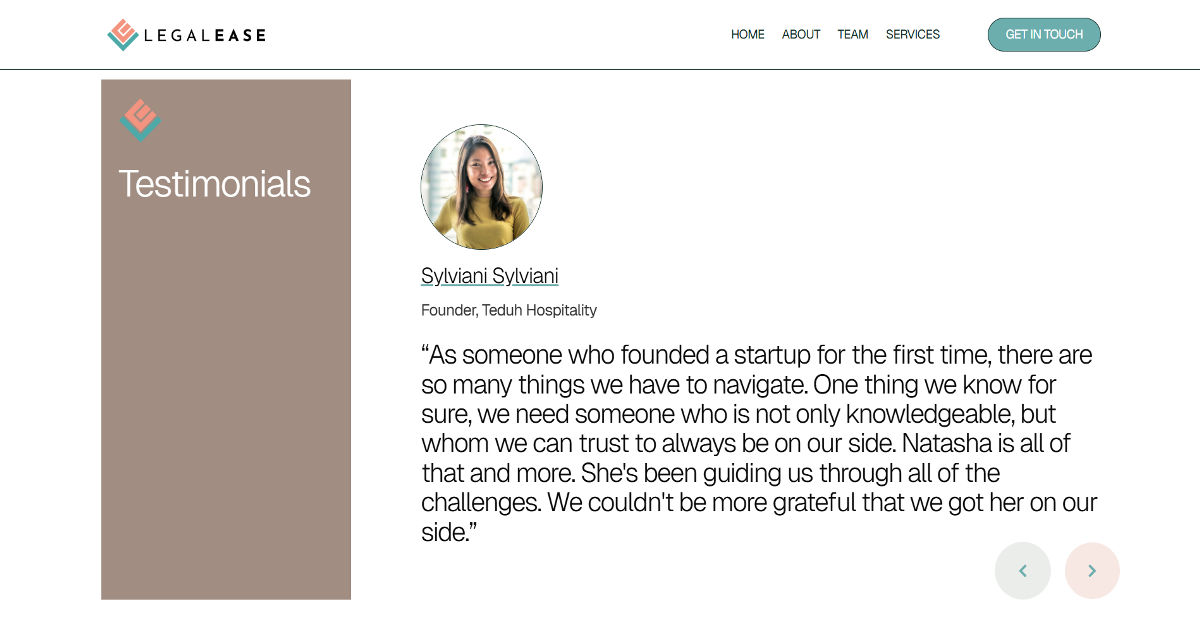
They're not full McKinsey-style case studies, but they're significantly closer than the testimonial quote with a logo that the section is criticising. Use them as a "halfway house" example acknowledging that LegalEase's approach is better than most, while noting that a full situation/complication/result structure would take it further.
Section 6: Contact and Conversion – The Trusted Advisor's Close
David Maister's most influential framework the Trust Equation, which he developed with Charles Green and Robert Galford in The Trusted Advisor identifies four components of trustworthiness: credibility, reliability, intimacy, and the inverse of self-orientation. The last component is the most powerful and the most commonly undermined by consultant websites: the degree to which the consultant appears to be focused on the client's outcome rather than their own.
A contact section that says "Ready to get started? Book your consultation now" is focused on the consultant's conversion goal. A contact section that says "Not sure if this is the right fit? Here are three questions to help you figure that out before we talk" is focused on the client's decision quality. The second is more aligned with how a trusted advisor thinks and it produces better leads, because clients who have self-qualified are more committed to the engagement.
What an effective consultant contact section includes:
A primary CTA that names what happens next in specific terms. Not "contact me" but "book a 45-minute strategy conversation. I'll come prepared with my preliminary diagnosis of the problem based on what you tell me in the pre-call form."
A secondary resource for visitors who aren't ready to book. A PDF of your methodology, a short self-assessment tool, or a curated set of three articles that address the most common version of the problem you solve. This captures lead information from buyers who are researching and not yet ready to commit.
A clear statement of what you don't take on. The consultants who command the highest fees are often distinguished not by what they offer but by what they decline. A brief, honest statement of the engagements that fall outside your practice by company size, by problem type, by sector signals confidence in your positioning and respect for the prospective client's time.
The Six Page Structure That Works
Based on the MBB model applied to independent consulting, the optimal site structure is:
Homepage Positioning statement, credibility signals (past employers, named clients, publications), primary insight preview, and two CTAs (book a conversation, read the latest thinking). Nothing more.
About The four-part narrative: origin, transition, conviction, application. Professional photograph. Contact and credential details.
Insights or Writing Original published thinking, organised by theme. Minimum one substantive piece per month. A newsletter sign-up for those who want more.
Work or Engagements Two to four case studies, built with the situation/complication/intervention/result structure. Anonymised where necessary, specific where permitted.
Services or How I Work Engagement model described in outcome terms. Client profile stated precisely. Pricing philosophy not necessarily specific fees, but the framing (project-based, retainer, minimum engagement size).
Let Your Website Be Your First Impression
This is six pages. McKinsey's website has hundreds. The difference is that McKinsey is building a global brand for ten thousand consultants. You are building a pipeline for one.
-> Build my consultant website
Frequently Asked Questions
Should an independent consultant's website use "I" or "we"?
Use "I" if you work alone, even if you occasionally bring in associates. Sophisticated clients can tell the difference between a solo practice and a firm, and finding out after signing a contract that "we" meant "I sometimes work with two contractors" destroys trust before the engagement begins. "I" combined with specific named associate relationships ("I bring in specialists in X and Y for engagements that require it") is more honest and, for many senior buyers, more reassuring than a vague "we."
How do you handle pricing on a consultant website?
The MBB model on public pricing, "contact us for a proposal" works for firms with institutional brands doing the qualification work. For an independent consultant without institutional brand, some form of pricing signal helps filter for clients who are a genuine budget fit. Minimum engagement sizes ("typical engagements run between X and Y") or fee structure descriptions ("I work on project fees, not time-and-materials") qualify buyers without the full transparency that might feel inappropriate for premium pricing.
How long should a consultant's homepage be?
Short enough that a time-pressed executive can read it in ninety seconds and know whether to go deeper. McKinsey's homepage is scroll-friendly but the key positioning is visible in the first viewport. The homepage's job is not to close the sale, it is to make the right visitor confident enough to read the case studies and the insights. Everything beyond that should be on secondary pages.
How do you keep a consultant website current without spending all your time on it?
The insight section is the only page that requires regular updating. All other pages about services, case studies should be evergreen for at least twelve months. A monthly insight piece (one substantive post, even 600 words) and a quarterly case study update is sufficient. The mistake is building a "News" section that requires daily or weekly updating, then abandoning it when client work takes over.
What's the biggest difference between a good consultant website and an excellent one?
A good consultant website communicates what you do clearly. An excellent one makes a prospective client think, "I wish I'd read this six months ago, before we made the decision we're now trying to fix." The excellent site demonstrates insight that is independently valuable that the client gains something from reading it even if they never hire you. That quality of demonstration is what earns the trust that converts at the highest fees.
.gif)


