

Initial Summary
Publishing a paper is only half the battle. The research that gets cited is not always the best research — it is often the most visible research. For academics at every career stage, a deliberate citation visibility strategy can meaningfully increase how often their work appears in literature searches, how quickly new publications attract citations, and how their long-term h-index develops. This guide breaks down the key components of a citation visibility strategy, the platforms that matter most, and the ethical, evidence-backed practices that make a measurable difference.
Why Citation Visibility Is a Strategic Problem, Not Just an Outcome
Most researchers treat citations as a lagging indicator — something that accumulates passively after publication. A growing body of research in bibliometrics, however, suggests that visibility choices made before and immediately after publication have a substantial impact on eventual citation counts.
A 2019 meta-analysis published in PLOS ONE found that open-access papers receive, on average, 18% more citations than paywalled equivalents — even after controlling for journal quality and field. A separate study in the Journal of Informetrics found that papers with complete, well-formatted metadata on Google Scholar accumulated citations significantly faster than comparable papers with incomplete profiles.
The practical implication is clear: if you are not actively managing your research's visibility, you are leaving citations on the table.
The Core Components of a Citation Visibility Strategy
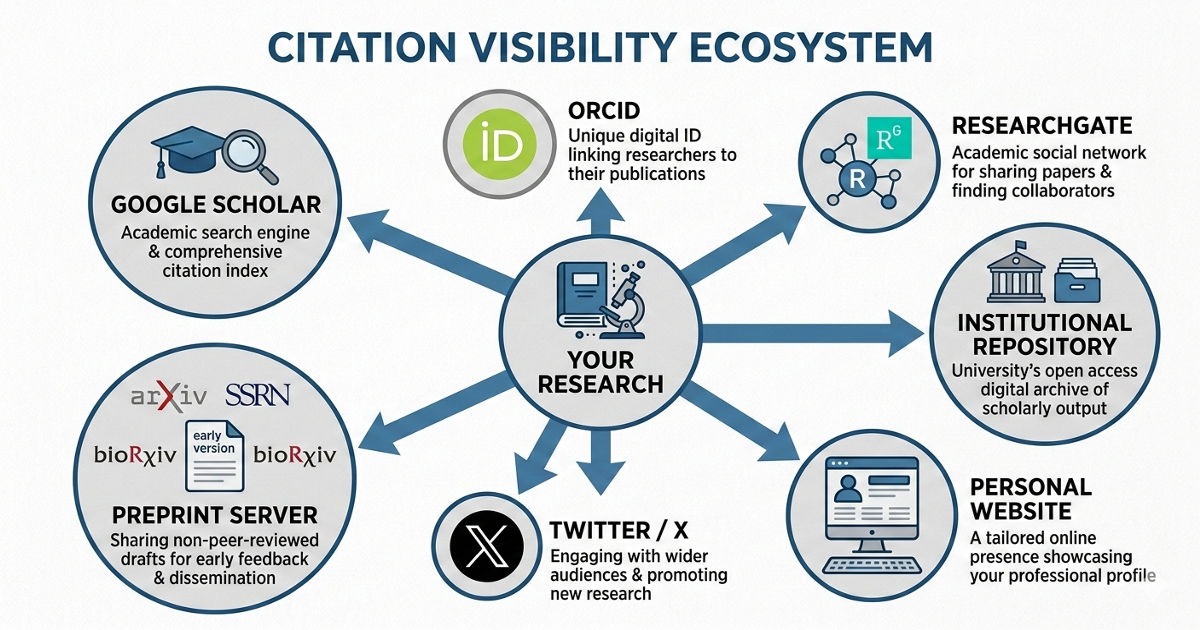
A complete citation visibility strategy operates across five distinct areas: profile optimisation, platform presence, content discoverability, network amplification, and tracking. Each area compounds the others — a well-optimised Google Scholar profile does more when paired with an active ResearchGate presence and a personal website with properly indexed publication pages.
1. Google Scholar Profile Optimisation
Google Scholar is the dominant academic search engine, used by the vast majority of researchers as their first search tool. A complete, accurate, and well-maintained Scholar profile is the single highest-impact action most academics can take to improve citation visibility.
Critical optimisation steps:
- Verify your profile is public. A private Scholar profile is invisible to external search. This sounds obvious but a surprisingly large number of researchers have private profiles.
- Claim all your papers. Google Scholar's auto-attribution algorithm sometimes misses papers or attributes them to wrong authors. Log in, review your profile, and manually add missing publications.
- Use a consistent author name. If you publish under slight name variations (initials vs. full name, hyphenated vs. unhyphenated surname), this fragments your citation record across multiple Scholar profiles. Standardise as early in your career as possible.
- Add your institutional affiliation and a current photo. Profiles with photos and institutional affiliations receive more profile views, which correlates with higher click-through rates to individual papers.
- Link your Scholar profile from your institutional page, personal website, and all academic social profiles. Each incoming link increases the profile's search visibility.
Key Insight: Open-access papers consistently receive more citations than paywalled equivalents, with some bibliometric analyses showing citation advantages of 15–20% or more. Posting a preprint or accepted manuscript to an institutional repository or preprint server (arXiv, SSRN, bioRxiv) before or alongside formal publication is one of the simplest and highest-impact visibility actions an academic can take.
2. ResearchGate and ORCID
ResearchGate has over 25 million registered researchers and generates substantial organic search traffic for academic paper titles. An optimised ResearchGate profile includes a complete publication list, full-text uploads where copyright permits, and regular engagement with the platform community.
ORCID (Open Researcher and Contributor ID) serves a different function — it is the persistent digital identifier that ensures your research output is correctly attributed to you regardless of name variations or institutional changes. ORCID integration is now required or strongly encouraged by most major funders including the NIH, Wellcome Trust, and European Research Council. An up-to-date ORCID profile also feeds data to CrossRef, DataCite, and other infrastructure that shapes how your work appears in discovery systems.
3. Preprints and Open Access Deposits
Beyond the citation advantage of open-access publication, preprint culture has restructured how cutting-edge research spreads. In fields like physics, economics, and increasingly biology and computer science, preprints on arXiv, SSRN, bioRxiv, or medRxiv are often read, cited, and built upon before the formal peer-reviewed version is even accepted.
Posting a preprint immediately upon submission or depositing an accepted manuscript in your institutional repository upon acceptance dramatically expands the window during which your paper can be discovered and cited.
4. Your Personal Research Website as a Discovery Layer
A personal research website or a lab website with a well-structured publications page serves a discoverability function that complements academic databases. When a researcher Googles a paper title or an author name, results from personal websites frequently appear alongside or above Google Scholar entries.
Key elements of a publications page that improves citation visibility:
- HTML-linked paper titles (not just a static PDF list) so Google can index and display individual papers in search results.
- Short lay summaries (2–3 sentences) for each paper, improving discoverability for searches using non-technical language.
- Direct PDF download links for papers where you hold the rights, reducing friction for readers who want the full text immediately.
- BibTeX or citation export links for each paper, making it trivially easy for researchers to cite your work in their reference managers.
Check whether your publications page is properly indexed by Google
Search the exact title of one of your papers followed by your name. If your personal website does not appear on the first page of results, it likely means your publications page structure or SEO setup needs improvement.
→ We’ll help you optimize your research pages for better Google visibility!
5. Strategic Dissemination on Academic Social Media
Twitter/X and LinkedIn play different roles in academic citation visibility. Twitter/X, despite reduced traffic since 2022, remains a significant dissemination channel for researchers in STEM, social science, and policy-adjacent fields. A well-structured tweet thread summarising a new paper — posted within 24–48 hours of publication consistently drives meaningful traffic to paper landing pages.
LinkedIn is more valuable for interdisciplinary or applied researchers whose work is relevant to industry practitioners. A post announcing a new paper, written in accessible language with a clear statement of what the finding means for practitioners, regularly reaches audiences that would never encounter the work through academic channels.
Wondering why some papers get cited more than others?
Citation impact is often influenced by visibility factors; indexed profiles, accessible full texts, and early dissemination, not just the quality of the research itself.
→ See how we can help you make a website which does that!
Building a Citation Visibility Calendar
One of the most practical outputs of a citation visibility strategy is a simple dissemination calendar — a routine that you execute for every new paper you publish. A basic version looks like this:
On preprint submission / paper acceptance:
- Upload preprint to relevant server (arXiv, SSRN, bioRxiv, etc.)
- Add accepted manuscript to institutional repository
- Update Google Scholar profile
- Update ORCID record
- Add to personal website publications page
On formal publication:
- Post Twitter/X thread summarising the paper in 4–6 tweets
- Post LinkedIn update (accessible language, practitioner framing if applicable)
- Update ResearchGate profile with full text where permitted
- Email 5–10 researchers in adjacent fields with a brief, personalised note about the paper
Quarterly:
- Review Google Scholar for unclaimed papers or attribution errors
- Check ORCID record completeness
- Review ResearchGate profile for any gaps
- Update personal website publications page
This routine takes less than two hours per paper and more than compensates in citation returns over a three-to-five year horizon.

Key Insight: A study published in Scientometrics (2020) found that papers tweeted or shared on academic social media within one week of publication received significantly higher early citation counts than comparable papers that were not. The early citation advantage tends to compound over time because highly cited papers appear at the top of database search results, creating a self-reinforcing visibility loop.
The Ethical Boundaries of Citation Visibility
Citation manipulation — self-citation rings, coercive citation by journal editors, and artificial inflation of h-indices — is a real and documented problem in academic publishing. It is also entirely unnecessary. The evidence-based, ethical practices described in this article consistently produce meaningful citation increases without any of the professional and reputational risk that manipulative practices carry.
Specific practices to avoid:
- Excessive self-citation (citing your own older work without genuine relevance to the new paper)
- Citing colleagues' work in exchange for reciprocal citations
- Posting fake or misleading abstracts to generate clicks
- Adding papers you did not meaningfully contribute to your Scholar profile
The aim is not to maximise citation counts through any means available — it is to ensure that your genuine research contributions are as visible as possible to the researchers who would find them valuable.
Is Your Research Getting the Citations It Deserves?
Most academics have at least two or three high-quality papers that are systematically under-cited — not because the work is weak, but because discovery barriers have prevented them from reaching the researchers who would build on them. A structured citation visibility strategy removes those barriers.
→ Start your citation visibility strategy with a free profile audit
Frequently Asked Questions
Does posting a preprint reduce the chances of a paper being accepted by a journal?
For the vast majority of journals, no. Most major publishers — including Elsevier, Springer Nature, Wiley, and virtually all society publishers — explicitly permit preprint posting before or concurrent with journal submission. The notable exception is a small number of medical journals with strict prior publication policies. Always check a specific journal's policy, but for most researchers in most fields, preprints are actively encouraged.
How long does it take for citation visibility improvements to show up in metrics like the h-index?
The h-index is a lagging indicator — it reflects accumulated citations over your career, and it only increases when a paper crosses the threshold of being cited at least h times. Visibility improvements show up first in paper-level metrics: views, downloads, and early citations in the six to eighteen months after publication. These early citations compound over time, so the h-index impact of a good visibility strategy tends to become significant over a three-to-five year window rather than immediately.
Is ResearchGate worth maintaining if I already have a Google Scholar profile?
Yes, for most researchers. ResearchGate generates substantial organic search traffic from Google — paper title searches frequently surface ResearchGate pages in the first few results. It also functions as a professional network where researchers request full texts, ask questions, and identify collaborators. The maintenance overhead is low once initial profile setup is complete. The two platforms are complementary, not substitutes.
What is the most common citation visibility mistake academics make?
The most common mistake is inconsistent author name use across publications. Publishing as "J. Smith," "John Smith," "John A. Smith," and "J.A. Smith" across different papers fragments your citation record across multiple Scholar profiles and makes accurate h-index calculation impossible. Standardise your author name as early in your career as possible and maintain it consistently across all publications, conference proceedings, and academic profiles.
Should I use Mendeley or Zotero to improve my citation visibility?
Mendeley's public profile function does add some discoverability — Mendeley indexes papers and creates public reference pages. However, the citation visibility impact of Mendeley is smaller than Google Scholar, ORCID, or ResearchGate. Both Mendeley and Zotero are primarily reference management tools for readers, not visibility tools for authors. They are worth maintaining but should not be prioritised over the higher-impact platforms described in this article.
.gif)


