

Initial Summary
For academics, the traditional visibility question has always had a clear answer: publish papers. Peer-reviewed publications in respected journals build the citation record, the h-index, and the disciplinary reputation that define an academic career. But a growing body of evidence and a growing number of highly visible researchers suggests that academic blogging is not a supplement to publishing papers. For certain visibility goals, it outperforms them. This article examines what the evidence actually says about the relative visibility impact of blogging versus academic publishing, and explains how to think about the right combination for your career stage and goals.
The Two Visibility Systems Academics Navigate
Academic publishing and academic blogging operate according to entirely different visibility logic, and conflating them leads to confused strategy.
The academic publishing visibility system is slow, citation-driven, and controlled by disciplinary gatekeepers. A paper published in a top-ten journal in your field will, over a five to fifteen year horizon, accumulate citations from researchers who encounter it through systematic literature search, course reading lists, and secondary citation (citing papers that cite you). Your visibility in this system is measured by your h-index, your journal impact factor portfolio, and your citation count. It is the primary system for peer recognition and career advancement within the academy.
The academic blogging visibility system is fast, search-driven, and largely unmediated. A well-written blog post on a topic that non-specialists search for can generate significant traffic and engagement within days of publication, reaching audiences that peer-reviewed publishing will never touch: policymakers, practitioners, journalists, prospective students, grant reviewers outside your discipline, and the general public. Visibility in this system is measured by web traffic, social shares, media enquiries generated, and the downstream reputation effects of being known beyond your immediate disciplinary community.
These systems are not competing for the same audiences. The question is not "which one is better" but "which one produces the outcomes you need, and in what combination?"
Key Insight: A study published in the Journal of Medical Internet Research (Eysenbach, 2011) found that articles tweeted and discussed online in the first days after publication received significantly more citations in subsequent months than comparable articles without social media attention. This early amplification effect where online visibility drives academic citation suggests that blogging and social dissemination do not merely reach different audiences from academic publishing. They can actively increase performance within the academic publishing visibility system itself.
What Academic Blogging Does Better Than Paper Publishing
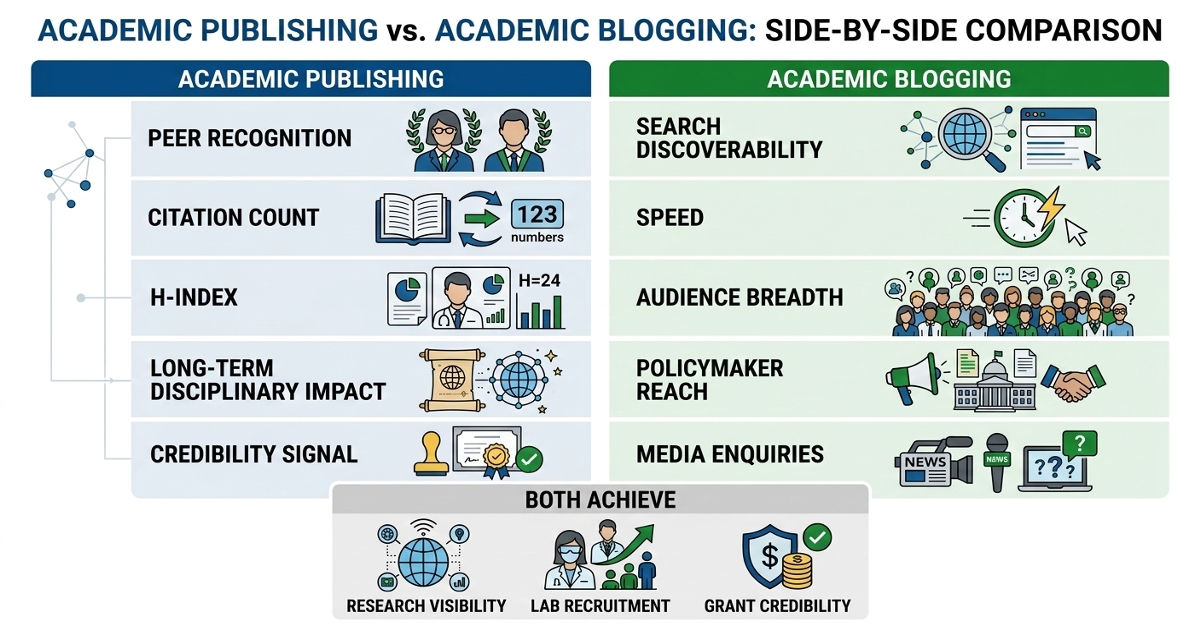
Speed of visibility. A peer-reviewed paper from submission to publication typically takes six months to two years. A blog post takes hours to write and minutes to publish. For timely topics, policy debates, emerging findings, responses to recent events blogging is the only tool that operates at the speed the moment requires. Researchers who blog about their area of expertise during relevant news cycles routinely receive media attention, policy engagement, and public visibility that papers published years later never generate.
Audience breadth. Peer-reviewed papers are written for peers. They assume prior knowledge, use discipline-specific terminology, and are optimised for argument rigour rather than accessibility. A well-written academic blog post can communicate the same underlying insight to a policymaker, a journalist, a practitioner, or a curious member of the public. For researchers whose work has real-world implications in health, education, climate, technology, economics this audience breadth is not a vanity metric. It is the difference between research that influences practice and research that does not.
Search discoverability. Google does not index paywalled journal articles. It does index well-optimised blog posts. A researcher who blogs regularly about their area of expertise will, over time, appear in search results for the exact queries that policymakers, practitioners, and journalists use when they are looking for expert input. This is a fundamentally different discoverability path from academic publishing, and for many researchers, it generates more external engagement than their entire publication record combined.
Recruitment and collaboration. Prospective PhD students and postdocs search for potential supervisors not only through literature review but through direct Google search. A professor who blogs about their research in accessible language describing open questions, ongoing projects, and the intellectual culture of their lab is vastly more discoverable to the right prospective students than one who relies solely on journal publications.
What Paper Publishing Does Better Than Blogging
Peer recognition and career advancement. Within the academic recognition system, peer-reviewed publications remain the primary currency. Tenure decisions, promotion cases, grant applications, and disciplinary reputation are still overwhelmingly driven by publication record. A researcher who blogs brilliantly but publishes rarely is at a significant disadvantage in these processes, regardless of their public visibility.
Citation-based impact within the discipline. Blog posts are not cited in academic literature (with very rare exceptions). A finding that appears only in a blog post however influential does not accumulate the citations that build a researcher's disciplinary reputation or contribute to systematic reviews. For quantitative impact within academia, publication is non-negotiable.
Permanence and archival credibility. Academic journals provide a permanent, citable record of research findings. Blog posts are ephemeral; they can be edited, deleted, or lost if a website goes down. For definitive statements of research findings, peer-reviewed publication provides a stability that blogging cannot.
Rigour and credibility signals. Peer review, however imperfect, signals that a finding has been subjected to scrutiny by domain experts. For research that will inform policy or practice, the credibility signal of peer review matters. A blog post however well-written does not carry the same epistemic weight in high-stakes decisions.
The Evidence on Blogging and Citation Counts
The relationship between online attention and academic citation is an active area of study in bibliometrics and science communication, and the evidence is more supportive of blogging's citation benefits than many academics expect.
Several studies have found that papers that receive significant online attention through academic social media, blog coverage, or media pickup accumulate citations faster in the years following publication than comparable papers without online attention. The proposed mechanism is plausible: online visibility increases the probability that researchers in adjacent fields, who might never have encountered the paper through disciplinary literature search alone, discover and cite it.
This is not a guarantee. High-quality papers can receive significant online attention and still underperform in citations if the topic is narrow or the methodology is contested. And low-quality papers can receive no online attention and still accumulate respectable citation records within tight disciplinary communities over long time horizons. But the evidence is strong enough to suggest that blogging and online dissemination are not citation-neutral activities; they are, in many cases, citation-positive.
Improve your paper’s discoverability with a simple blog summary
Search Google for your paper’s main topic and see whether your paper or website appears within the first two pages of results. If it does not, writing a short blog post that explains the paper’s key findings in accessible language with a link to the published version can significantly improve its visibility.
→ We’ll help you turn your research into discoverable content!
A Framework for Combining Blogging and Publishing
The most effective academic visibility strategies treat blogging and publishing as complementary tools deployed at different stages of the research lifecycle, not as alternatives.
Before publication: Blog about the research question you are investigating, not the findings. A post describing why a problem matters, why existing approaches are inadequate, and what you are trying to do differently builds an audience for the eventual paper while the research is in progress.
At submission: Post a preprint to an appropriate preprint server (arXiv, SSRN, bioRxiv) and write a brief, accessible blog post linking to it. This initiates online visibility before the formal publication timeline begins.
At publication: Write a lay summary blog post, 500 to 800 words describing what the paper found, why it matters, and what readers should take away. Link directly to the published paper. Share on LinkedIn, Twitter/X, and any relevant academic social media. This is the single highest-impact dissemination action available at publication.
Ongoing: Write analytical posts about developments in your research area, responses to policy debates where your research is relevant, and descriptions of ongoing work. Each post builds search visibility and audience familiarity that compounds over time.

Key Insight: A 2023 analysis of academic blog readership by the London School of Economics Impact Blog one of the most widely read academic blogging platforms found that the average LSE blog post received more readers in its first week than the average social science journal article received in its first year of publication. For researchers whose work has policy relevance, blogging is not a lower-status substitute for publishing it is a higher-reach channel for a different and equally important goal.
Is Your Research Visible to the Audiences That Matter Most?
Papers build disciplinary reputation. Blogs build public authority, policy relevance, and research discoverability. Most researchers optimize entirely for one at the cost of the other. The researchers with the most durable, multi-dimensional careers tend to do both and to understand clearly what each one is for.
→ Download a research visibility checklist covering both academic publishing and blogging
Frequently Asked Questions
Does blogging take time away from research and publishing?
It takes time, but for most researchers the trade-off is favourable. A blog post summarising a recently published paper typically takes two to four hours to write. That investment increases the paper's visibility, discoverability, and probability of citation for years. The time cost of not blogging is harder to see but equally real: papers that never reach beyond the disciplinary community, research that never influences practice, and an online presence that doesn't support the recruitment, grant, and collaboration goals of an active lab.
Will my institution or department penalise me for blogging instead of publishing?
Almost certainly not, as long as you maintain an active publication record alongside your blogging. The concern is when blogging substitutes for publishing rather than supplementing it. A researcher with a strong publication record who also blogs publicly is increasingly viewed positively by institutions — as someone who contributes to public engagement and broadens the impact of university research. The REF (Research Excellence Framework) in the UK and equivalent evaluation systems in other countries increasingly include evidence of societal impact alongside publication metrics.
What academic blogging platforms are most appropriate for researchers?
For maximum control over long-term discoverability and ownership, a personal or lab website is the best platform for academic blogging. Content you publish on third-party platforms (Medium, Substack, The Conversation) is subject to those platforms' terms of service and discovery algorithms, which can change. The Conversation specifically is worth contributing to for pieces intended for a broad public audience, as it has high domain authority and reaches a substantial non-academic readership. But the primary publishing home should always be a platform you control.
Can a blog post be cited in academic literature?
Rarely, and typically only in specific circumstances grey literature, policy briefs, or where no peer-reviewed equivalent exists. For most academic purposes, a blog post is not citable in the formal academic sense. This is one of the fundamental distinctions between blogging and publishing, and it is why blogging cannot substitute for peer-reviewed publication as a mechanism for disciplinary credibility and career advancement.
How do I know if my academic blogging is having any impact?
Track a small set of metrics: organic search traffic to blog posts (via Google Search Console), inbound media enquiries that reference your blog content, LinkedIn engagement on posts linking to your blog, and whether new professional contacts mention having read your writing. Over time, you will also notice whether prospective PhD students or collaborators reference your blog content when they make initial contact, a strong indicator that your writing is reaching the right audiences.
.gif)


