

Initial Summary
Oncology researchers face a unique challenge online: their work is simultaneously highly technical, deeply human, and consequential in ways most academic fields are not. A strong oncology researcher website must speak fluently to peer scientists, prospective collaborators, grant funders, hospital administrators, and — in some cases — patients and their families. The websites that do this well share common traits: they lead with clarity of purpose, they surface research outputs without burying them in jargon, and they communicate the human stakes of the science without becoming sentimental. This article looks at three oncology researcher websites that genuinely work, unpacks the design and content decisions behind each, and distills the patterns any oncology researcher can apply when building or improving their own site.
Why an Oncology Researcher Website Is Different From a Generic Academic Profile
Most academic websites are built for a single audience — other academics. They list publications in reverse chronological order, provide a brief institutional biography, and call it done. For oncology researchers, this approach leaves significant value on the table.
Oncology research sits at the intersection of science, medicine, clinical practice, and public health. The audiences who need to understand your work — and who may fund it, collaborate on it, or be affected by it — span an unusually wide range. A department head evaluating you for a collaborative grant reads your website differently from a journalist covering a breakthrough trial. A prospective PhD student interested in translational cancer biology has different questions from a hospital foundation deciding where to direct donor funds.
A well-designed oncology researcher website does not try to serve every visitor with the same content. It creates clear pathways so that each type of visitor can quickly find what they came for and comes away with an accurate, compelling impression of what you do and why it matters.
1. Dr. Matthew Vander Heiden — Koch Institute at MIT
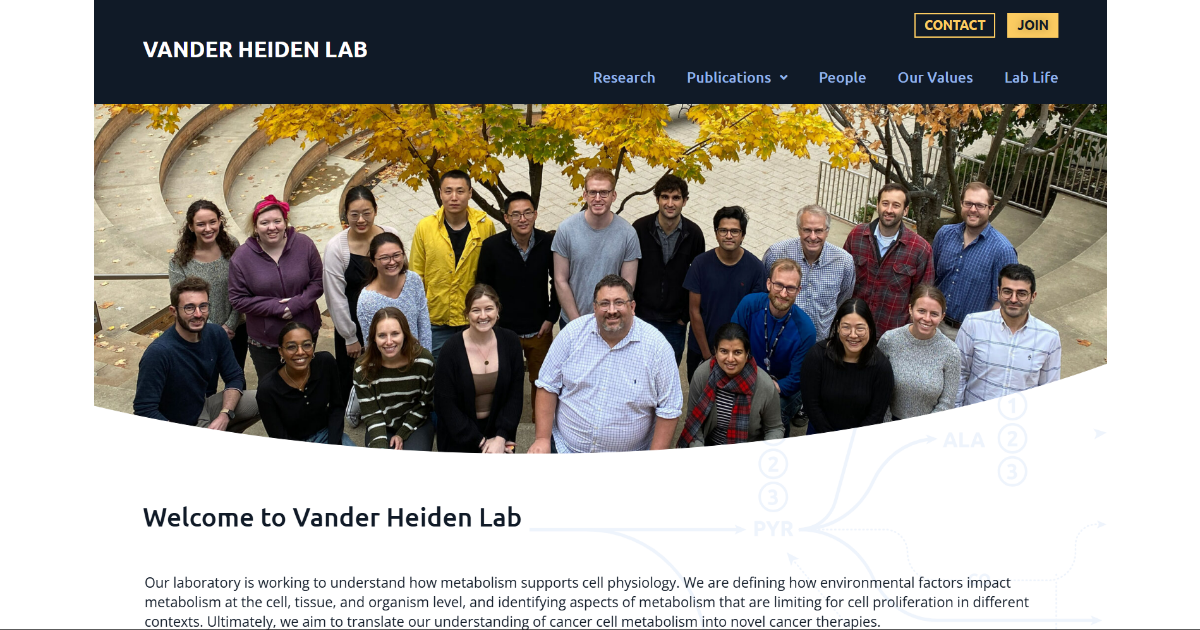
Dr. Vander Heiden's lab at MIT studies cancer metabolism — how cancer cells rewire their metabolic processes to fuel growth. The lab website is a model of clear scientific communication for a technically complex research area.
What works:
A headline that does real work: Rather than a generic "Welcome to the Vander Heiden Lab" header, the site leads with a clear statement of the lab's core scientific question. The headline functions as a research thesis statement — it tells a scientifically literate visitor exactly what the lab is about before they read further.
Publications that are navigable, not just listed: The publications section is organised by research theme rather than simply listed by date. This allows a collaborator or reviewer arriving with a specific scientific interest to find relevant work in seconds rather than scanning through an undifferentiated list.
Transparent funding acknowledgement: The site clearly acknowledges its primary funders. This is a small detail that signals institutional integrity and helps orient visitors who want to understand the research agenda in context.
Key Insight: Research by the Nielsen Norman Group consistently finds that academic websites lose the majority of non-expert visitors within the first 20 seconds not because the science is too complex, but because the page fails to answer the question "why does this research matter?" before asking visitors to engage with technical detail. A single sentence of plain-language context on your homepage can double the time non-expert visitors spend on your site.
Pattern to steal: Organise your publications by research theme or question, not just by date. This one structural change dramatically improves how useful your publications page is to both collaborators and funders.
2. Dr. Christina Curtis — Stanford Medicine
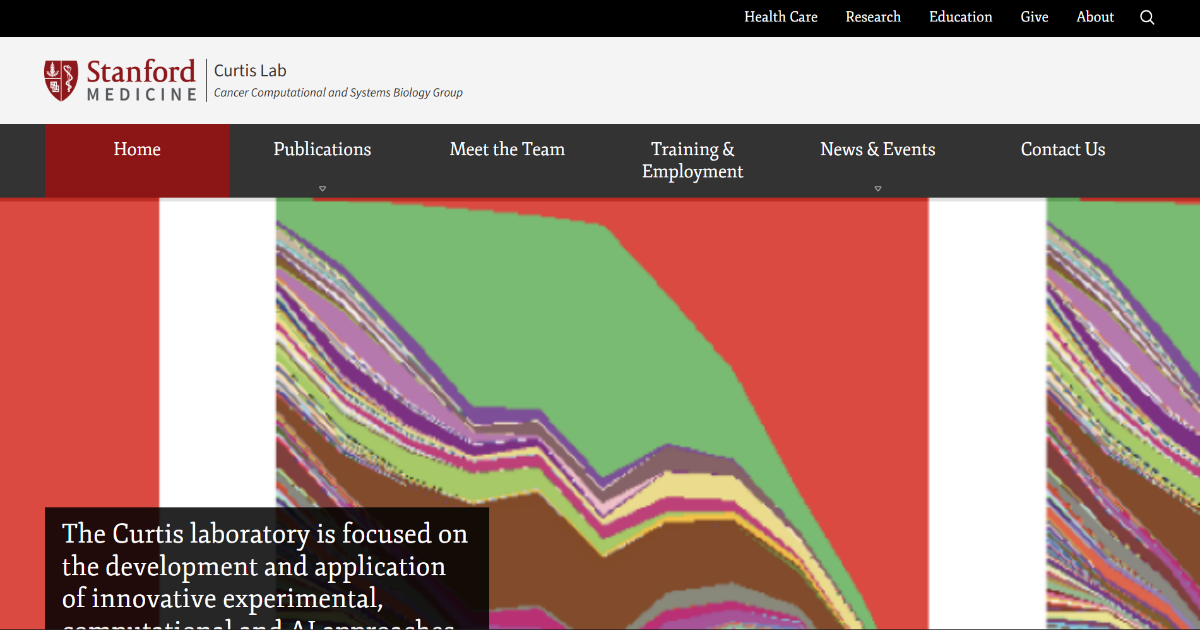
Dr. Christina Curtis leads the Curtis Lab at Stanford, focusing on the evolutionary and ecological dynamics of cancer. Her website is one of the most effectively structured oncology lab sites in the field.
What works:
Research-first navigation: The site's primary navigation immediately surfaces the lab's research focus areas rather than defaulting to a personnel-first structure. A visitor understands the scientific mission within seconds of landing on the homepage, before they have read a single word about Dr. Curtis herself.
Plain-language research summaries alongside technical content: Each research area has both a lay-accessible description and links to the relevant technical publications. This dual-layer approach serves both the general visitor curious about cancer evolution and the peer reviewer assessing methodological depth.
Team page that communicates culture: The lab team page goes beyond headshots and titles. It includes brief descriptions of each member's research interest, conveying a sense of the intellectual community within the lab — which matters enormously for prospective graduate students and postdoctoral fellows.
Pattern to steal: Lead with your research mission, not your biography. Visitors want to understand what you study and why before they are ready to evaluate who you are.
Is Your Oncology Research Website Working Against You?
Most oncology researcher websites were built once, in a hurry, and haven't been updated since. They bury the research mission under layers of navigation, list publications in an undifferentiated wall of citations, and say nothing about why the science matters beyond the lab. If your website isn't actively generating collaborations, attracting strong graduate applicants, and supporting your grant narrative — it's working against you.
→ Book a free website review for your research lab
3. Dr. Leif Ellisen — Massachusetts General Hospital Cancer Centre
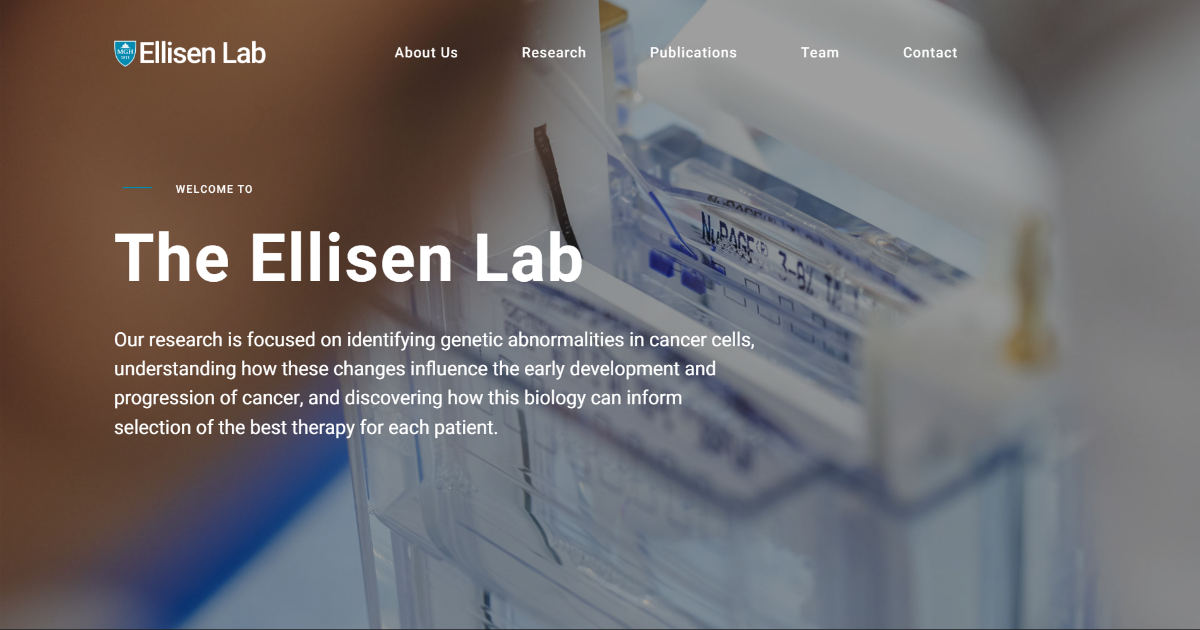
Dr. Ellisen's lab at MGH focuses on breast cancer genetics and tumour suppressor mechanisms. His website is notable for how effectively it bridges the academic and clinical worlds, a specific challenge for oncology researchers working in hospital-affiliated settings.
What works:
Clinical context for basic science: The site consistently connects basic research findings to their clinical implications. This is not superficial — the research summaries genuinely explain how mechanistic discoveries translate toward patient outcomes. This framing serves hospital donors, clinical collaborators, and institutional leadership simultaneously.
A "Join the Lab" section that speaks to multiple career stages: Rather than a generic open positions post, the lab has a structured section for prospective members at different career stages — PhD students, postdoctoral fellows, and clinical research fellows — each with specific information about what the lab offers at that stage. This reduces friction for applicants and signals that the lab thinks carefully about mentorship.
Media and outreach section: The lab maintains a section for press coverage and public-facing content. This signals an engagement with communicating science beyond peer-reviewed publication — increasingly valued by funders and institutions.
Pattern to steal: If your research has clinical implications, surface them explicitly on your homepage. Don't assume visitors will infer the connection. This is the single most effective thing a translational oncology researcher can do to expand their website's audience.
The Design Patterns That Make These Websites Work
Across these three examples, five consistent structural patterns stand out.
Research missions come before biographies on every one of these sites. The most effective oncology researcher websites lead with what the lab studies, not who the principal investigator is. The PI's credentials and biography matter — but they land more effectively after the visitor has understood and been interested by the research itself.
Plain language and technical depth coexist throughout. Every research section is readable by an intelligent non-specialist, with the technical depth reserved for linked publications. Two-tier communication — a lay summary and a link to the full paper — serves far more visitors than choosing one register and excluding the other.
Publications are organised by theme, not just by date. Organising by theme first allows any visitor to navigate directly to what is most relevant to them, rather than scrolling through a chronological list looking for a specific research area.
Team pages communicate culture, not just credentials. Brief, genuine descriptions of each member's research interest communicate a functioning intellectual community far more effectively than a grid of headshots and institutional titles.
Clinical relevance is made explicit for translational work. If your research has implications for patients and in oncology, most of these sites state those implications plainly rather than leaving them implicit for visitors to infer.
Is Your Oncology Research Website Communicating Your Work Clearly?
Many oncology researcher websites struggle to balance scientific depth, clinical relevance, and accessibility for collaborators, funders, and prospective trainees. A well-structured website can make your research easier to understand, attract stronger applicants, and surface collaboration opportunities that might otherwise be missed.
→ See how we design research lab websites
Key Insight: A study examining oncology researcher profiles across major cancer research institutions found that labs with well-structured websites with clear research summaries, navigable publication lists, and visible clinical context received measurably more unsolicited collaboration enquiries and postdoctoral applications than labs of equivalent publication quality with poorly structured sites. Your website is an active research recruitment and collaboration tool, not a passive institutional requirement.
Frequently Asked Questions
Do I really need a personal website if I have an institutional profile page?
Yes. Institutional profile pages are constrained by university templates and IT policies. They typically cannot be updated quickly, cannot be structured around your specific research narrative, and cannot be optimised for search. A personal lab website gives you full control over how your research is presented and found. Most top-tier oncology researchers maintain both.
How long should a research summary be on my homepage?
Two to four sentences for the homepage, with links to fuller descriptions for each research area. The homepage summary has one job: to give a first-time visitor enough context to decide whether to explore further. It does not need to be comprehensive — it needs to be clear and compelling.
Should my oncology research website be public-facing or peer-facing?
Both, with different sections serving each audience. Your research summaries should be written for an intelligent general reader. Your publications, methodology descriptions, and technical content serve your peers. Building this distinction into your site's architecture — rather than defaulting entirely to either register — dramatically expands the useful audience for your site.
How often should I update my website?
Publications should be added within a week of acceptance. Research area summaries should be reviewed annually or whenever a major project concludes. Team pages should be updated within a month of any member joining or departing. The most damaging thing a research website can do is show a publications list that stopped three years ago it signals a lab that has gone quiet.
What platform should I build my oncology research website on?
Webflow and Squarespace are both viable for researcher websites that require professional presentation without heavy developer involvement. WordPress remains an option but requires more ongoing maintenance. For labs at major research universities, many institutions offer supported web hosting to check whether your institution provides this before investing in an external platform.
.gif)


