

Initial Summary
An IT consulting website carries a credibility burden most professional services sites don't: the people evaluating you are often technically sophisticated enough to judge not just what you're saying, but how your site performs. A CTO evaluating an infrastructure partner will notice if your pages load slowly. A Head of Engineering shortlisting a software delivery firm will notice if your navigation breaks on mobile. A CISO assessing a cybersecurity consultancy will notice if your contact form lacks SSL. The site itself is already speaking before a single word is read. This guide examines the IT consulting websites that get the full picture right from the first-impression credibility signals enterprise buyers need, to the technical specificity specialist buyers are looking for, to the conversion design that turns a qualified visitor into a real conversation.
What Separates IT Consulting Websites That Win Business
IT consulting is one of the most crowded professional services categories online. Every firm from a solo cloud migration specialist to a 500-person digital transformation practice is competing for the same search terms and the same enterprise buyer attention. The sites that consistently win business share a specific set of characteristics that go well beyond clean design.
They name the problem before they name the solution. Enterprise buyers arrive with a specific challenge – a cloud cost overrun, a legacy ERP migration, a cybersecurity gap flagged by an audit. The website that names that specific problem in the first ten seconds wins the evaluation before the conversation begins.
They use evidence, not assertion. "Industry-leading expertise" and "proven track record" appear on thousands of IT consulting sites and mean nothing to a buyer who has been burned before. Named clients, specific technologies, measurable outcomes, and verifiable timelines are what distinguish a consultancy that has actually solved these problems from one that only claims to have.
Key Insight: An IT consulting website is being evaluated by people who will spend months working alongside your team on technically complex, high-stakes problems. If the site feels generic, loads slowly, or can't explain what you do in precise technical terms, sophisticated buyers draw exactly the conclusion you don't want them to draw.
1. Thoughtworks
Thoughtworks is a global technology consultancy with over 10,000 professionals across 50 offices, and their website is one of the most-studied examples in the IT consulting category. What makes it distinctive is not the scale . It's the intellectual posture. The site leads with ideas and perspective before it leads with services.

- Thought leadership as the primary homepage content. Before a visitor encounters a single service description, they've encountered evidence that the people at Thoughtworks are genuinely thinking about hard problems in ways other firms aren't. Featured articles, engineering assessments, and technical perspectives fill the hero area before any service catalogue appears.
- The Technology Radar as a signature asset. Thoughtworks' quarterly assessment of emerging tools, frameworks, and techniques has become one of the most referenced documents in software engineering. Publishing it prominently and freely generates inbound from exactly the technical audience Thoughtworks wants to reach and creates intellectual authority no marketing copy can replicate.
- Case studies framed around business outcomes. "Reduced time-to-deploy from six weeks to two days for a major global retailer" is a case study. "Delivered digital transformation excellence" is a brochure line. Thoughtworks' work section consistently uses the first format.
- Technical vocabulary that earns expert trust. Cloud native development, data mesh architecture, API design, platform engineering precise technical vocabulary that a technical buyer immediately recognises as accurate, not borrowed from a glossary.
Pattern to steal: Publish one genuinely original piece of technical thinking per month not a trends roundup, but a specific technical position, a framework critique, or a case observation that only someone who has done this work could write. Over eighteen months, this accumulates into intellectual authority that no amount of design spend can replicate.
2. NCS
NCS is Singapore's leading ICT service provider and was named Company of the Year in Managed IT Services by Frost & Sullivan for two consecutive years (2024 and 2025). Their website demonstrates how a large Asia-Pacific technology firm communicates scale, credibility, and sector depth without losing the clarity that enterprise buyers need when evaluating a specific engagement.

- Third-party recognition given visual weight. The Frost & Sullivan Company of the Year award appears prominently on the homepage, not buried in a press section. For enterprise procurement teams doing initial shortlisting, independently verified recognition from a credible analyst firm does more trust-building work than any self-description could.
- Sector-first navigation. Government, telecommunications, enterprise NCS structures navigation around client segments rather than internal service lines. This puts the buyer's context first and signals genuine sector expertise rather than a generic IT capabilities catalogue.
- Certifications surfaced where procurement teams look. DPTM certification (Singapore's Data Protection Trustmark, managed by IMDA), ISO 45001, and BizSAFE STAR all appear in the credentials section. For Singapore public sector buyers especially, these certifications are active procurement checklist items surfacing them on the site removes a qualification question before it is asked.
- Market position stated with verifiable evidence. Citing IDC's Worldwide Semiannual Services Tracker for a market share claim is a verifiable, third-party backed statement exactly the kind that converts sceptical enterprise buyers who have heard the same boast from every competitor.
Pattern to steal: If you hold government or enterprise certification status IMDA recognition, MAS-regulated vendor status, ISO certification, PSG pre-approval make it visible on the homepage. For Singapore buyers, these signals materially reduce procurement risk perception before the first meeting.
3. Slalom
Slalom is a business and technology consulting firm that deliberately structures itself around local market proximity rather than centralised global delivery. Their website communicates this model with unusual clarity differentiating sharply from every firm that leads with global scale as though scale were the same thing as quality.

- Geography-first positioning. The site is structured around local offices in Singapore, Sydney, London, New York before global capabilities. This signals to a mid-market buyer that they will work with people in their timezone and in their regulatory context, not with offshore delivery teams managed from another continent.
- Technology partnership credentials prominently displayed. AWS Premier Partner, Google Cloud Partner of the Year, Microsoft Solutions Partner partner tier credentials from major technology vendors are a primary proxy for technical depth, and enterprise buyers actively filter for them during shortlisting.
- Culture as a procurement signal. Slalom's Great Place to Work recognition appears on the homepage, not in a careers footnote. For IT buyers who have experienced disengagement and turnover on large consulting engagements, strong internal culture is a genuine indicator of delivery quality.
- Named vertical practices with differentiated content. Financial services, healthcare, retail, and manufacturing appear as distinct practice areas with different case studies not one consulting narrative repackaged with sector logos swapped in.
Pattern to steal: If your firm has genuine technology partner status AWS, Google Cloud, Microsoft, Salesforce, ServiceNow display the partner tier prominently on the homepage. In IT consulting, partner tiers are independently verifiable signals that enterprise procurement teams specifically seek during shortlisting.
4. Publicis Sapient
Publicis Sapient sits at the intersection of business strategy, technology implementation, and experience design. Their website communicates this three-way positioning with discipline, speaking simultaneously to the CMO who cares about customer experience, the CTO who cares about technical architecture, and the CEO who cares about transformation outcomes.
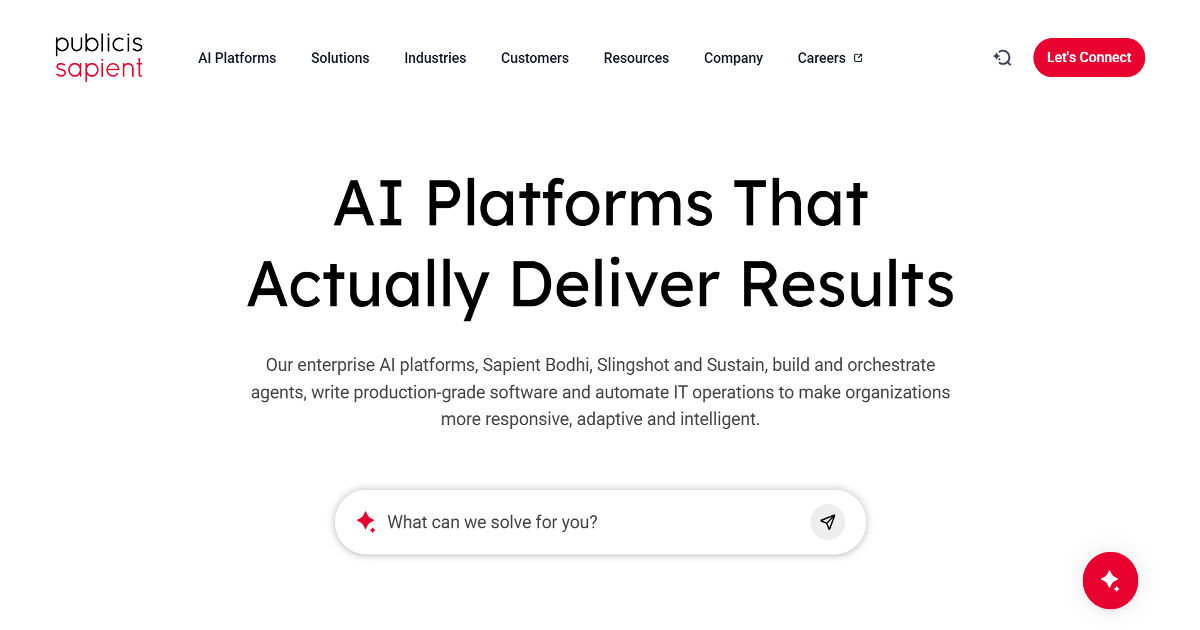
- A proprietary framework as positioning anchor. The site is organised around Publicis Sapient's SPEED capabilities Strategy, Product, Experience, Engineering, and Data. A named, structured framework organises a complex multi-disciplinary practice into a navigable structure, signals intellectual rigour, and gives prospective clients vocabulary for describing the engagement to their own stakeholders.
- Industry-first, capability-second navigation. Visitors navigate by industry (financial services, retail, automotive, energy) before encountering service descriptions. The buyer identifies themselves before they encounter any capability content a structural choice that puts client context first.
- Video testimony from named client peers. Case study pages include short client videos. For an enterprise buyer evaluating a multi-million dollar transformation partner, video testimony from a recognisable peer is among the highest-trust content formats available.
Pattern to steal: Give your methodology a name. Even if your approach isn't fully proprietary, naming it "the three-phase delivery model," "the alignment-architecture-activation framework" makes it discussable, memorable, and distinct from the generic "agile delivery" description every competitor also uses.
5. PALO IT Singapore
PALO IT is a global technology consultancy with a strong Singapore presence and particular strength in sustainable technology, digital product development, and responsible AI. Their website is notable for something most IT consulting sites avoid: a genuine values-forward positioning that communicates not just what the firm does but why it exists.

6. Wipro
Wipro is a global IT services and consulting firm that has made one of the more visible transitions in the category: from being perceived as a cost-reduction outsourcing vendor to being positioned as a strategic AI and cloud transformation partner. Their website does meaningful work in communicating that repositioning.
- AI positioned as embedded, not additive. Rather than adding an AI page to an existing structure, Wipro restructures its entire service narrative around AI and automation enablement, signalling that the shift is strategic rather than cosmetic.
- Sector depth communicated through dedicated sections. Industry-specific sections for banking, healthcare, and manufacturing contain genuinely different content: different case study types, different regulatory frameworks, different technology partner combinations, not one narrative rebadged by sector.
- Volume of client evidence at scale. A large firm can list a breadth of named enterprise clients that a boutique cannot. Wipro uses this breadth strategically as a signal of cross-industry transferability that matters to enterprise buyers seeking partners who have solved adjacent problems before.
The Design Patterns That Make IT Consulting Websites Win Business
After examining these examples, consistent differentiators emerge across all firm sizes:
Pattern 1: Technical vocabulary earns trust before a proposal is submitted. Sites that use precise technical language specific cloud architectures, named frameworks, actual platform names signal to technical buyers that the people behind the site understand the problem. Sites that use only general "digital transformation" language signal the opposite.
Pattern 2: Third-party validation beats self-description at every stage. Award recognition, technology partner tier status, analyst firm rankings, government certification any independently verifiable credential does more trust-building work than any marketing claim. These belong above the fold.
Pattern 3: Industry specificity beats breadth claims. An IT consulting site claiming expertise across every sector convinces buyers in none of them. Demonstrating genuine depth in two or three verticals with differentiated case studies, specific regulatory knowledge, and named
Not sure which patterns your site is already getting right?
Run your homepage against the five patterns above and note where it falls short. Even identifying one gap gives you a clear starting point and if you want a second pair of eyes, we can tell you exactly where your site is losing enterprise buyers before they ever contact you.
Pattern 4: Case studies with business outcomes, not technology descriptions. "Migrated the client from on-premise Oracle to AWS" is a technology description. "Reduced infrastructure cost by 43% while cutting deployment time from 14 days to 4 hours for a 3,000-employee financial services firm" is a business outcome. Only the second converts a curious visitor into an interested prospect.
Pattern 5: Site performance is a proxy for delivery quality. An IT consulting website that loads under two seconds on mobile, renders correctly across devices, and navigates cleanly communicates technical standards before the engagement begins. A site that fails these basics has a credibility problem no case study can fully offset
Not sure whether your IT consulting website is communicating what you think it is?
Run the five-pattern test above against your current homepage. If your site leads with a service list rather than a client problem, buries its certifications, or hasn't published substantive technical content in the last quarter, those are the gaps your shortlisted competitors are already filling.
-> Build my IT consulting website
Key Insight: The majority of IT consulting buyers complete significant vendor research online before their first contact with a firm. If your website isn't answering the questions they're already asking about technical depth, sector experience, and delivery evidence a competitor's website is answering those questions for you.
Frequently Asked Questions
Should an IT consulting website list all technology partnerships and certifications?
List the ones materially relevant to your target buyer's technology stack and procurement checklist. An AWS partner badge matters deeply to a buyer evaluating cloud migration; it matters far less to a buyer evaluating ERP implementation. Be selective about which credentials lead the homepage and which belong in a dedicated credentials section the most relevant ones should be immediately visible.
How detailed should case studies be on an IT consulting website?
Detailed enough to demonstrate that you have actually solved the problem. The minimum useful case study includes the client's industry and scale, the specific technical challenge, the technologies and approach used, and a measurable outcome expressed in business terms. Three substantive case studies in your core vertical consistently outperform ten vague "success stories" spread across all industries.
Should a small IT consulting firm have a different website strategy than a large one?
Smaller firms should lean harder into specificity. A five-person cloud consulting firm that clearly owns a specific vertical "we migrate Singapore financial services firms from legacy infrastructure to AWS" is more compelling to the right buyer than a twenty-person firm claiming general IT expertise. Specificity is the small firm's primary competitive advantage; don't dilute it by claiming capabilities you can't fully support.
How important is SEO for an IT consulting website in Singapore?
Increasingly important, particularly for inbound IT managers and in-house technology teams who research vendors before approaching referral networks. Precise keyword combinations "cloud consulting Singapore," "cybersecurity consulting Singapore," "ServiceNow implementation partner Singapore" generate qualified inbound from buyers at a late stage of evaluation who have already decided they need help.
.gif)


