

Initial Summary
Academic SEO is the process of making your expertise understandable to both search engines and AI assistants. Publishing research is no longer enough, discoverability now depends on structured clarity, authority signals, and consistent online identity.
Imagine you've just published ground breaking research that could reshape your field. You've poured years into the work, navigated peer review, and finally hit publish. But when someone searches for your research area, they find your competitors instead. Your university's website buries your faculty page three clicks deep. Your personal site if you even have one doesn't appear in the top 50 search results.
This is the harsh reality for thousands of academics in 2026. Academic excellence no longer guarantees academic visibility. In an era where AI systems like ChatGPT, Claude and Google AI Overviews increasingly mediate scholarly discovery, understanding academic SEO isn't optional; it's essential for research impact, student recruitment, and career advancement.
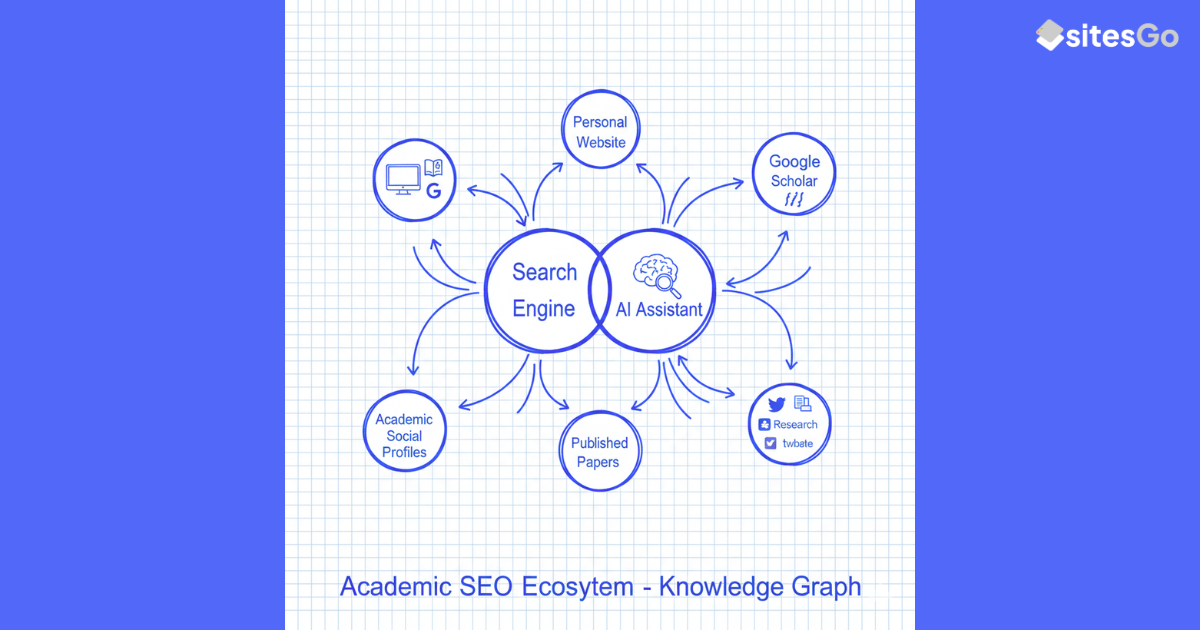
Key Insight : AI does not evaluate your best paper, it evaluates your entire digital footprint
What Is Academic SEO, Really?
Academic SEO is the practice of optimizing your scholarly web presence; personal websites, institutional profiles, research repositories, and academic content to rank higher in search engines and AI-powered discovery tools. It's about ensuring that when students, colleagues, potential collaborators, or funding agencies search for expertise in your field, they find you.
Unlike commercial SEO, which often prioritizes sales conversions, academic SEO focuses on:
- Research discoverability: Making your publications, datasets, and findings findable
- Expert positioning: Establishing yourself as an authority in your field
- Talent attraction: Connecting with prospective PhD students, postdocs, and collaborators
- Knowledge dissemination: Sharing your expertise with broader audiences beyond academia
Why Traditional Approaches No Longer Work
For decades, academic visibility followed a simple formula: publish in high-impact journals, present at prestigious conferences, and let your institution handle the online presence. That strategy is increasingly obsolete.
The AI Search Revolution
In 2026, SEO becomes reputation-first. Search engines now rank content based on real creator authority rather than keyword volume. If your name and expertise aren't visible online, your research won't stick in search rankings, even if it's brilliant.
Consider this: AI systems pull from everything they can find about you, published papers, conference presentations, social media, institutional profiles, and yes, that outdated department page listing research from 2018. When this information is scattered, contradictory, or incomplete, AI gives muddled answers about your expertise.
The Declining Power of Institutional Websites
University websites are important, but they're not enough. Most institutional sites prioritize administrative hierarchy over discoverability. Your faculty profile gets buried under layers of department pages, and you have no control over when (or if) it gets updated. Personal academic websites give you control over your scholarly narrative and often rank higher in search results than departmental pages.
The Core Components of Academic SEO
Effective academic SEO rests on four interconnected pillars:
1. Technical SEO: Building the Foundation
Think of technical SEO as the infrastructure that makes everything else possible. Without a solid foundation, even the best content won't rank well.
- Site speed: Academic sites are notorious for being slow. Compress images, minimize code, and use modern hosting. Google penalizes slow sites ruthlessly.
- Mobile optimization: Over 60% of academic searches happen on mobile devices. Your site must be responsive and fast on smartphones.
- Structured data: Implement schema markup for research papers, courses, events, and your professional profile. This helps search engines understand your content.
- Clean URLs: Use descriptive URLs like '/research/climate-modeling' instead of '/page?id=1234'. This helps both humans and search engines.
2. Content Strategy: Show, Don't Just Tell
Generic academic content doesn't cut it anymore. AI systems increasingly evaluate content based on how efficiently it can be parsed, summarized, cited, and reused. This means your content strategy must evolve.
- Research narratives over lists: Don't just list publications. Explain the story arc of your research; why it matters, how it connects, where it's going. AI loves context.
- Accessible explanations: Create multiple layers of content: technical papers for specialists, blog posts for educated generalists, and social media snippets for broader audiences.
- Regular updates: Fresh content signals active expertise. Even a simple monthly research update or teaching reflection improves visibility.
- Multimedia formats: Videos explaining your research, podcasts discussing your field, and infographics visualizing data all improve engagement and SEO.
3. On-Page SEO: Make Every Page Count
On-page SEO involves optimizing individual pages to rank for specific search queries. For academics, this means strategic optimization of:
- Title tags: Include your name, expertise area, and institution. Example: 'Dr. Sarah Chen | Climate Modeling Expert | Stanford University'
- Meta descriptions: Write compelling 155-character summaries that encourage clicks. Focus on your unique research contributions.
- Heading structure: Use H1 for page titles, H2 for major sections, H3 for subsections. This helps both readers and search engines navigate your content.
- Internal linking: Connect related content on your site. Link publications to research areas, teaching pages to course materials, etc.
4. Link Building: Academic Authority Signals
In academic SEO, quality backlinks demonstrate scholarly authority. But forget buying links that's a quick path to penalties.
- Google Scholar and ORCID: Maintain complete, up-to-date profiles. These are authoritative sources that search engines trust.
- University profile: Ensure your institutional faculty page links to your personal website and is regularly updated.
- Research repositories: Upload preprints to arXiv, ResearchGate, or Academia.edu with links back to your site.
- Conference presentations: Share slides on SlideShare or your website, linking to full papers and related research.
Curious how discoverable your research actually is?
We’ll map where you appear (or don’t) across Google, Scholar, and AI assistants and show the fastest visibility wins.
→ Let's work on your research visibility together!
Keyword Research for Academics
Many academics get keyword research wrong by focusing only on highly specialized technical terms. The reality? People search in questions, not jargon.
The Question-Based Approach
Instead of optimizing solely for 'computational neuroscience' or 'postcolonial literature,' think about what prospective students, potential collaborators, or curious readers actually search for:
- 'How does machine learning apply to brain research?'
- 'What is postcolonial theory in simple terms?'
- 'Best universities for climate science PhD?'
- 'How to get published in Nature?'
Tools like Google's 'People Also Ask' and Answer the Public reveal these question-based searches. Create content that directly answers them.
Long-Tail Keywords: Your Secret Weapon
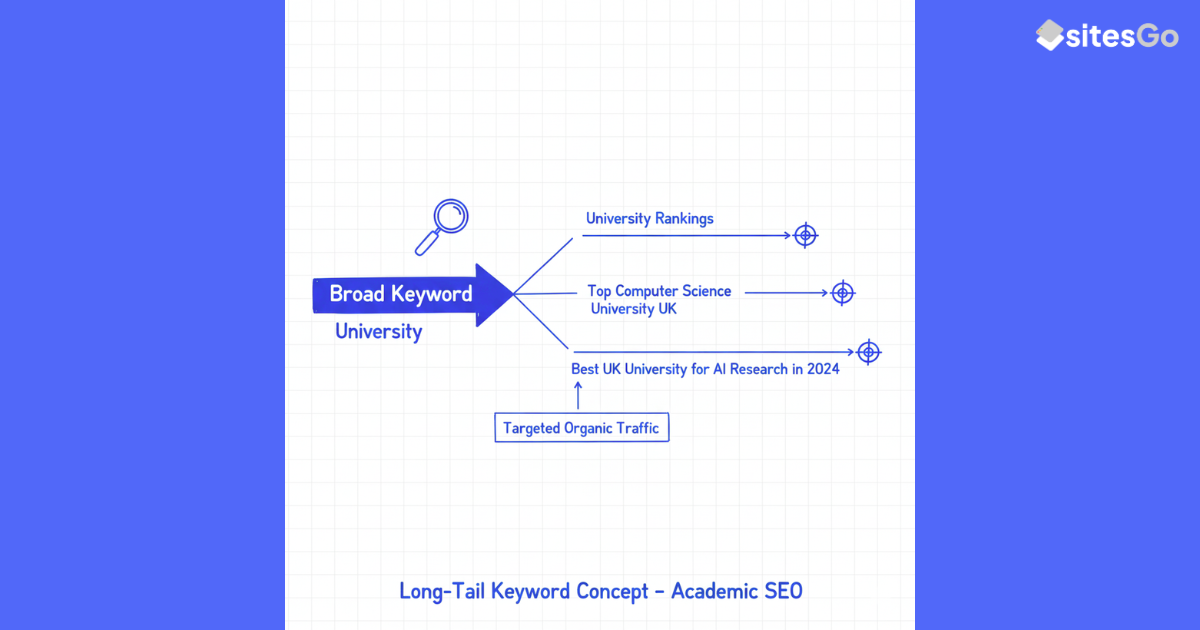
You'll never rank #1 for 'biology' or 'history.' But 'epigenetic mechanisms in cancer resistance' or 'medieval manuscript preservation techniques'? Absolutely achievable.
Long-tail keywords specifically, multi-word phrases have less competition and attract more qualified visitors. Someone searching your long-tail phrase is far more likely to become a student, collaborator, or research follower than someone searching generic terms.
Optimizing for AI-Powered Search
Here's where 2026 diverges sharply from previous years. AI platforms are upgrading their algorithms, making it harder to manipulate results. What works now:
Make Your Content AI-Legible
AI systems extract meaning differently than traditional search engines. They need:
- Clear structure: Well-organized content with logical headings makes AI extraction easier.
- Definitive statements: AI loves clear answers. After explaining complexity, provide simple summaries.
- Context and connections: Explain how your research fits into broader conversations. AI uses this to understand relevance.
- Citations and references: Link to primary sources and related research. This builds authority and helps AI verify your expertise.
Focus on E-E-A-T
Google's E-E-A-T framework (Experience, Expertise, Authoritativeness, Trustworthiness) is especially crucial for academic content. Demonstrate these through:
- Credentials: List your degrees, positions, and affiliations prominently.
- Publications: Link to peer-reviewed work and explain its significance.
- Professional involvement: Mention editorial boards, conference organizing, grant review panels.
- First-hand research: Share insights from your own studies, not just literature reviews.
Key Insight: Search visibility in 2026 is not about gaming algorithms, it’s about making your expertise structurally undeniable.
Local SEO for Campus-Based Academics
If you teach on campus or run a physical lab, local SEO matters enormously. Prospective students search for 'biology professors near me' or 'chemistry labs in Boston.'
- Google Business Profile: Create or claim your profile. Add office hours, contact info, and photos.
- NAP consistency: Ensure your Name, Address, and Phone number are identical across all online platforms.
- Location pages: If you have offices in multiple locations, create dedicated pages for each with unique content.
Common Academic SEO Mistakes (And How to Fix Them)
Mistake 1: Forgetting About Your Website After Launch
SEO isn't a one-time project. Fresh content, updated research, and new publications signal ongoing expertise. Even quarterly updates make a difference.
Mistake 2: Neglecting Site Speed
Academic sites often load slowly due to heavy PDFs, uncompressed images, and outdated code. Use tools like Google PageSpeed Insights to identify and fix issues.
Mistake 3: Ignoring Mobile Users
If your site doesn't work flawlessly on phones, you're invisible to the majority of potential students and collaborators. Yeah that's true! To help me prove this. I would like to consciously keep track of the times you just opened a site on open, just for convenience over opening it on a laptop. So test rigorously on multiple devices.
Mistake 4: Over-Optimization
Keyword stuffing, excessive linking, and manipulation tactics backfire. Write naturally for humans first, with SEO best practices as a framework.
Mistake 5: Relying Only on Your University Site
Your institutional profile is important but insufficient. Control your narrative with a personal site that you can update anytime and take with you if you change universities.
Measuring Success: Analytics That Matter
Don't drown in vanity metrics. Focus on indicators that align with academic goals:
- Organic search traffic: How many people find you through search engines? Track trends over time.
- Keyword rankings: Monitor your position for key terms related to your expertise. Tools like Google Search Console show this.
- Engagement metrics: Time on page and pages per session indicate genuine interest in your content.
- Inquiry quality: Are you receiving relevant emails from potential students or collaborators? That's the ultimate validation.
- Citation increases: Better visibility correlates with more citations. Track this in Google Scholar.
Tools Every Academic Needs
You don't need enterprise-level SEO software. These essential (mostly free) tools will transform your visibility:
- Google Search Console: Free tool showing how Google sees your site, what queries bring traffic, and technical issues to fix.
- Google Analytics 4: Track visitor behavior, traffic sources, and engagement.
- Screaming Frog SEO Spider: Free version crawls up to 500 URLs, identifying broken links, duplicate content, and technical issues.
- Answer the Public: Discover questions people ask about your research topics.
- Grammarly or Hemingway Editor: Improve readability, clearer writing helps both humans and AI understand your content.
The Long Game: Why Academic SEO Is Worth It
Academic SEO isn't about overnight success. It's a strategic investment in your long-term scholarly impact. The professor who starts today will, in six months, rank for their expertise while competitors remain invisible. The research lab that implements structured data now will appear in AI-powered search results while others get overlooked.
Remember: every citation, every prospective student, every collaborative opportunity begins with discovery. If people can't find you, your brilliant work might as well not exist.
The good news? Most academics haven't embraced SEO yet. Your competition is minimal. Starting now gives you a massive first-mover advantage in your field.
So take that first step. Audit your current visibility. Fix the technical issues. Create that blog post explaining your research. Update your profiles. Build your academic website with SEO in mind from day one.
Final Conclusion
Academic SEO is not marketing, it is accessibility. If researchers cannot find your work, your work cannot influence the field.
Actionable Next Steps
- Create a personal research website
- Connect Google Scholar + ORCID + website
- Publish one plain-language explanation article
- Add structured headings across pages
- Update quarterly
Make your research discoverable, not just published
SitesGo structures professor websites for academic SEO and AI indexing, so your research appears when students, collaborators, and journalists ask questions online.
-> Let’s make you a SEO optimized website!
Frequently Asked Questions
How is academic SEO different from regular SEO?
Academic SEO prioritizes research discoverability, expert positioning, and educational value over commercial conversions. While traditional SEO often focuses on product sales and lead generation, academic SEO aims to connect researchers with collaborators, attract qualified students, and disseminate knowledge. The metrics differ too: success means citation increases, quality student inquiries, and speaking invitations rather than e-commerce transactions. Academic content must also maintain scholarly rigor and accuracy while being accessible, a balance that commercial content doesn't require.
Do I need a personal website if my university already has a faculty page?
Absolutely. University faculty pages are necessary but insufficient. They're typically buried in institutional navigation, updated infrequently, lack personality, and disappear if you change institutions. A personal site gives you control over your narrative, updates instantly when you publish new research, ranks independently in search results, and travels with you throughout your career. The best strategy is maintaining both your university profile for institutional legitimacy and your personal site for discoverability and depth. Think of your institutional page as your business card and your personal site as your portfolio.
What if I'm not comfortable with technology or coding?
You don't need technical skills to implement effective academic SEO. Modern website builders like Wix and Squarespace handle technical optimization automatically. For content strategy, focus on clear writing and regular updates skills you already have as an academic. Free tools like Google Search Console provide insights without requiring technical knowledge. If you can use Microsoft Word, you can manage your academic website. Many universities also offer IT support or library services specifically to help faculty with web presence. The biggest barrier isn't technical skill it's simply getting started.
Should I hire an SEO agency or do it myself?
Most academics can handle fundamental SEO themselves updating content, maintaining profiles, and implementing basic best practices. These activities align naturally with scholarly communication you're already doing. Consider professional help for technical website issues, major redesigns, or if you're at a career stage where your time is more valuable elsewhere. However, avoid agencies promising #1 rankings or using manipulative tactics. The best approach is often a hybrid: learn the fundamentals yourself (ensuring you maintain control) and consult specialists for specific challenges like site speed optimization or structured data implementation
.gif)


